‘No place easier’ to vote than Nevada, ‘unfortunately,’ Lombardo says
Oct 22, 2026 | 8:00 am ET
Description
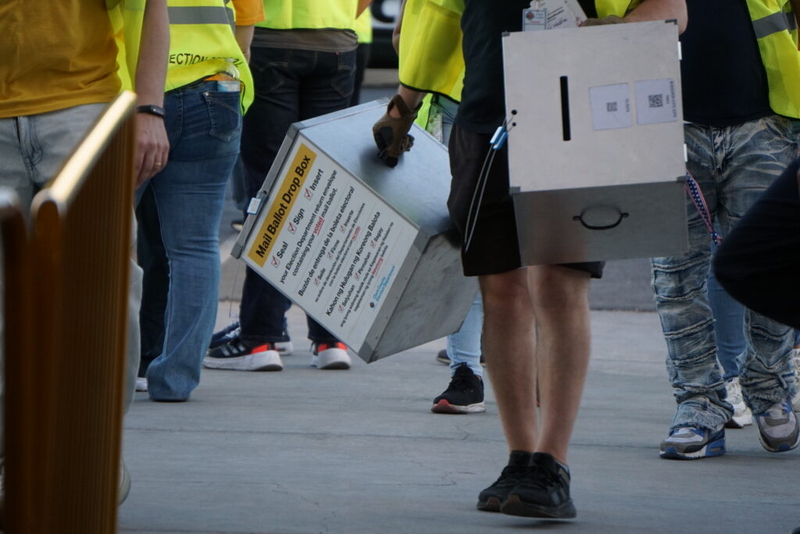
Election workers deliver mail ballot drop boxes to the Clark County Election Center on June 9, 2026. (Photo: Jeniffer Solis/Nevada Current)
Republican candidates, such as Nevada Gov. Joe Lombardo, are walking a precarious tightrope by urging citizens to vote even while toeing the Republican party line that elections are not secure.
In audio obtained by the Current from an October fundraiser, Lombardo, who faces a second-term challenge from Democrat Attorney General Aaron Ford, urged supporters to overcome voter apathy while simultaneously taking a shot at election integrity.
“If you are close to individuals and you ask ‘em ‘have you voted and they say ‘no,’ convince them. There’s no place easier to vote in the nation than Nevada. Unfortunately,” Lombardo added, his last-minute jab drawing laughter from the crowd.
“Early voting starts the 17th. In-person voting is on the third. Then you can put your mail ballot in five days after the fact,” asserted Lombardo, who has a beef with a 2024 Nevada Supreme Court ruling that allows unpostmarked ballots to be counted for three days after the election.
The governor’s supporters roared at the suggestion that mail-in ballots are suspect. “What I’m driving at is there’s no excuse. No excuse,” he said.
Lombardo’s campaign did not respond to requests for comment on how the governor balances the desire to turnout voters with messaging that calls integrity into question, or what he meant when he lamented that voting is easy in Nevada “unfortunately.”
The episode is indicative of an electorate that has been whipsawed by President Donald Trump’s adherence to the notion that elections are rigged, even as he implores voters to get out to the polls and “pretend I’m on the ballot.”
The president has made efforts to impose federal authority over state elections, which dovetails with his persistent false claims of winning the 2020 election and his anti-immigrant agenda, a central tenet of his administration.
The Trump-endorsed Safeguard American Voter Eligibility (SAVE) Act, which would impose a national voter identification requirement, is stalled in Congress, and last month, the Supreme Court blocked Trump’s executive order prohibiting mail-in voting.
Like Trump, Lombardo has made election reform a focus in his first term.
In 2023, lawmakers refused to take up legislation the governor sought to undo universal mail balloting. In 2025, Lombardo vetoed a voter identification bill he initially supported because mailed ballots would have still been verified via signature matching. The 2023 legislation the governor backed also would have required mail-in ballots to be received by the time polls close on Election Day, rather than 5 p.m. four days after the election, no matter how early the ballots were postmarked.
In November, Nevada voters are expected to approve a Lombardo-supported voter identification ballot measure for the second time and amend the state constitution.
In the process, Lombardo has not shied away from election deniers. He has campaigned at Trump’s side, and in 2023 and 2025, vetoed measures that would have imposed prison terms on fake electors.
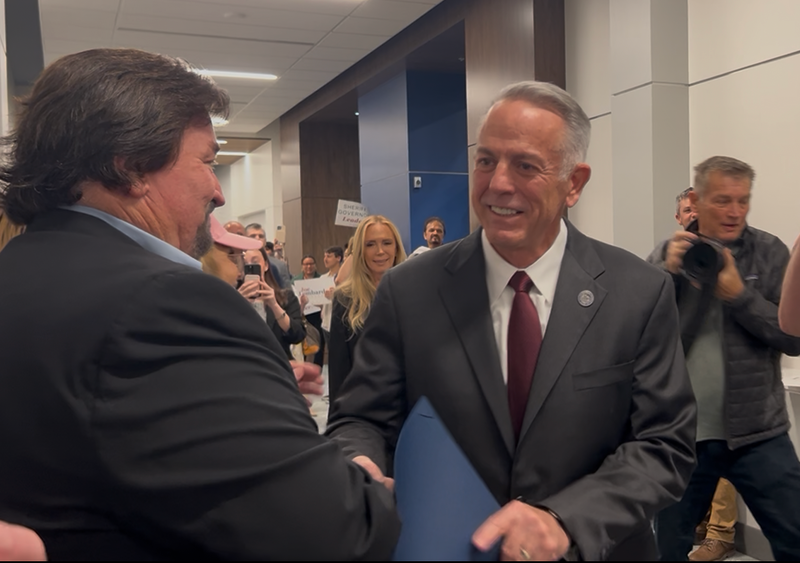
When Lombardo filed for election in March, supporters included Nevada Republican Party Chairman Michael McDonald, one of the six fake electors who sent bogus electoral college certificates to Congress after Trump lost Nevada in 2020.
Last week, Lombardo campaigned with election denier Joey Gilbert.
Voter fraud is almost nonexistent in the United States, according to a variety of experts.
In July, Trump’s Dept. of Homeland Security asserted that Nevada may have as many as 15,903 “non-citizens” registered to vote. The government eventually whittled that number to 185. The state contends there is no proof any are undocumented.
“The President has spent the better part of a decade attempting to manufacture a crisis around voting when there is none,” Nevada Secretary of State Cisco Aguilar said in July, after Trump’s Department of Justice sent one of seven subpoenas to Aguilar, demanding personal voter data.
The effect of questioning election integrity is unknown, however, eroding trust in the electoral process in an effort to mobilize the bases could prove risky “for Republican candidates and American democracy,” writes Christopher Miller, a visiting assistant professor of Philosophy, Economics, and Law at the University of Richmond. “That’s because reduced trust in election integrity can reduce motivation to vote – even if based on flawed information. But it’s not at all clear which Americans are most likely to stay home in November.”
“Only 65% of Republicans, 64% of Democrats and 57% of independent voters are very or somewhat confident that the 2026 vote count will be reliable,” Miller wrote. “Conventional wisdom suggests such discouraging numbers would depress turnout.”
He cited a study from Germany that indicated casual voters may be less motivated to vote when faced with the prospect of rigged elections, “because there’s no trustworthy result that voters are seeking to affirm.” Voters who are skeptical of “elite messaging” may be more motivated to vote.
As of Wednesday afternoon, 16 million Americans had cast early ballots, according to NBC News. Of those, 50% were registered Democrats, 32% were Republicans, and 18% were something else. In Nevada, Democrats had a slight lead over Republicans and others.
Early voting in Nevada ends Friday, October 30. Election day is Tuesday, Nov. 3.
Las Vegas, NV