Colorado priest from Uganda released after 13 months in ICE detention in Aurora
Oct 22, 2026 | 6:00 am ET
Description
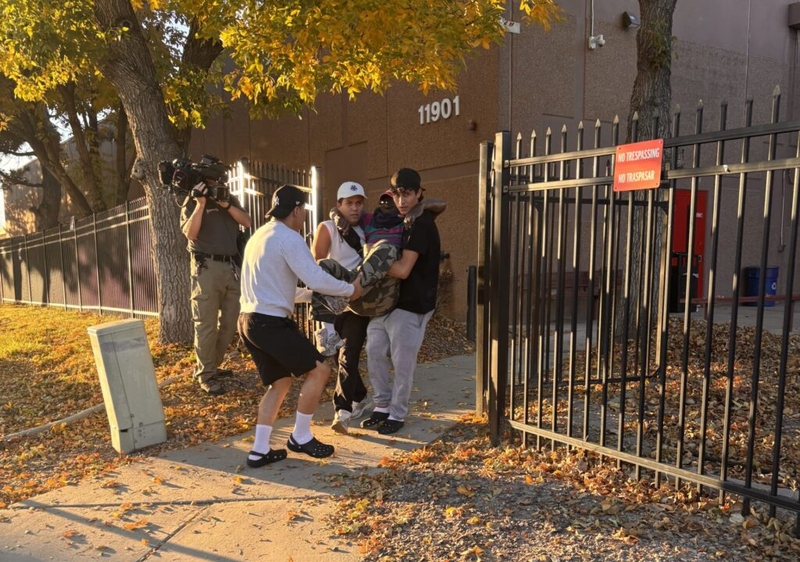
Two fellow detainees carried Rev. Edward Nalwamba, who will be 79 in November, out of the U.S. Immigration and Customs Enforcement facility in Aurora Tuesday because it did not provide him with a wheelchair when he left. (Photo courtesy of Joy Athanasiou)
After 13 months in an Aurora immigrant detention center, where he became reliant on a wheelchair as his health deteriorated, a Ugandan priest who has lived in Colorado for more than 25 years was released by federal immigration officials Wednesday.
A judge ordered Rev. Edward Nalwamba’s release earlier this week. Two fellow detainees on Tuesday carried Nalwamba, who will be 79 in November, out of the U.S. Immigration and Customs Enforcement facility because it did not provide him with a wheelchair when he left. Private prison company The GEO Group operates the detention center.
“Everyone was so happy that he was being released, but … watching these other detainees, who are also being released, volunteer to carry him all that way and carry all of his possessions — it was heartbreaking, and it was infuriating,” Joy Athanasiou, one of his immigration attorneys, said.
Nalwamba told Newsline Wednesday that he’s sad for the other detainees he left behind in the detention center, who he said are all “good people.” But he is grateful for “kind people” who voluntarily carried him out of the facility, because he doesn’t know what he would have done without their help.
“They just hoisted me in their hands and began walking with me half a mile up to the vehicle that was going to pick me up,” he said. “That showed me they are good people by the way they went (out of their) way. They just did a good thing and they went away.”
Nalwamba said other countries treat their livestock better than he was treated while detained. The American immigration system is “calloused” toward human beings, and he said those working at the ICE facility are rude, rough and inhumane.
It is like you are an animal, like people are taking care of goats or cows. I have never imagined human beings treated like I saw in this place.
“It is as if they’ve gotten so used to treating people that way. It is like you are an animal, like people are taking care of goats or cows,” Nalwamba said. “I have never imagined human beings treated like I saw in this place.”
U.S. Sen. John Hickenlooper, a Colorado Democrat, said in a post on X that his staff visited the facility to ask GEO to provide Nalwamba a wheelchair and to allow him to call his caretakers.
“GEO staff assured us they would do both. They failed to deliver on either,” he said. “There is no excuse for this cruelty. None.”
Nalwamba’s lawyers filed a habeas corpus petition — a legal mechanism that challenges wrongful detention — earlier this year, but ICE told the judge it scheduled his deportation for June 30, so the judge denied the motion to release him. Cyrus Chung, a federal magistrate judge, ordered his release Monday after his lawyers filed a second petition since ICE continued to hold Nalwamba in its Aurora detention facility.
Nalwamba said he’s “in another world” after his release. He’s staying with a family who lent him an electric scooter to help him get around. He’s talked to his children, he had a good night’s sleep and he’s well fed.
“I am a happy man,” he said.
Athanasiou said that while she and his friends were “so happy and so relieved” ICE released him, they were nervous that it would not actually happen. ICE had said it would release him a couple times in the past, but since it never happened, his friends and supporters were skeptical.
“I spent a lot of time … reassuring his friends and his community that they had to release him because the court ordered his release, that they couldn’t play games this time,” Athanasiou said.
Worsening health
For months, Nalwamba presented respiratory symptoms that could be indications of tuberculosis. His symptoms include coughing, chest pain, a runny nose, a scratchy throat and voice, headaches, dizziness and general fatigue.
The priest, who talked to Newsline while waiting to see a doctor at Denver Health’s TB clinic, joked that he’ll be “up and running” within a couple days. The family he is staying with took him to the doctor Wednesday to rule TB out since he was unable to get a clear diagnosis while in detention, Athanasiou said.
Colorado issues public health order over tuberculosis case at Aurora ICE facility
Getting other medical care, rehabilitation and physical therapy will come next, Athanasiou said, since Nalwamba had limited access to healthcare while in ICE custody. He was healthy and able to walk when ICE arrested him, but he received no physical therapy or support to help him regain strength, which Athanasiou said is partly why he is wheelchair-bound.
“You think about somebody being essentially imprisoned for a year, and then trying to come out and just resume their life, there’s a lot of pieces that have to get put into place,” Athanasiou said.
He’ll also return to his church community, which Athanasiou said has been very important to him. Reconnecting with the young men with developmental disabilities he previously cared for will be key to reestablishing himself, too.
Asylum case
A citizen of Uganda, Nalwamba first came to the U.S. for a religious conference in January 2002, but he stayed after his visa authorization expired. Colleagues in Uganda expressed fear that his life would be in danger, since government agents were looking for him. Nalwamba had previously testified in immigration hearings that he publicly condemned human rights abuses by the Ugandan government.
The priest wanted to file for political asylum after learning about threats to his life, but the attorney he hired at the time did not submit his application before the one-year deadline required by U.S. immigration law.
He retired two years ago after working as a priest at the Resurrection Anglican Fellowship in Greenwood Village for about 15 years. He worked full-time caring for a person with developmental disabilities before ICE arrested him in September 2025.
Nalwamba had been under supervised release, without incident, since 2011, following a previous eight-month detention by ICE. He described his 13 months in the Aurora ICE facility this time around like a “maximum (security) prison” compared to last time.
“You don’t want to go to the hospital, because they shackle you like you’re a bull,” he said.
Nalwamba’s attorneys in the spring filed a motion with the Board of Immigration Appeals to reopen his asylum case, and that motion is still pending. Political conditions in Uganda have “deteriorated significantly” since Nalwamba left, Athanasiou said, with widespread targeting of political opponents.
The U.S. Department of State has a “do not travel” advisory for Uganda due to crime, health, terrorism and unrest. Athanasiou said Canada recently implemented a policy to allow anyone who receives a deportation order to Uganda to review whether Canada could grant asylum to the applicant given worsened political conditions.
‘Inhumanity and cruelty’
Athanasiou has worked with clients who have been in detention centers for upwards of two decades, and she said “this type of inhumanity and cruelty never existed” prior to last year. She said the White House and U.S. Department of Homeland Security leadership are intentionally ignoring federal standards that regulate immigration detention facilities.
“Previously, the government would enforce the private prison companies following those standards and would penalize them for violating the standards,” Athanasiou said. “Now, all of the oversight has been largely eliminated, and all of the government entities who used to hold the private prison companies accountable, those offices have really been hollowed out.”
Trump dramatically broadened the scope of ICE operations since he returned to office last year, seeking to carry out the “largest domestic deportation operation in American history.” ICE officers have arrested immigrants without permanent legal status across the U.S., regardless of how long they have been in the country, the legal status of their family members or whether they have criminal records.
Before Trump returned to office, Athanasiou said habeas corpus petitions were rare, with a few hundred or maybe a thousand filed annually. That’s because there’s never been “a mass-scale, unlawful detention by the government like we’re witnessing today,” she said. A ProPublica tracker identified almost 90,000 habeas petitions filed on behalf of detained immigrants since January 2025.
“Now, unfortunately, this is a daily scenario, and the demand is 100 times greater than what we can provide,” said Athanasiou.
Nalwamba said he loves America and has always thought that African countries should aim to be like the U.S. But his time in ICE custody showed him that America has to change, too, he said.
“The American people (need to) insist that this immigration thing changes, because the way it is being done is not humane at all,” he said. “It is not what America is, the leader of the world.”
Denver, CO