New Hampshire sets up digital system to accommodate new Medicaid work requirements
Oct 22, 2026 | 5:00 am ET
Description
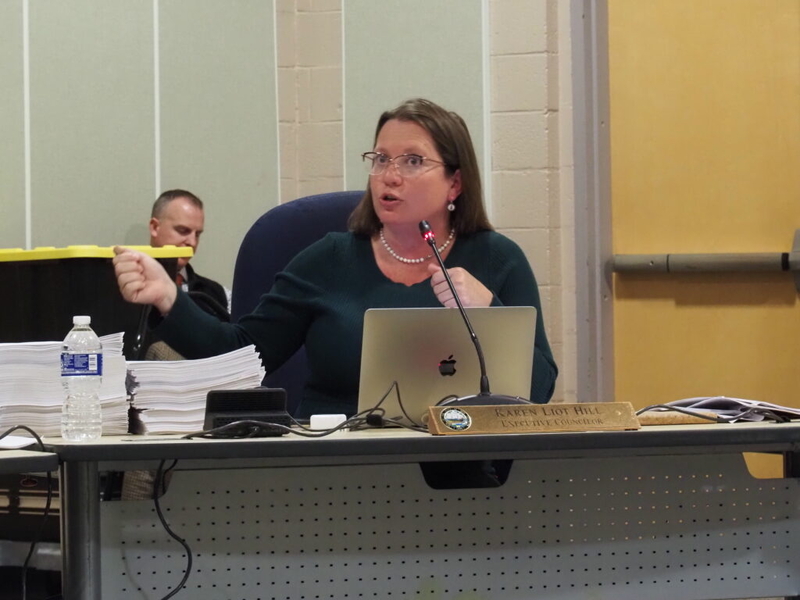
During Wednesday's Executive Council meeting in Pelham, Karen Liot Hill said she's "glad to hear that there's going to be this automated component that hopefully is going to prevent unnecessary losses and people being dropped simply because they didn't submit some piece of paperwork." (Photo by Maya Mitchell/New Hampshire Bulletin)
In preparation for incoming Medicaid work requirements, New Hampshire is purchasing technology systems designed to help the state implement the new policy.
Congress has mandated that states like New Hampshire institute work requirements for their expanded Medicaid programs by January. The requirements mean many Medicaid enrollees who aren’t “medically frail” (though some are concerned about how the government will define medical frailty) will be required to work at least 80 hours per month in order to receive health coverage from the program. New Hampshire is currently preparing to implement the requirements.
Now, New Hampshire Employment Security is updating its state-run job matching software to help. The agency’s Job Match System helps connect employers and job candidates. The state hired Florida-based Geographic Solutions Inc. to upgrade the technology system so it can also be used to enroll people in Medicaid, track their work hours and report that information to the Department of Health and Human Services, which runs the state’s Medicaid program.
Employment Security Commissioner Rich Lavers said he expects the vendor to have the system operational before the work requirements go into effect Jan. 1. On Wednesday, the Executive Council approved a contract to pay Geographic Solutions roughly $118,000 to complete the work.
“I’m glad to see this interagency cooperation,” Executive Councilor Karen Liot Hill said, adding: “Certainly there is the risk that people who rely on Medicaid to access healthcare in our state could get cut off the rolls and sometimes due simply to administrative issues. So I’m glad to hear that there’s going to be this automated component that hopefully is going to prevent unnecessary losses and people being dropped simply because they didn’t submit some piece of paperwork, because that can have a really devastating impact on people’s lives.”
The work requirements have, since inception, been widely criticized by Democrats and public health advocates who say they’ll merely kick people off Medicaid who are actually working due to paperwork issues and won’t encourage more people to start working.
In a report Tuesday, the New Hampshire Fiscal Policy Institute estimated 23,000 to 29,000 fewer adults — or potentially about half of the roughly 50,000 expansion population enrollees — could be enrolled in expanded Medicaid by 2028, citing the policy. Although, some have questioned whether it will be that severe. Liot Hill, the council’s only Democrat, said “that number may be on the high side.”
The work requirements also come around the same time as other major changes to Medicaid in both New Hampshire and across the country.
For instance, Congress also instituted cost-sharing for Medicaid enrollees and cuts to other health programs, including the Supplemental Nutrition Assistance Program, or SNAP.
On the state level, the New Hampshire Legislature voted last year to start charging some Medicaid recipients premiums. The premium plan has been paused though, while New Hampshire and federal officials sort through questions about whether the plan contradicts federal law.
Congress gave states some latitude on how the requirements are implemented. For example, states choose how to define medical frailty and they choose what evidence enrollees may provide as proof of work. Many experts say the decisions states make here will affect whether the requirements push working people off Medicaid unfairly.
New Hampshire has already made some of these choices. State lawmakers have chosen to require documentary evidence of meeting the work requirements, rather than letting enrollees self-attest to meeting them. Lawmakers also chose to require quarterly compliance checks as opposed to twice-yearly checks required by federal law. On medical frailty, the state plans to require enrollees with disabilities or other qualifying conditions to provide a note from their medical provider verifying that their condition impairs their ability to perform activities of daily living. Still, several other key decisions have yet to be made.
The Fiscal Policy Institute argues that the state’s decisions so far have been more stringent than what is required, which could mean more people lose coverage.
New Hampshire is trying to avoid the mistakes made last time the state implemented Medicaid work requirements. In 2018, New Hampshire enacted a state law requiring Medicaid enrollees to work 100 hours a month. However, about a month after the effective date of the rule, only about 8,000 of the 25,000 people subject to the requirement had complied and documented their work hours. The rest were set to lose coverage until the state reversed course and then-Gov. Chris Sununu paused the requirements. State lawmakers then ditched the plan. Now, however, the orders are coming down from Congress.
Concord, NH