Judge dismisses last-ditch attempt to block Colorado graduated income tax ballot measure
Oct 21, 2026 | 7:08 pm ET
Description
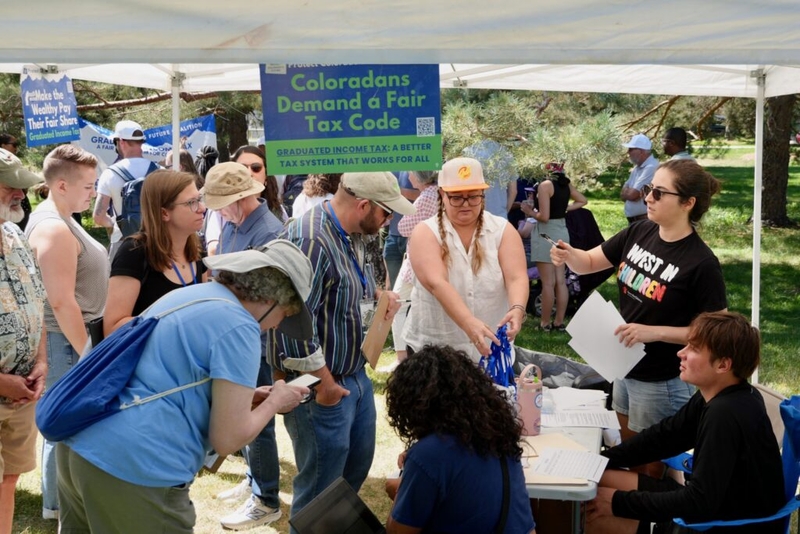
Canvassers in Denver received petition packets as they prepared to gather signatures in support of a graduated income tax measure that will appear on the Colorado ballot in November. Colorado is one of at least nine states that will decide whether to cut, cap or raise taxes this fall. (Photo by Chase Woodruff/Colorado Newsline)
A judge in Denver has dismissed a last-minute attempt by conservative opponents of a graduated income tax proposal to invalidate the measure on the ballots already in Colorado voters’ hands.
In an 18-page order issued Wednesday, Judge Heidi L. Kutcher of the Denver District Court rejected opponents’ argument that votes on Amendment 87 shouldn’t be counted because of paperwork issues with some of the entities that circulated petitions for the measure. The failure by some circulators to comply with an administrative rule established by the Colorado secretary of state’s office, Kutcher said, doesn’t outweigh Coloradans’ “fundamental right” to the initiative process as enshrined in the state constitution.
“To invalidate a signature that is otherwise a valid Registered Elector’s signature because a paid circulator was not registered by a licensed Petition Entity or registered for a specific initiative would place significant restrictions on the Registered Electors’ right to participate in the initiative process,” Kutcher wrote.
Amendment 87, which would raise income taxes on the top 3% of Colorado earners and slightly cut them for everyone else, qualified for the ballot last month after the secretary of state’s office determined proponents had submitted 130,938 valid signatures, more than the required threshold of 124,238 valid signatures, including from at least 2% of the registered voters in each of Colorado’s 35 state Senate districts, as required for constitutional measures. A long list of Colorado progressive groups is backing the Amendment 87 campaign, which relied on a combination of volunteers and paid signature gatherers.
Represented by attorneys from the powerful law and lobbying firm Brownstein Hyatt Farber Schreck, plaintiff Michael A. Hancock, a conservative activist from Arapahoe County, sued proponents and Colorado Secretary of State Jena Griswold on Sept. 16, seeking to have thousands of signatures invalidated and the measure barred from the 2026 ballot, which was already certified.
The lawsuit was initially based on the allegation that 69 of the measure’s petition circulators lacked a training certificate required by the secretary of state’s rules. After the secretary of state’s office provided “updated information” showing that 66 of those circulators had, in fact, received training, the plaintiff subsequently argued the signatures should still be invalidated because those 66 circulators hadn’t to compled with a secretary of state rule requiring entities circulating petitions to submit “a signed form that includes a list of the proposed initiatives … the petition entity will circulate.”
In her ruling, Kutcher noted testimony from secretary of state’s office employees that the form in question “primarily provides an additional data gathering tool,” rather than aiming to prevent fraud, and that the plaintiff had “not asserted any fraudulent conduct by any Petition Entity or Paid Circulator.” Invalidating signatures over the issue “would violate the supremacy of the constitutional provision for initiatives,” she wrote.
“We appreciate the Court’s careful consideration of this matter, and look forward to voters making their voices heard on this question,” Griswold said in a statement Wednesday. “My office will continue to uphold Colorado law and ensure Coloradans can cast their vote on any measure that is qualified to the ballot.”
Denver, CO