Revealed: The money behind the last-minute fringe candidate ad blitz in Alaska’s U.S. Senate primary
Oct 21, 2026 | 4:00 pm ET

Description
A super PAC listing this Wasilla office space as its address boosted a Green Party and fringe Democratic Party candidate in Alaska's U.S. Senate race. (Amy Bushatz/Mat-Su Sentinel)
A left-leaning dark money organization and a GOP fund were among the groups behind the last-minute blitz of cash into Alaska’s U.S. Senate primary in August, when super PACs flooded the state with ads for fringe candidates on both the left and right, according to new filings with federal campaign finance regulators.
The ads were part of apparent efforts to boost lesser known candidates onto the four-person general election ballot who would dilute support for the mainstream candidates opposed by the groups.
At the time, the super PACs — Fair Deal Alaska and Right for Alaska — disclosed spending millions of dollars on mailers, phone calls and digital ads to boost Alaska U.S. Senate candidates like Richard Grayson, who lives in Arizona and said he was running “for fun,” and conservatives Gerald Heikes and Earl Southworth, who have reported no fundraising.
But federal law allowed the vast majority of the groups’ donor information to remain secret until after ballots were counted, which one critic describes as a major loophole.
“It’s outrageous that super PACs, which must, by law, disclose their funders, are able to game transparency rules in so many ways,” Michael Beckel, the director of money in politics reform at Issue One, a Washington, D.C. advocacy group, said in an email. “No super PAC should be able to avoid disclosing its donors until after voters have already made their choices at the ballot box.”
The policy issue, Beckel added, is a “bipartisan problem, and neither party has clean hands.”
“The sad reality today is that both Republicans and Democrats are pumping massive amounts of money into opaque groups,” he said, “leaving voters in the dark about which ultra-wealthy megadonors and special interests are trying to buy access and influence through large political contributions.”
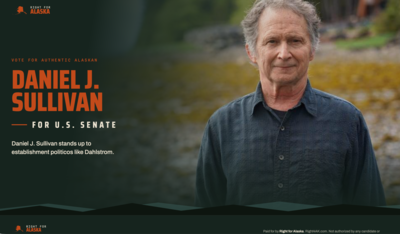
The Aug. 18 primary resulted in Democrat Mary Peltola advancing to the general election along with incumbent Republican U.S. Sen. Daniel S. Sullivan and two other GOP candidates who could end up pulling votes from him: Heikes, and Petersburg teacher Daniel J. Sullivan.
Leading up to the primary, GOP-aligned Fair Deal Alaska spent more than $800,000 on mailers and phone calls to boost multiple fringe left-leaning candidates who, had they advanced to the general election, could have pulled votes from Peltola.
Fair Deal Alaska listed its address as a suite in a Wasilla office building that offers “virtual office and mail services,” and at the time, its officials did not respond to requests for comment about its ad campaign.
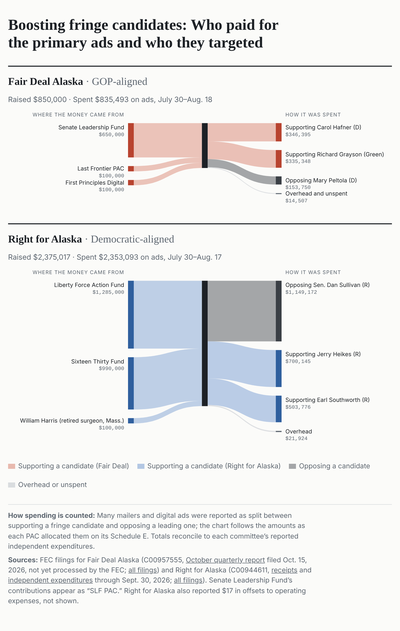
Only this week did the group say where its money came from: $650,000 from Senate Leadership Fund — the main GOP group supporting U.S. Senate candidates across the country, which in turn has drawn much of its cash in recent months from Elon Musk.
Another $100,000 for Fair Deal Alaska came from Last Frontier PAC, a group supporting incumbent Sen. Sullivan that’s funded by wealthy conservative donors. The last $100,000 came from First Principles Digital, a super PAC that says it backs “pro-crypto” candidates.
Last Frontier PAC, Senate Leadership Fund and First Principles Digital did not respond to requests for comment on their contributions to Fair Deal Alaska.
The Democratic-aligned Right for Alaska, meanwhile, spent nearly three times more. Much of its $2.35 million went toward boosting fringe Republican and other conservative candidates in apparent efforts to put candidates on the general election ballot who could pull votes from Sen. Sullivan.
Because of the late timing of most of its contributions, Right for Alaska had to disclose only the donor behind a single $100,000 contribution, a retired Massachusetts doctor. The group’s officials did not respond to requests for comment at the time.
New filings made in September show that the rest of Right for Alaska’s money came from two groups. Roughly $1 million came from Sixteen Thirty Fund, described by Politico as “the left’s preeminent dark money hub,” which put more than $300 million into liberal causes and elections in 2024.
Sixteen Thirty Fund is a 501(c)(4) “social welfare” nonprofit, meaning that it does not have to disclose its donors. The fund did not respond to a request for comment sent Thursday.
The rest of Right for Alaska’s fundraising, another $1.3 million, came from what the group identified as an Alexandria, Virginia-based contributor called “Liberty Force Action Fund.”
There’s no evidence of that group’s existence online — Google returns no results for a query of its specific name — though its Alexandria post office box was once used by a Texas-based company called Liberty for All Inc.
The same political operative behind Right for Alaska, Thomas Datwyler, is also affiliated with another apparently Democrat-aligned super PAC, Alaska Values, that this week disclosed more than $1 million in spending to oppose the incumbent Sullivan and boost Heikes, the Republican U.S. Senate candidate who’s reported no fundraising.
New Facebook ads from Alaska Values feature a man attacking Sullivan for supporting for “the largest debt increase in history,” and urging viewers to vote only for Heikes on their ranked choice general election ballots. The group has not yet disclosed any of its donors.
Beckel, the campaign finance reform advocate, said that proposed federal legislation already exists that would force groups like Right for Alaska, Fair Deal Alaska and Alaska Values to disclose information about “large, last-minute campaign contributions.”
The Stopping Hidden Interests and Non-Disclosure in Elections Act, or SHINE Act, was introduced earlier this year by Democratic Rep. Jason Crow of Colorado. It remains stuck in committee.
This story was originally published in the Anchorage Press. Subscribe here.
Juneau