Seth Bodnar attracting Democratic and Republican voters as an independent candidate for US Senate
Oct 21, 2026 | 3:49 pm ET
Description
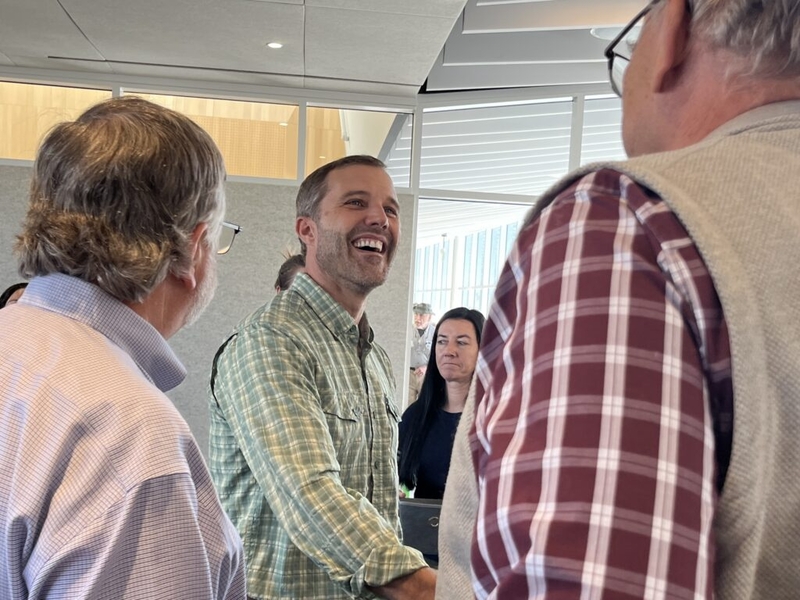
Seth Bodnar, an independent, visits with crowd members at an Indivisible Missoula U.S. Senate candidate debate in September 2026. Bodnar is the former University of Montana president running in four-way race that features a favored Republican, a Democrat and a Libertarian candidate (Keila Szpaller/The Daily Montanan).
In the 1992 race for Montana governor, Republican Marc Racicot squeaked past Democrat Dorothy Bradley.
More than 30 years later, they’re aligned on Seth Bodnar, the independent candidate for the U.S. Senate.
“We’ve come together on an independent, and I don’t mind that at all,” Bradley said. “I think there’s a place in our system for independents.”
Bodnar, 47, is a Green Beret, former executive at GE Transportation, and, most recently, president of the University of Montana from 2018 to 2026.
Early this year, he stepped down from UM to contemplate running for office.
Since he filed, he’s outraised the Republican candidate by more than $1.8 million, drawn support from across the political spectrum, and chastised both Democrats and Republicans in Washington, D.C.
But a Republican, Democrat and Libertarian are on the ballot, too.
Prominent Democrats had urged their nominee, political newcomer Alani Bankhead, to withdraw in order to coalesce progressive support for Bodnar, although Bodnar is quick to argue Republican Kurt Alme could have withdrawn and helped his cause too.
Now, Bodnar’s aspirations and his fundraising abilities appear as high as his chances of losing. The Cook Political Report lists the race as solid Republican, and Sabato’s Crystal Ball marks the seat as safe for Republicans.
Bodnar has detractors, including those who believe Bankhead is the true independent in the race and those skeptical of big money in politics. But he is connecting with Montanans, often resonating on the disaffection he espouses for both political parties.
Tom Stergios, a Republican his whole life — “but not a Trump Republican” — said he’s supporting Bodnar because Republicans have been “rubber stamps” for President Donald Trump’s agenda.
Stergios is a tech executive in Missoula who collaborated with Bodnar on a program that drove employment for UM students. In a world that needs a legislative check on the constitution, he said Bodnar has shown he can make hard calls.
“I don’t know if you could get a blank white canvas and draw up a more perfect candidate,” Stergios said.
‘Politically homeless’
Originally from Pennsylvania, Bodnar graduated first in his class at West Point, studied at Oxford as a Rhodes Scholar, served in the U.S. Army and was deployed to Iraq, and taught at West Point before working for GE.
In 2012, Bodnar registered to vote as a Democrat in Connecticut, and former staff for U.S. Sen. Jon Tester, a Democrat, are working on his campaign, but Bodnar said he can’t claim any political party.
“I believe strongly that one of the biggest threats to the United States of America is the toxic partisan warfare that’s ripping us apart, and that there is a large majority — I call it ‘the commonsense majority’ — of this state and of this country that feels politically homeless, like I do,” Bodnar said in an interview with the Daily Montanan.
His campaign points out he registered to vote with no party affiliation a couple of years later in Florida.
Bodnar points to the more radical positions of members of both parties as ones he eschews — he said slogans on the left like “open borders” and “defund the police” are “crazy,” and he has problems with the far right too.
“Pardoning people who have attacked police officers and claiming that Jan. 6 wasn’t an absolute assault on our democracy is also crazy,” Bodnar said.
In 2019, Bodnar was sworn into the Montana Army National Guard after being a member of the U.S. Army Reserve following active duty.
Bradley, a former legislator and longtime Democratic leader in Montana, said she knows people on both sides of the aisle who share Bodnar’s feeling of displacement in partisan politics.
She’s drawn to Bodnar for a different reason. Bradley said she once asked U.S. Sen. Mike Mansfield of Montana, the longest-serving Senate majority leader, what he was elected to do.
“He said, ‘I am elected to think,’” Bradley said. “That was a flag in my life forever. And that’s what I saw with Seth.”
Record at UM
Bodnar hasn’t cast political votes, but he has a record as president of a Montana flagship university.
He took the helm after Commissioner of Higher Education Clayton Christian asked his predecessor, Royce Engstrom, to step down in December 2016 after plummeting enrollment.
Over eight years, Bodnar curtailed the slide and stabilized enrollment. He stressed the benefit of a public education — for everyone — and focused on supporting students that traditionally are the first to drop out.
Retention rose under his tenure. In fall 2025, UM counted the highest number of students staying on board from their first to second years, 77.2%; it was an all-time record since at least 2000, the earliest year comparisons are available. (It ticked up again this fall.)
During Bodnar’s tenure, UM also boosted graduation rates. It was ranked the No. 1 “military friendly” college nationwide, and No. 1 three years in a row for promoting public service.
Bodnar’s record also includes a federal lawsuit, settled in 2024, against UM and the Montana University System by a group of women, including former high ranking UM officials, who alleged UM created a “brick wall” and “retaliatory culture” for them on his watch.
In the 2021 complaint, Cathy Cole, one of the four original plaintiffs and former vice president for enrollment, said Bodnar commented on her weight and said she shouldn’t be the face of UM, among other allegations. UM and the university system settled with 18 plaintiffs for $350,000.
Bodnar’s supporters note gender discrimination existed at UM long before he worked there.
Some of the allegations predate his tenure, and his campaign page includes a list of comments from female colleagues at UM who spoke to his integrity and commitment to help them advance.
Bodnar said he isn’t perfect and “discrimination is real in the world.”
He denied making the comments alleged in the complaint. In an interview with the Daily Montanan, he sidestepped a question about whether there was truth in the experiences of both his female supporters and detractors. But Bodnar pointed to data from UM.
“The fact that we saw the number of women deans at UM go from one to seven, we saw the number of non-interim vice presidents go from zero to three, and the fact that the majority of our leadership team was women showed that I think we collectively created an environment where women in leadership roles could thrive and succeed,” Bodnar said.
In 2018, UM counted just one woman as permanent dean of an academic unit; its dean of students also was a woman and, later, a plaintiff in the lawsuit.
Mary-Ann Sontag, a faculty member at UM and one of the original plaintiffs, said she believes the women on campus who said they had positive experiences with Bodnar.
She told the Daily Montanan problems existed for women at UM too, and one way to solve problems is to point them out.
“I think the lawsuit did that. And I think things changed. And I find that admirable,” Sontag said.
Sontag, former president of the faculty senate, also said she’s been disheartened to see efforts to discredit plaintiffs instead of acknowledging some change was needed.
“How is that a positive move?” Sontag said.
Deena Mansour, director of the Mansfield Center at UM, has worked at the university since 2009. The Mansfield Center works on civic engagement globally.
As director, Mansour must remain nonpartisan, but she commented to the Daily Montanan on her experience as a female employee.
Mansour said she would never discount the experiences of other women.
At the same time, Mansour said Bodnar trusted and empowered her to lead the Mansfield Center, which can be a sensitive environment. She said when he left, “there were a heckuva lot more women in positions of power than when he came.”
“Being a leader of any organization has its challenges, and people are going to be upset with you if you make hard decisions, regardless,” Mansour said.
Montana ‘in crisis’
Bodnar said he and his wife, Chelsea Bodnar, decided the time is right for him to run because the world looks grim for their three children, 16-year-old twins and 12.
“We are on a path to hand over to our kids a United States of America that’s less prosperous, that’s less secure, that’s more divided, that’s more in debt, and in which our kids have fewer rights than we did,” Bodnar said. “It’s a moral failure.”
He talks about ending corruption in politics on both sides, lowering healthcare costs, stopping tariffs that are harming Montanans, and ensuring changes to Medicaid won’t hurt rural Montanans.
“Rural Montana is in an absolute crisis,” Bodnar said.
He pointed to a farmer in Conrad who told him her operation burns about 300 gallons a day as the cost of diesel and fertilizer soar.
“You do the math — $3 a gallon for diesel versus $6,” Bodnar said.
A rancher from outside Lame Deer told him when the Trump administration lifted import quotas on beef, he was watching a calf sale where his steers were listed at 525 pounds. Bodnar said the rancher told him the price dropped from $4.80 a pound to $3.80 a pound from a Wednesday to a Friday.
“That’s $500 per head out of his pocket,” Bodnar said.
To work through his agenda in the Senate, Bodnar has been pressed to address which party he’ll caucus with, and he argues he won’t caucus with either Democrats or Republicans, but will work with others who are “independent minded.”
In other states, Democrats have bet on independents. Democrats who won primaries bowed out of general elections in Idaho, South Dakota and Nebraska, but Bankhead stayed put, leaving Bodnar with a vastly different landscape.
Jessi Bennion, political scientist with Montana State University and University of Montana, said things can change, but it’s late in the game for the tide to shift against Alme.
“He’s the absolute frontrunner,” Bennion said.
Bodnar said he’s focused on the campaign, not on what might be next.
“What keeps me going is the hunger that I’m seeing all across this state for leadership that brings us together to actually solve problems rather than trying to rip us apart just to win elections,” Bodnar said.
More people unaffiliated with Democrats, GOP
The profile of a university president is high in Montana, and the campaign elevates Bodnar’s visibility and the strength of an independent in a state that used to be purple.
Bennion said nationally, the number of people who identify themselves as independents is nearly 45% and growing.
Jeremy Johnson, political scientist with Carroll College, said the appeal of an independent is due in part to discontent with Trump and the cost of living, but Democrats also have had problems in Montana.
Montana’s history of voting split tickets waned in the Trump years, but he said current frustration leaves an opening.
“Some of that (independence) may be reasserting itself, but it’s still too early to say,” Johnson said.
Helena, MT