The outcome of Maine’s US Senate race may not be known for weeks. Here’s why.
Oct 21, 2026 | 11:15 am ET
Description
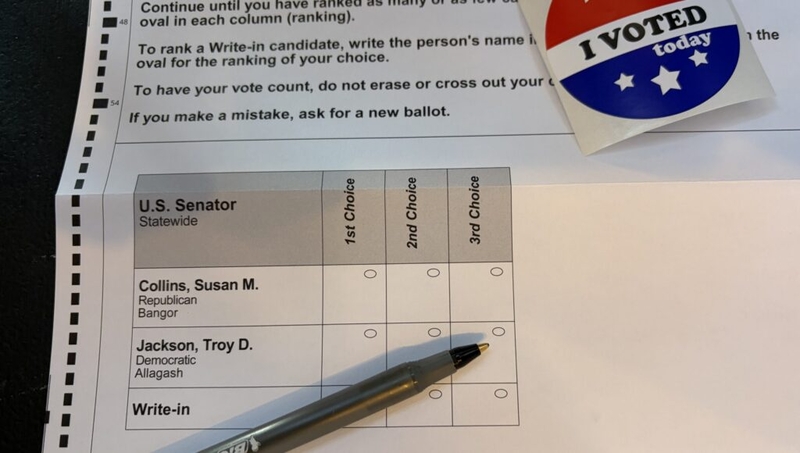
Maine's November 2026 ballot for U.S. Senate lists Republican incumbent U.S. Sen. Susan Collins and Democratic nominee Troy Jackson, along with space for a write-in candidate. (Photo by Lauren McCauley/ Maine Morning Star)
The winner of Maine’s U.S. Senate seat might not be known for days or weeks after the Nov. 3 election. That’s because the odds favor a ranked-choice runoff.
“We think there’s a huge likelihood that it’s going to happen,” Secretary of State Shenna Bellows told Maine Morning Star.
While only two candidates, incumbent Republican U.S. Sen. Susan Collins and Democratic nominee Troy Jackson, will appear on the ballot, the six declared write-ins prompt ranked-choice voting, meaning voters can rank three names on their ballot.
That’s also the case for the race for Maine’s 2nd Congressional District between former Gov. Paul LePage and State Auditor Matt Dunlap, as there is one declared write-in.
If a voter writes in the name of someone who isn’t a declared write-in candidate — such as former Democratic U.S. Senate nominee Graham Platner, who dropped out in July — their vote will not be counted for any candidate. Counted as blanks, those votes, along with ballots where the first choice is left blank, still matter in determining whether the race goes to a runoff. That has been a tipping point in the past.
The primary elections for state and federal offices in Maine can use ranked-choice voting, but the method only applies to federal races in the general election, so the three-way gubernatorial election will not be ranked.
Maine and Alaska, the only two states to use the method for statewide elections, have U.S. Senate races that could determine the balance of power in U.S. Congress. Some worry the possibility of delayed outcomes due to runoffs open an opportunity for President Donald Trump to cast doubt or interfere in the results.
“Any time between an election and the call in the race, any of that sort of purgatory, basically, I think conspiracy theories end up filling the gap,” said Kyle Kondik, managing editor of Sabato’s Crystal Ball, the University of Virginia Center for Politics’ nonpartisan newsletter on American elections. “I mean the president is very irresponsible about what he says about election integrity and so I’m sure he would allege foul play even if there was no real evidence of it.”
So far, the Trump administration has attempted to restrict voting by mail, purge voter rolls and send sensitive personal information to the Department of Homeland Security, among other efforts to influence voting ahead of the midterms, which have largely failed.
“We are mindful that all eyes of the nation will be on Maine should the U.S. Senate race go to ranked choice voting,” Bellows said. “For that reason, we’ve been preparing for weeks inside the office to discuss staffing levels and what measures we could take to make the processes as efficient as possible.”
A look back
A look back to 2024 shows why Bellows thinks a ranked-choice runoff is likely. Democratic U.S. Rep. Jared Golden, who currently serves the 2nd District, had been challenged by Republican Austin Theriault, a state legislator at the time.
After the count of first-choice votes, Golden received 196,388, while Theriault received 194,130. There were 421 first-choice votes for declared write-in Diana Merenda. Meanwhile, 11,997 people left their first-choice blank (or wrote in someone who was not a declared write-in).
A race goes to a ranked-choice runoff if no candidate receives more than 50% of votes on Election Day. That calculation is based on total ballots cast, including blanks.
In this race, there were 402,936 total ballots cast. So, while Golden won a plurality of first-choice votes, he received just under 49% of total votes.
“A very small number of voters has a big impact because the law is total ballots cast,” Bellows said.
Golden eventually won the runoff, which was completed in four days, by Nov. 15, 2024. Last-place candidates (in this case, Merenda) are eliminated first and votes are then redistributed to a voter’s next choice. That’s repeated until one candidate receives more than 50% of votes.
However, the official outcome was delayed longer. Theriault requested a recount, which in Maine is a hand count done by representatives from each campaign. Theriault’s campaign ended the recount after a handful of counties and cities had been completed, saying those counts answered their outstanding questions. The race was officially called for Golden on Dec. 4, 2024.
A similar sequence of events could occur in determining the official results of Maine’s U.S. Senate race, which polls have as a virtual toss-up.
“If the race actually reflects the polling, it seems pretty plausible that one of the two candidates actually won’t get to 50%, that neither of them would,” Kondik said.
Another possibility could be that Collins wins the most first-choice votes, but that there are more write-ins than blanks this year, and Jackson ends up winning after second choices are factored in, or vice versa.
That’s what happened in 2018, when Golden was initially elected in the nation’s first use of ranked-choice voting for a congressional race.
Former Republican U.S. Rep. Bruce Poliquin received the most first-choice votes, however the second-choice votes for the third party candidate that year overwhelmingly went to Golden, handing him the victory after the runoff.
Poliquin filed multiple lawsuits to try to block the tabulations, but federal courts affirmed the method’s constitutionality for general elections for federal races.
Maine voters passed ranked choice voting by referendum in 2016. After that, the justices of the Maine Supreme Judicial Court issued a unanimous advisory opinion concluding that the parts of the law that apply to general elections for state offices were unconstitutional under the Maine Constitution, which requires the winners of those offices in a general election to be decided by a “plurality.” Primary elections and elections for federal offices are governed by state statute and not by the Maine Constitution.
The court more recently weighed in this year, again determining that expanding the method to general elections for state office would violate the Maine Constitution.
Noting all the prior cases, Bellows said, “We are prepared for anything, whether that is litigation or other types of federal interference.”
But critics of ranked-choice voting, including Mark Brewer, chair of the political science department at the University of Maine, caution that the method opens up more questions from people who have ulterior motives, particularly in light of declining trust in elections.
“Voters are increasingly questioning the integrity of American elections,” Brewer said, “not that there’s any evidence that should lead them to do so, but primarily because we’ve had a chief executive who’s for the last 10 and a half years, or however long he’s been doing it, questioning the integrity of American elections.”
Tabulation timelines
While municipalities informally report results to the state and media on election night, under Maine law, they have two days to report official counts to the Secretary of State’s Office. That means it may not be clear on election night whether ranked-choice tabulations are needed.
“We’ll make it as quickly as we can,” Bellows said of that determination. “If it is obvious that neither contender has received 50% plus one, then we’ll make that announcement even before all the clerks have officially filed. We want to give the public and the candidates as much notice as possible. We also want to be sure that we’re correct.”
State law does not stipulate when the runoff would need to begin or end, though there are other statutory deadlines that must be met, such as submitting results to the governor by Nov. 23. The law is also silent on the order, if there are multiple runoffs and recounts that need to occur.
In 2024, for example, the runoff and multiple legislative recounts occurred at the same time. This year, Bellows said, “We will most likely start ranked choice voting first, and then move into recounts as that capacity allows.”
Based on how long ranked-choice tabulations have taken in the past, Bellows said she expects a runoff would likely go until at least the Friday of the week following Election Day. During the primary in June, the ranked-choice runoffs for the Democratic and Republican primaries for governor, as well as the Democratic primary for the 2nd District, took a week and concluded well past midnight.
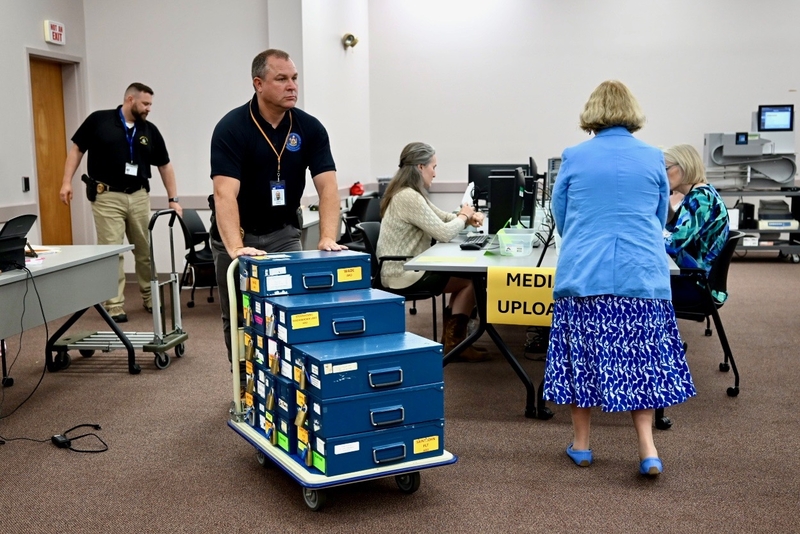
The bulk of that time is the Secretary of State’s staff logging results from every ballot, checking multiple times to ensure the totals line up. The tedious process has in the past been livestreamed on the Secretary of State’s Facebook page. Actually running the ranked-choice tabulation formula produces results in a matter of minutes.
“We think it’s better to be accurate than fast,” Bellows said, “although we certainly are going to try to be as fast and accurate as possible.”
While not a requirement, the results from the counties farthest away are typically logged first, so there is adequate time in case any missing materials need to be retrieved, Bellows said.
When it comes to recounts, the candidates get to choose which areas of the state get recounted first.
There are no automatic recounts in Maine. (That was almost an issue in 2024, when no candidate initially requested a recount after preliminary results had shown a tie between Rep. Lucas Lanigan and his challenger, Democrat Patricia Kidder.)
Any candidate other than the apparent winner can request a recount with the Secretary of State within five business days after the election — except for races that use ranked-choice voting, when only a candidate who received one of the top three rankings at the end of the second to last round can request a recount.
Candidates do not have to pay a deposit for the recount if the races are very close — 1% or less of the apparent margin of victory. Beyond that, state law outlines the cost, which is paid by the requester.
Forecasters such as Kondik already anticipated not knowing the result of Alaska’s U.S. Senate race on Election Day, since that race has four candidates on the ranked ballot. But the possibility of having to wait for Maine as well could further delay the overall ability to call the balance of power in the U.S. Senate, with Maine seen as one of the four seats Democrats would need to flip to gain control.
“Maine is one of the most difficult to forecast races on the board,” Kondik said, “and it’s hugely consequential for the outcome of the Senate.”
Augusta, ME