Steil, Berman face off in debate for 1st Congressional District seat
Oct 21, 2026 | 4:45 am ET
Description
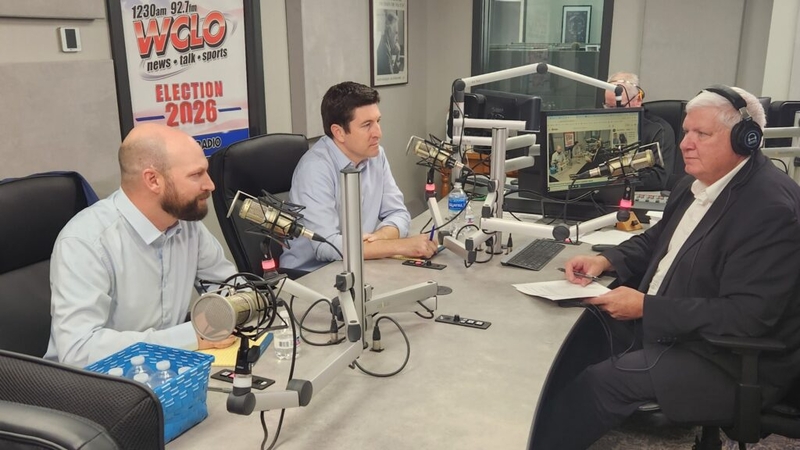
1st Congressional District Democratic candidate Mitchell Berman, left, and Republican incumbent Bryan Steil, center, debate Tuesday at radio station WCLO in Janesville, responding to questions posed by WCLO's Tim Bremel, right. (Photo by Erik Gunn/Wisconsin Examiner)
Wisconsin’s 1st Congressional District incumbent U.S. Rep. Bryan Steil (R-Janesville) and his Democratic party challenger, Mitchell Berman, parried for an hour Tuesday in their only face-to-face encounter scheduled before the Nov. 3 election.
The debate took place in the studio of Janesville radio station WCLO and was moderated by Tim Bremel, who hosts the station’s daily morning talk program.
Steil is a corporate lawyer who has represented the 1st District since 2019. Berman is an emergency room nurse who won the Democratic nomination in August. The two took contrasting approaches during the hourlong exchange.
Berman has focused his campaign on rising costs, including for healthcare, and Tuesday he returned several times to the 2025 massive tax and spending bill — the One Big Beautiful Bill Act — that Steil voted for. The Republican-authored legislation cut taxes for the wealthy while cutting funding for Medicaid and other safety-net programs over the next decade.
“Our healthcare has been gutted and has become unaffordable, and we’re seeing politicians in Washington enriching themselves and working at the behest of their corporate donors and special interests,” Berman said in his opening remarks. “That’s why I got into this race, and we need to change and make Washington work for working people again.”
Steil defended his vote and said he has been working “to clean up Washington.” He accused Berman, and Democrats in general, of lying about the 2025 bill’s impact and also appeared to accuse Berman of positions that the challenger never took.
Bremel’s first question cited a poll that put inflation and the cost of living at the top of voters’ concerns. He asked the candidates to identify “one specific federal policy you would prioritize to improve household finances for the residents of the First District.”
Berman called for repealing “blanket tariffs” levied by the Trump administration. “We know that tariffs are a tax on the American people, and everyone knows we’re paying more for everything at the store right now because of that,” Berman said. Steil “has voted to continue these blanket tariffs eight times, and that, to me, I think is unconscionable.”
When it was his turn, Steil praised the Trump administration’s embrace of fossil fuels to “unleash American energy.”
Steil highlighted provisions in the 2025 tax law that cut taxes on overtime pay and tips, a new $6,000 tax deduction for people 65 or older, and another measure that makes changes to the federal child tax credit, expanding it for some families.
“My opponent opposes that tax relief,” Steil said of Berman in a follow-up comment. Berman took exception to that charge.
“Those components of tax relief that my opponent just talked about, I don’t oppose,” Berman said. He asked Steil, however, why those four provisions “for regular working class people” are set to expire after 2028 while the bill’s “tax relief for billionaires was made permanent.”
Steil ignored the direct question. “We just have a firm disagreement,” he told Bremel. “I’m working to reduce taxes for people here in South Central and Southeastern Wisconsin,” he added, and reiterated Berman’s opposition to the 2025 bill without answering the question Berman had posed.
Healthcare costs
Bremel’s next question, focusing on public concerns about healthcare costs, asked the two for their first priority in making “changes to the federal healthcare system,” including how it would be paid for.
Steil again defended his vote on the 2025 bill, accusing Berman of putting out “false information” about the Medicaid provisions. The Republican congressman said the bill “results in an increase in $1 billion in federal money coming to the state of Wisconsin for Medicaid.”
The $1 billion refers to additional Medicaid matching funds to the state under a provision in the 2025-27 Wisconsin budget. That boost resulted from a deal reached between Democratic Gov. Tony Evers and Republican leaders in the state Legislature. State lawmakers and the governor rushed the budget to be signed before the federal provision took effect, which would have cut Wisconsin off from the additional money without the state budget change.
Berman didn’t address that issue, but countered that in contrast to the $1 billion Steil touted, the federal bill cut “a trillion dollars from Medicaid over the next 10 years.” He also cited projections that 270,000 Wisconsinites could lose insurance coverage after the expiration of enhanced subsidies to lower the cost of Affordable Care Act marketplace health policies.
“I know what that looks like when people are showing up to the hospital underinsured and uninsured, and that cost gets shifted to folks who have insurance,” Berman said.
Steil said the bill’s Medicaid work requirements on “able-bodied, childless adults of working age” would strengthen the program. He also credited the federal bill for “removing illegal immigrants from receiving free taxpayer-funded healthcare.
According to the Center for Children and Families at Georgetown University, undocumented immigrants and many immigrants with legal status were already prevented from getting Medicaid coverage.
“This legislation creates red tape, which makes it more difficult for people who qualify for those benefits to obtain them, and so they lose their benefits,” Berman responded.
Berman said nothing about Medicaid and immigrants, but Steil replied, “My opponent is arguing to use your taxpayer dollars for illegal aliens. That was very clear right there.”
Replied Berman, “I don’t believe that’s what I said.”
Campaign finance
In response to another question, about campaign finance and congressional ethics, Berman cited his endorsement by the campaign finance reform group End Citizens United.
“We are a grassroots-funded campaign, and we don’t take any corporate PAC money,” Berman said.
Steil contended that Berman’s claim was a lie because an ad in which the Democrat said he doesn’t take corporate PAC money was paid for by the Democratic Congressional Campaign Committee. “What do they take? Corporate PAC money,” Steil charged.
“If you look at my FEC reports, there is no corporate PAC money,” Berman said, referring to his campaign’s filings with the Federal Election Commission.
Steil’s most recent filings show his campaign has $1.6 million in corporate PAC donations, 31% of the $5.3 million he raised in 2025-26, according to Open Secrets, an independent group that tracks money in politics analyzing FEC data.
On Social Security and Medicare, Steil said the programs should be protected by “rooting out wasteful spending.”
Berman responded by observing that Steil had voted against 2022 legislation authorizing Medicare to negotiate prices on select drugs with pharmaceutical companies, and that the Trump administration had cut jobs from the Social Security Administration, making it more difficult for people to navigate the system.
“Our current administration pardoned multiple people who committed egregious Medicaid and Medicare fraud,” Berman added, “and I was wondering if my opponent would denounce that.”
In response, Steil referred to “significant, record-breaking arrests and convictions in Milwaukee County” relating to Medicaid fraud, but added that “there’s a lot more work to do to root out the waste, fraud, abuse in these federal programs.”
On immigration, Berman called for “transparency and accountability” in the federal agencies responsible for immigration enforcement, “making sure these organizations are following the law and getting the most heinous criminals off of our streets and focused on those folks.”
Steil said immigration policies should be linked to “workforce needs” in the U.S. “I don’t support amnesty,” said Steil. “It sounds like my opponent does.”
Madison, WI