This institute could get $4 billion from a ballot measure. With just three workers, is it ready?
Oct 20, 2026 | 8:00 am ET
Description
In summary
One research institute will receive $4.2 billion in bond money if voters approve Proposition 38 in November. Currently only one institute in the state meets the criteria to qualify for the money.
The science research institute that would likely receive $4.2 billion in public taxpayer money if voters approve Proposition 38 this November had only three employees as of last month — far fewer than the 51 staffers it planned to have hired by last year.
Public statements and public records CalMatters obtained raise questions about how well prepared the institute is to shepherd so much money if the bond measure passes.
Prop. 38 would allocate up to $8.4 billion in bonds for scientific research on diseases and cures concerning the immune system, with an emphasis on finding treatments for Alzheimer’s, cancer and heart disease. The ballot language stipulates that a single, unnamed research institute would receive half the bond’s money to conduct research and partner with other researchers if it meets highly specific criteria. Bonds are a type of debt that must be repaid.
Previous reporting by CalMatters found only one institute in California currently meets those criteria: the California Institute for Immunology and Immunotherapy. The institute’s principal funder is billionaire Gary K. Michelson, who wrote Prop. 38 and by far the largest donor to its political campaign.
Backers of the proposition said state bond money is needed to stabilize research funding after President Donald Trump repeatedly attempted to cut existing and future federal science grants.
The measure’s critics say Prop. 38 is well-intentioned but poorly designed because it overlooks the many established public and nonprofit university and hospital research labs in California. They also say California should not subsidize subsets of scientific research and instead should support research more broadly.
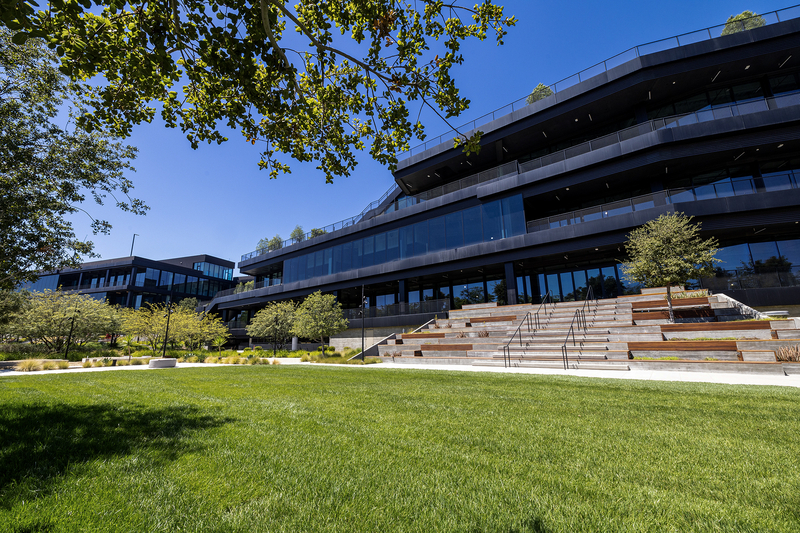
CalMatters obtained documents that included the five-year business plan of the California Institute for Immunology and Immunotherapy. The plan was part of the formal affiliation agreement between UCLA and the institute, which the two parties signed in August 2024. Among other details, the agreement requires the institute to pay UCLA 7.5% of the net revenue of any drugs and technologies developed by the institute’s staff. The institute is one of the founding tenants at a UCLA-owned research park in West Los Angeles, where the institute is leasing 235,000 square feet of research space, the institute says.
Far fewer employees than plan called for
Between summer 2024 and summer 2025, the institute committed to hiring “approximately” 51 employees, including six executives, five “world-class” scientists who can lead research labs, and 40 other employees, such as data scientists, lab technicians, biologists and administrative personnel. Between 2025 and 2027, the institute would hire roughly 90 more workers, including 10 research lab leaders, according to the agreement.
But John Mazziotta, a senior UCLA official who also serves as a board member of the immunology institute, last month said the institute has hired just three employees: a chief operating officer, a general counsel, and a scientific advisor, and “they’re well into the search” for a director. Mazziotta, the CEO of UCLA Health and vice chancellor for health sciences at UCLA, made his comments during the Sept. 16 UC Regents meeting.
The Yes on Prop. 38 campaign has repeatedly refused to comment on whether the bond was written specifically for the immunology institute. Claudia Briggs, a spokesperson for the campaign, told CalMatters in July that whichever nonprofit receives the $4.2 billion portion of the bond fund should be a sophisticated one that “is prepared to accelerate lifesaving research immediately while maintaining the highest standards of scientific quality, accountability, and stewardship of public funds.”
At a September press conference, a Yes on Prop. 38 spokesperson appeared to confirm CalMatters’ findings that only one institute currently qualifies to be the one to receive half the bond money. “It is very likely that CIII, which is a research institute affiliated with UCLA, will qualify for half of the funds under the current criteria,” said Robin Swanson. CIII is the initialism for the immunology institute.
According to the five-year plan, the institute was supposed to spend $25 million on personnel between 2024-25 and 2025-26 and $45 million total on operating expenses in that time, including maintenance, utilities and rent. It was also supposed to spend an additional $167 million in that time on capital expenses, such as construction and demolition. However, Mazziotta told UC regents that the institute had so far spent a total of $20 million on “operating expenses, hires” and other expenses.
The Yes on 38 campaign refused CalMatters’ request to interview Michelson for this story, as did Michelson himself in a separate email. A spokesperson for the institute, Becky Warren, sent a written statement that didn’t answer CalMatters’ questions about employing far fewer people than the five-year plan laid out. Instead, she highlighted the promise of the institute and a few of its milestones, including signing the affiliation agreement with UCLA and clearing a state environmental review of its forthcoming research facility.
The institute won’t get state bond money if it isn’t ready to begin work, “plain and simple,” wrote Swanson, the Yes on 38 spokesperson, in an email. She stressed that though the institute very likely qualifies, the ultimate decision to award half the bond funding is up to the California Department of Public Health.
Institute facility will be built by 2028
The UCLA research park that houses the institute isn’t slated to be fully built until at least late 2028, according to the agenda item of the September UC regents meeting. The research park is a former mall UCLA acquired in late 2023 that’s now undergoing major retrofitting.
But the 2024 affiliation agreement between UCLA and the institute anticipated this. The agreement permitted the institute to use UCLA health research space on another campus property on an interim basis. Mazziotta told regents that research is underway there.
Mazziotta also told the regents the institute’s construction costs are not fully funded — it still needs roughly $100 million. He said UCLA was in serious talks with a donor to provide about $50 million to the institute.
If Prop. 38 passes, the bond funding would be provided in increments based on how often the institute requests new money that senior state officials approve. If all the funds are depleted, Californians would repay the bond at a rate of $500 million to $600 million annually for about 20 years.
Institute would be exempt from public records act
CalMatters submitted the public records request to UCLA, which must comply with the California Public Records Act. The institute, as a private nonprofit, does not have to comply. And while Prop. 38 would channel billions of dollars in taxpayer money to the institute, the proposition’s language specifically exempts the nonprofit that will receive the $4.2 billion from state public meetings laws, political reform laws and the public records act. The other half of the funds would go to a council that’ll pick projects led by researchers from a limited pool of universities and nonprofits. The council would generally be governed by the state’s political reform act, which prohibits financial self-dealing.
Briggs defended the institute’s exemption in Prop. 38, writing that applying state transparency laws to existing private organizations would “not fit well with how private entities are organized and operate.” Instead, she noted the selected nonprofit institute would be required to publish annual reports on its research progress and financial plans plus commit to annual state audits, among other disclosures written into the ballot measure.
Still unclear to the UC regents is the relationship between UCLA and the institute on matters of public disclosure. Four senior UCLA officials sit on the institute’s board. So is a document held by those UCLA officials public because it’s related to UCLA affairs or private because it’s related to the institute’s affairs? UC’s general counsel couldn’t explain where that dividing line is after a regent member asked him. The regent member, Michael Cohen, said he wants more clarity when the regents meet again in November.
Gov. Gavin Newsom and the California Democratic Party endorsed Prop. 38, as have dozens of patient and research advocacy groups, plus the state GOP. The union of graduate students and post-doctoral researchers, whose pay often relies on science research funding, has also endorsed the proposition. The union doesn’t represent faculty.
Money raised in support of Prop. 38 now exceeds $66 million, including at least $61.2 million in contributions from Michelson and his policy institute. Roughly $14 million of that includes loans from Michelson. The no camp has raised about $8,800
Sacramento