In 7th Congressional District race, candidates focus on affordability, quality of life
Oct 20, 2026 | 5:59 am ET
Description
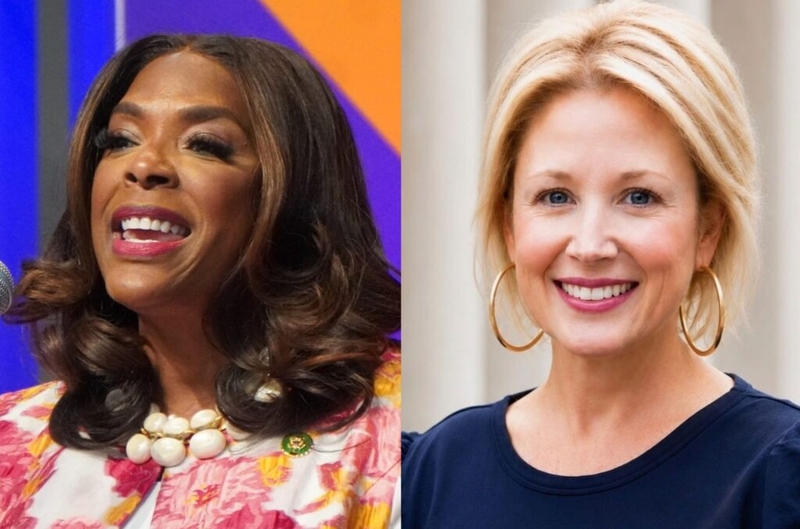
In Alabama's 7th Congressional District, U.S. Rep. Terri Sewell, D-Birmingham (left), who has held the seat since 2011, faces Republican nominee Ammie Akin (right), a first-time candidate. (Left: William J. Ford/Maryland Matters; Right: Courtesy Ammie Akin; photo illustration by Brian Lyman/Alabama Reflector)
The two candidates for Alabama’s 7th Congressional District agree affordability is the defining issue of the race, but they disagree on what caused it and how it should be fixed.
First-time political candidate Ammie Akin won the Republican nomination for the district against David Perry in the August 11 Republican special primary. She is challenging U.S. Rep. Terri Sewell, D-Birmingham, who has held the seat since 2011.
The 7th District spans key portions of Jefferson and Tuscaloosa counties, alongside Black Belt counties like Dallas, Wilcox, Lowndes and Sumter. The district saw some alteration after Republican lawmakers implemented its controversial and previously contested 2023 congressional maps earlier this year. However, the Cook Political Report rates it a D+10, solid Democratic district in November.
The candidates
Akin, a long-time educator, school administrator and non-profit operator said two of her campaign priorities—crime and education— come back to that core issue of affordability.
“I think we need to start asking quality of life issues and affordability-type issues because what is driving people to crime? Well, crime is when people are desperate,” Akin said. “Are they desperate for food? Are they desperate to feed their family? Can they make money? Do they have a job? We have to look across the district, and we have to consider the communities and the quality of life in these communities, and what we need to do to improve that quality of life if we’re going to stop crime.”
Like Democratic candidates across the country, Sewell has made affordability a focal point of her re-election bid.
“When people talk about affordability in my district, they’re talking about the cost of gas, the cost of housing, the cost of groceries—people are concerned with, you know, everyday kitchen table issues, and they want to see change in Washington to address those concerns,” Sewell said.
Sewell cited legislation she has sponsored to stop President Donald Trump’s tariffs as a member of the U.S. House’s Trade subcommittee, part of the Ways and Means Committee.
“And hopefully—God willing—with the election of the Democrats, I’d get the gavel and be the chair of the subcommittee on trade, so we can work on trying to bring down the prices of everything,” she said.
Trump’s tariff war is projected to cost households an average $820 in 2026; executive tariffs have cost Alabama $5.4 billion, at a per-household equivalent of $2,365. Trump’s war on Iran, which began February of this year, has further exacerbated inflationary pressures on everyday commodities like gas and food.
After federal cuts to the program, Affordable Care Act enrollment in Alabama has also dropped by 23%—roughly 95,000 people, statewide—and some 21,000 of those are in the 7th District.
In the 7th Congressional District, roughly 15.7% to 21.3% of the general population lives below the poverty line, with child poverty reaching 25% to 28% in recent estimates. Approximately 26.7% to 28.1% of adults hold a bachelor’s degree or higher, trailing state and national averages. According to Sewell’s annual report, the district received more than $398 million in federal grant money during 2025.
Akin argued the challenges facing the district—which suffers from the highest poverty rates and lowest-performing schools—originate from within, the misallocation of federal funds, and said “the answer isn’t always another government program.”
“You know people are going to say: ‘Well, Alabama is a ruby red state; it must be the fault of the Republicans.’ Oh no!’ Akin said. “You look at who’s run District Seven for the last sixteen years, and it’s not a Republican. It’s a solid blue, woke Democrat who campaigns with Stacey Abrams and Alexandria Cortez, and [Sewell] is a woke liberal who is spending her time traveling the country with people that do not represent her district.”
Sewell said she was “very much aware that our district was the poorest district of the state of Alabama when I inherited that district, and we’ve worked very hard to try to address those concerns.”
“Our district didn’t get into this shape overnight,” she said. “It has been decades, generations of disinvestment in Alabama’s 7th Congressional District. And since I’ve been elected, we’ve done nothing but try to address that by investing heavily in our district.”
Akin said she was “not applying for a job with either party.”
“I’m applying for a job with the constituents of Congressional District Seven and what is most important to me is what helps the people in Congressional District Seven, and so I am not digging my heels in on a party line,” she said. “I’m digging my heels in on what’s right for people.”
Akin did not indicate whether or not she is prepared to vote against Republican leadership if they propose new cuts to Medicare or Social Security, or with Democrats, if there are efforts to restore or extend access to Medicaid.
Sewell emphasized her commitment to bipartisan work on housing affordability, highlighting the July passage of the 21st Century Road to Housing bill to fund affordable home construction. She plans to reintroduce the John Lewis Voting Rights Amendment Act, which would restore voting protections overturned by the U.S. Supreme Court. Additionally, she pledged that within her first one hundred hours, a Democratic-led House would immediately reverse the Trump administration’s $1 trillion in proposed Medicaid cuts to protect vulnerable families in Alabama.
Sewell plans to balance the party’s dual stated goals of passing consumer-focused legislation while ramping up aggressive congressional oversight of the current administration, but is not interested in pursuing impeachment proceedings against Trump.
“That didn’t work the first term, right? And so why would we waste our precious power and time doing that?” Sewell said of impeachment. “We’ll be utilizing our power and our time to directly affect the cost of gas and groceries by getting rid of these illegal tariffs by addressing the serious cuts of Medicaid that have come that will be coming down in 2027.”
Fundraising
According to the most recent campaign filings, Akin raised $262,893.67, of which she loaned about 38% ($100,000) at the start of her campaign. She spent $210,806 and had $52,087.67 remaining as of September 30. Akin has not received political action committee (PAC) money.
Sewell raised $2,207,233.12, of which about 19% came from individual donors. The majority of cash contributions, about 81% ($1,795,750.00), came from PACs. Sewell spent $1.6 million and had $281,600 on hand as of July 22.
Montgomery