South Dakota’s own tradition fades amid success of nonresident pheasant hunting
Oct 17, 2026 | 10:16 am ET
Description
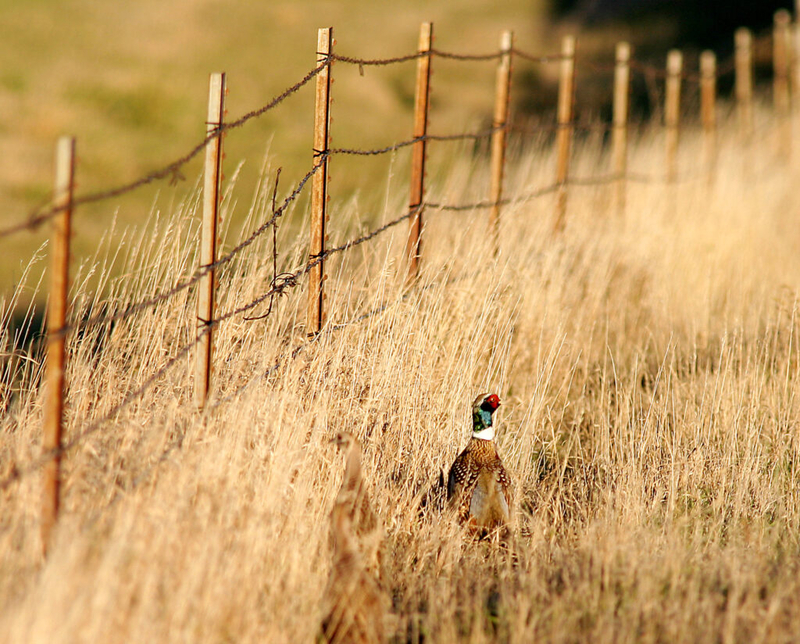
A pheasant stands along a South Dakota fence line in 2023. (Unmodified photo courtesy of USDA-NRCS South Dakota)
South Dakota has spent decades convincing out-of-staters to come here and hunt pheasants.
Tourism campaigns market pheasant hunting as a bucket-list experience, especially during the opening of the season, which is this weekend. Later this month, elected officials, business leaders and invited guests will gather for the Governor’s Pheasant Hunt, an event devoted as much to economic development as hunting.
Yet amid that success story sits an uncomfortable fact. Fewer South Dakotans are participating in it.
Last year, the state Game, Fish and Parks Department estimated that about 57,000 South Dakota residents hunted pheasants. More than 82,000 nonresidents did.
Visitors have outnumbered resident pheasant hunters since 2002, but the more revealing comparison is with South Dakota’s past.
South Dakota wildlife officials offer hunting license refunds as deer disease reports continue
In 2000, the state had about 755,000 people and nearly 80,000 resident pheasant hunters. Since then, South Dakota has gained roughly 180,000 residents — enough to create two more Rapid Cities — while losing more than 22,000 resident pheasant hunters.
In that timeframe we have gone from roughly 1 in 10 South Dakotans hunting pheasants to 1 in 16.
Pheasant hunting has become one of South Dakota’s more successful industries. Game, Fish and Parks estimates pheasant hunters spent $304.5 million in South Dakota in 2025.
Nonresident hunters are also the financial backbone of the pheasant system, generating far more small-game license revenue and more habitat-stamp revenue than residents.
That success helps explain why the decline in resident hunters attracts little urgency.
A South Dakotan who decides not to hunt this fall does not create an immediate budget problem. A motel room may still be rented by someone from Minnesota. The nonresident license still gets sold, and the Governor’s Hunt still showcases another successful year.
Economic developers promote South Dakota’s quality of life because people choose where to live based on more than economics. For generations, pheasant hunting was part of that sales pitch. Families hunted together. Neighbors shared permission. Young hunters learned from parents, grandparents and family friends. Opening-weekend stories were traded in cafes, grain elevators, schools and workplaces.
Nobody claimed access was unlimited or guaranteed, but the first question was often, “Where should we hunt?”
Increasingly, the question is, “What does access cost?”
Hunting leases have become more common, and commercial hunting has expanded. During the 2024-25 season, 235 private shooting preserves reported releasing more than 632,000 pheasants and a harvest of about 380,000. Nearly 94% of the harvested birds had been released.
Preserves provide jobs and give hunters another option. But a tradition once built largely on relationships is increasingly a marketplace built on transactions.
Landowners have every right to respond to those opportunities. They provide most of South Dakota’s wildlife habitat and bear many of its costs. But a resident looking for a place to hunt after work or on a Saturday afternoon faces different circumstances than a visitor arriving with a lodge reservation, guide and substantial budget.
Game, Fish and Parks has not ignored access. It maintains public hunting land and private-land access programs, and partnerships with conservation groups continue adding acreage.
Those efforts matter. But Pheasants Forever says lack of access is widely acknowledged as a primary barrier to hunter participation.
Still, the numbers do not prove lack of access is why South Dakotans stopped hunting.
Was it access, cost, time, hunting pressure, urbanization or changing interests? Did fewer families retain connections to farms and landowners? Did older hunters leave without anyone taking their place?
Game, Fish and Parks can estimate how many pheasants were harvested. Tourism officials can estimate how much hunters spent. What South Dakota does not appear to have is a recent public effort to ask former resident hunters why they stopped hunting pheasants.
That distinction matters. If resident participation were rising, state leaders would likely point to it as evidence of success. Declining participation deserves the same attention.
South Dakota tracks visitor spending, habitat acres, harvest numbers and tourism growth. Its advertising campaigns and Governor’s Hunt make clear that it has a strategy for recruiting out-of-state hunters.
What is less clear is whether it has a strategy for retaining resident hunters. How many resident pheasant hunters does South Dakota hope to have 10 years from now, and what number would state leaders consider success?
South Dakota should continue welcoming nonresident hunters. But a state cannot measure the health of its hunting tradition only by counting the people who travel here.
South Dakota has become remarkably good at inviting the rest of the country to hunt pheasants.
The more important question may be why fewer South Dakotans are accepting the invitation.

Pierre, SD