‘We’ve got to button it up’: Childcare council reduces schedule, shifts priorities ahead of session
Oct 16, 2026 | 2:05 pm ET
Description
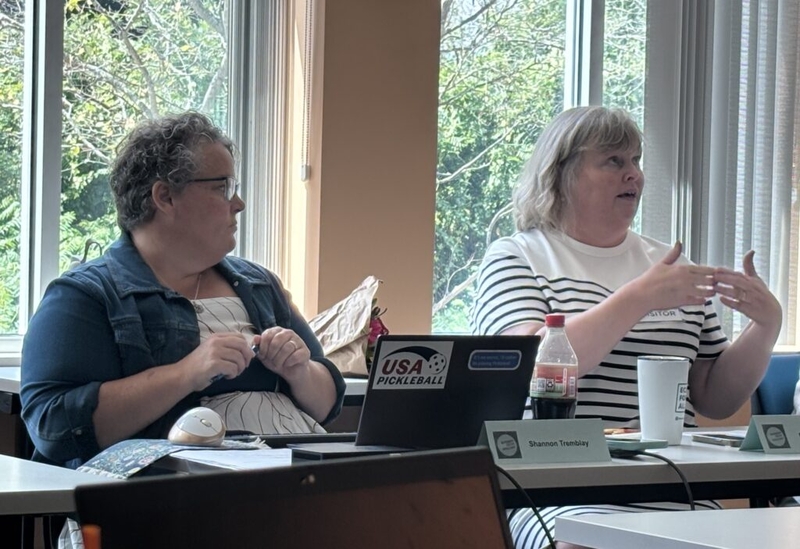
Shannon Tremblay (left), director of the New Hampshire Child Care Advisory Council, and Marianne Barter, the council's former chair, sit during a meeting of the council on Aug. 14, 2025. (Photo by Claire Sullivan/New Hampshire Bulletin)
The New Hampshire Child Care Advisory Council is reducing the number of its scheduled meetings ahead of a new legislative session and another budget year.
The council was legislatively enacted in 1995 and serves as the official advisory body for childcare matters in New Hampshire. The council’s role is to inform and advise the Department of Health and Human Services, the governor, the state Legislature, and the Department of Education on early education and childcare policy.
At the council’s annual meeting on Oct. 8, members voted to reduce the meeting schedule from every other month to quarterly to give members “more time for meaningful discussion and decisions on complex issues.”
“Meetings were getting to be where it was more of just an update meeting, and not actually like getting any real good work done as far as making recommendations to either legislators or state level,” said Shannon Tremblay, director of the council. “So the recommendation came to start meeting quarterly and have those meetings be a little bit longer and not so many updates.”
The council comprises voting members who represent early education organizations, the state’s childcare resource and referral network, the business community, the state community college system, the state university system and governor-appointed “consumers of childcare services.”
In addition to reducing the frequency of meetings, the vote also changed the length and scope. The two-hour meetings will now be three to four hours with a “stricter” agenda in hopes that council members and presenters prioritize policy initiatives instead of providing updates.
“We’ve got to button it up,” said Marianne Barter, executive director of Merrimack Valley Day Care Center in Concord and formal council chair.
The change comes as childcare advocates prepare for a new legislative session and budget year. While the council is nonpartisan, meetings have been a place where advocates, providers and council members align on priorities for the year ahead.
In preparation, meetings will also have topics of discussion “aligned to the work” and the state legislative cycle. Advocates have stated they try to renew momentum for state dollars to go toward the childcare workforce grant, childcare quality funding and out-of-school-time program.
As director, Tremblay holds the only paid position on the council and is responsible for managing its affairs. She said the “bulk” of work of the council does not happen at advisory meetings, and reducing the commitment will make it easier for members to get things done.
“There still will be time for those updates because we’re going to have a longer meeting, but have more space for discussion about what’s happening around,” Tremblay said.
Council meetings will now be reserved for deliberation, decision and statutory advisory work, while provider input, workgroup preparation and updates will happen between meetings.
Despite more work being done offline, Tremblay said the council will still be “very transparent.” State law requires that representatives from the Department of Health and Human Services on behalf of the commissioner and the Bureau of Child Development and Head Start Collaboration attend. It is one of the few times childcare providers can publicly hear from state officials that manage childcare governance regarding policy changes and updates, as well as voice their concerns to the people directly responsible for implementing them.
“It’s not necessarily like we’re trying to go behind closed doors,” she said. “There’s so much stuff going on and things happening everywhere. We’re really trying to focus on policy and making sure that providers are getting the information.”
Under the new schedule, the next council meeting is planned for Jan. 14.
Concord, NH