Clearing of Durham’s homeless encampments tests NC community’s resolve
Oct 16, 2026 | 6:00 am ET
Description
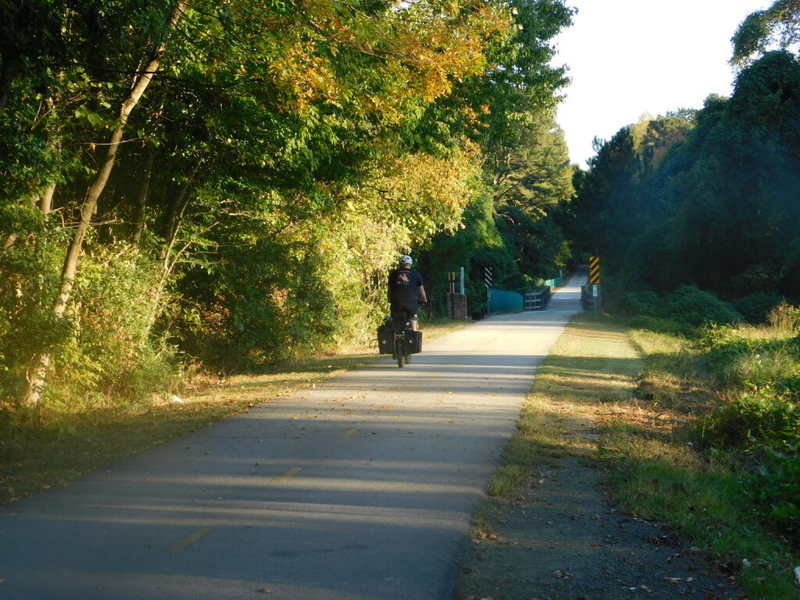
A biker on the American Tobacco Trail near Fayetteville and Pilot streets this week, in the area where police recently cleared a homeless encampment. (Photo: Greg Childress/NC Newsline)
Tito Husband began his first week as store manager of the Food Lion on the corner of Fayetteville and Pilot streets about a week after Durham police launched “Operation Safe Passage” to remove a nearby homeless encampment, which allegedly doubled as an open-air drug market.
Husband told NC Newsline that he was already aware of the encampment and its resulting chaos before his arrival. Residents who live near the store had begun to shop at the Lakewood Shopping Center Food Lion, where he worked before his new assignment, to avoid aggressive panhandling at the Fayetteville Street store, he said.
Since Husband has become store manager at the Fayetteville Street store, customers have told him that the panhandling has eased since police cleared the encampment that was along the city’s popular American Tobacco Trail.
“There’s still a little bit of panhandling in the area, but I’m trying to deal with it as best as I can,” Husband told NC Newsline last week. “As soon as customers let me know that panhandlers are in the area, we try to get police involved so we can make a better experience for our customers.
The former encampment — and others still intact across Durham — have tested a city long known as a welcoming haven for people struggling with homelessness, addiction, or other social challenges.

“We’ve been hearing a lot from people who are unhappy about the way we’ve approached encampments — both directions, right?” Durham City Councilwoman Chelsea Cook said during a recent work session. “Some folks are unhappy that we have cleared encampments and not others. They feel that because there is no policy that we’re sort of applying things and they don’t see the reason behind them.”
Even socially conscious residents who live in neighborhoods where encampments have sprung up have grown weary of the criminal activity, debasement of property and life and violence they say sometimes accompany such encampments.
“I can speak for thousands and thousands of African Americans who live in this city — we are tired of the crap,” Victoria Petersen, a longtime Durham activist, said during the work session. “We’re tired of these tents all over the place and talk about we’ve got to find someplace for all of these homeless people.”
Petersen said the encampment near Fayetteville and Pilot streets was rife with drugs, prostitution and gang activity. Its location near Fayetteville Street Elementary School, “where children can see,” made its presence in the neighborhood worse, she said.
Police made several arrests and confiscated drugs and weapons during Operation Safe Passage. It cleared the homeless encampment and erected a chain link fence to prevent people from returning to the area. City officials have told area media that police have responded to more than 700 calls for service in the area. Those calls included two for homicides and one for a sexual assault.
Former Durham city councilwoman Jackie Wagstaff told NC Newsline that the encampment was “truly out of control.”
“The bus shelter became an extension of their tents. They would go sit in there all day,” Wagstaff said. “You could drive by anytime and see somebody sitting in there with no shirt on, high as a kite. That is what we had to deal with.”
Wagstaff said the encampment also created a harrowing experience for residents who used the trail for biking or walking.
“The people who bike on that trail, when they got to the encampment, they literally had to part the Red Sea to get through there,” Wagstaff said.
At the work session, Wagstaff complained that it took multiple calls to the city to get police to address the encampment problem. Similar calls from more affluent areas are addressed more quickly, she said.
“This is bigger than one block,” Wagstaff said. “It is about whether Durham will treat residents fairly no matter their zip code, income level or political influence, and whether unhoused people will be met with real solutions instead of inconsistent crisis management.”
Others who spoke at the council work session were critical of the police clearing the encampment.
“It was a reprehensible targeting and vilification of the most vulnerable people in our city, and also cruelly orchestrated to dehumanize its victims and be celebrated as if it were a victory,” said Rayna Rusenko, a sociologist of homelessness and public policy. “These actions do not bring safety.”
Ellie Nobblitt, a member of the National Union of the Homeless in Durham, said sweeps of homeless encampments are violence against poor and homeless people who have nowhere else to go.
“There is no alternative shelter right now for folks,” said Nobblitt. “The shelter is not safe.”

But Councilwoman Shanetta Burris said critics who insist homeless encampments are being targeted by police are displaying a “level of irresponsibility.”
“To my knowledge, that’s not what’s happening in the city or the community,” Burris said.
She said the encampments police raided were drug hubs where she saw “able-bodied people posted in the tent selling poison to their own people.”
“I want to know what’s dignified about people who look like me who are sleeping in tents on the ground, who have nowhere to bathe, who have nowhere to use a restroom,” Burris said.

City Councilman Nate Baker has proposed a new encampment policy that would, among other things, prohibit clearing encampments unless a shelter alternative is available for residents. The policy would also require the city to protect unhoused residents’ personal belongings by storing them for a “period of time.”
“There are also some detailed and stringent provisions, in cases of emergency, where the city does need to move quickly to protect health and safety,” Baker said. “And of course, none of this impacts the other laws that we implement. If there’s a fire, you put out the fire. If there’s lawbreaking, you can address that.”
Baker also noted House Bill 437, which bans unauthorized public camping, establishes penalties for drug offenses near homeless shelters and allows local governments to designate temporary public locations for people experiencing homelessness. HB 437 has been vetoed by Gov. Josh Stein, a Democrat, but the Republican-led General Assembly is expected to pursue a veto override after the November election.
“If the veto is overridden, I don’t think that would render this null and void,” Baker said. “We would have to change some of the language in order to be more in compliance with that.”
North Carolina advocacy groups speak out against homeless ban bill
Ryan Smith, director of the Durham Community Safety Department, said that there are approximately 1,000 people in Durham experiencing unsheltered homelessness and another 1,000 experiencing other forms of homelessness.
“We currently have a waitlist of nearly 200 people to get into our main shelter for single adults, and another 50 families on a waitlist for our family shelter,” Smith said in an email response to questions.
He pointed to the city’s new “Strategic Framework to Make Homelessness Rare and Brief” by quickly moving more people into housing through a process known as Housing Sprints.
“Through this process, Durham has housed 104 people, including 50 children,” Smith said. “Thirty-eight people were housed through two August sprints alone, including 25 members of nine families.”
The city’s goal is to “build a system that is both robust enough and nimble enough to house anybody experiencing homelessness in Durham within 30 days,” Smith said.
“That goal is still at least five years away, but successes over these past six months give us confidence that it is a horizon we can reach,” he said.
Raleigh, NC