In Detroit debate, Benson and James each blame the other’s party leadership for today’s problems
Oct 15, 2026 | 11:01 pm ET
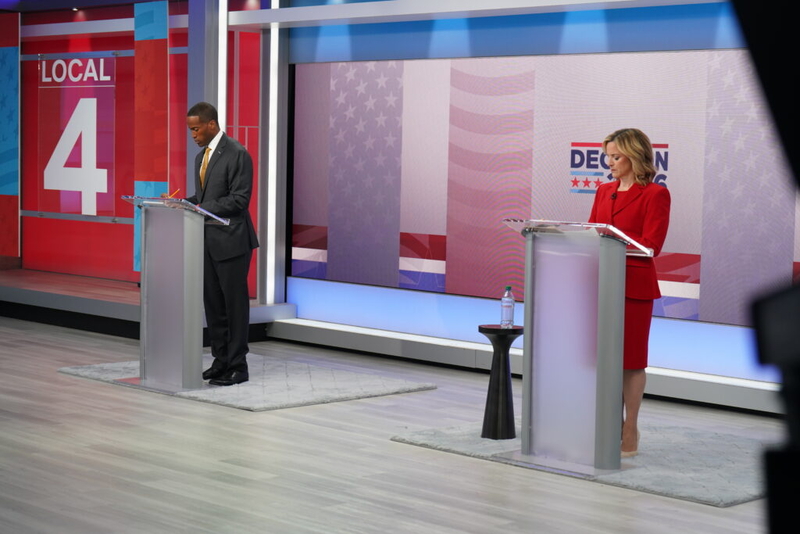
Description
Democratic gubernatorial nominee and Michigan Secretary of State Jocelyn Benson, appears with Republican gubernatorial candidate, U.S. Rep. John James (R-Shelby Township), at a televised debate on Thursday, Oct. 15, 2026, at WDIV-TV, in Detroit, Mich.
Jocelyn Benson and John James could agree on one thing at a Thursday debate hosted by WDIV in Detroit — something needs to change in Michigan. But they disagreed on who was to blame.
James, a U.S. representative from Shelby Township and the Republican nominee, said it’s Gov. Gretchen Whitmer and the last eight years of Democratic executive power in Lansing. Benson, the secretary of state and Democratic nominee, pointed the finger at President Donald Trump and the Republican leadership in Washington.
“Who do you want Michigan’s next governor to work for? I will work for you, not the highest bidder, not Donald Trump,” Benson said in her closing remarks. “He’s done everything Donald Trump asked. Every lie that Donald Trump tells, he repeats. Every bad economic policy Donald Trump promotes, he promotes. I defend our elections. He denies their results.”

James shot back, saying, “My opponent wants you to believe that she hasn’t been in Lansing for the past eight years in power, and has done nothing to change the way you’ve been living for the past eight years. I want you to believe your own eyes. I want you to believe what we can do to increase cost of living and affordability for all of us to make it better. I want you to believe that we can come together and make excellent schools. I want you to believe that we can fix our infrastructure when her party promised to fix the roads that are still not fixed.”
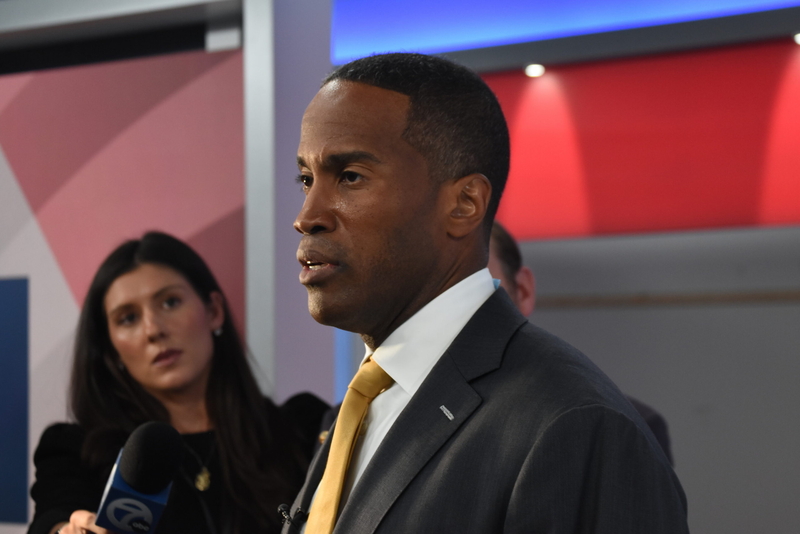
Speaking to reporters after the debate, James also criticized the focus on Trump in midterm races nationwide, calling him “some dude in Washington, D.C., who’s going to be gone in two years.” James was not present at a rally featuring Vice President J.D. Vance earlier in the day.
Benson repeatedly criticized James’ congressional voting record, condemning his votes on legislation that cut SNAP benefits, increase healthcare premiums and continue the war in Iran.
While James disputed each of those attacks from Benson, he did not levy similar ones during the debate on her tenure as secretary of state — though he was widely critical of Democratic leadership in Lansing, he did not actively target any of her specific actions in the Michigan Department of State, focusing instead on the growth of state budget spending and on a lack of transparency in agencies like the Michigan Economic Development Corporation.
He did express skepticism to reporters afterwards about the department’s recommendation not to certify for the ballot a citizens-only voting ballot measure. The measure narrowly failed to meet the required number of valid petition signatures before the bipartisan Board of State Canvassers.
Both candidates centered much of their messaging on affordability and economic growth in Michigan, though their plans to do so differed.
Asked what one state-level change they would each make in order to make life in Michigan more affordable, James responded that energy prices need to go down and blamed clean energy policies for higher energy costs, while Benson focused her response on healthcare costs and blamed federal cuts to programs such as Medicaid coming from Republicans.
Much of Thursday’s debate echoed the first debate of the general election cycle, held Oct. 6 in Grand Rapids — for example, both candidates suggested an openness to suspending the federal and state gas taxes in order to lower prices at the pump.
Tariffs were also a recurring topic of conversation. James highlighted federal legislation that he introduced to use tariff revenues to offset costs on manufacturers, while Benson spotlighted a plan to develop subnational agreements between Canada and Michigan in order to lower tariff impacts.
Each had new responses to each other’s plans, however — Benson said that James “says he has a plan to do something about, but he waited until Congress was out of session to actually do everything he just talked about,” while James questioned the legality of Benson’s plans and called them “basically tantamount to smuggling.”
The U.S. Constitution and federal law grant control over international trade, including tariffs, to the federal government, raising questions about how enforceable Benson’s plan would be.
Benson defended her plan to reporters after the debate, saying, “I hope to be able to work with the federal government to drive down those costs, but I’m also willing to negotiate agreements with our neighbors to the north that are legally enforceable, so that we can find ways to drive down costs and ensure if goods or services are going just between Michigan and Canada or Canada to Michigan, that we’re able to negotiate carve-outs of existing federal policy that can hold up in court and protect our jobs and protect our costs.”
Benson tied together issues of property tax reform and improving educational outcomes, both of which are also central to James’ plans.
“One of the ways we can truly reform property tax in the state, and I agree we need to reduce it, is a better revenue sharing model between the state and our local communities, so that our local communities aren’t forced to find ways to make ends meet without the support of the state,” she said, reiterating her plan to scrap the longtime school funding model in the state budget of a per-pupil allowance. “Replace it, as my plan will, with a weighted, equitable funding model that will meet the unique needs of every school district and every community. That’s how we actually can put districts and local communities in a place where they can reduce the cost of property tax.”
James, on the other hand, focused messaging on lowering property taxes as well as income taxes by cutting spending on the state level, and noted in response to Benson that the per-pupil allowance in the state budget has increased over recent years — though that increase is smaller than it appears or even a decrease in actual year-to-year spending power when inflation is considered.
As in the first debate, attacks on the issue of data centers got personal, with Benson targeting James for owning stocks in companies developing data centers and James targeting Benson for her husband’s employment at the company developing the large-scale data center in Saline.
Both candidates have proposed a moratorium on data center development in Michigan if elected, but when asked what happens when that moratorium ends, the candidates seemed to have differing approaches.
Benson said that, during the moratorium, guardrails on issues like water and energy usage and noise abatement would need to be developed before turning the choice to communities, while James has said that his “moratorium is the locals come before Lansing,” and that he wants to leave decisions up to local control.
Lansing, MI