Trump administration expands vehicle access to Alaska’s Denali National Park
Oct 15, 2026 | 7:22 pm ET
Description
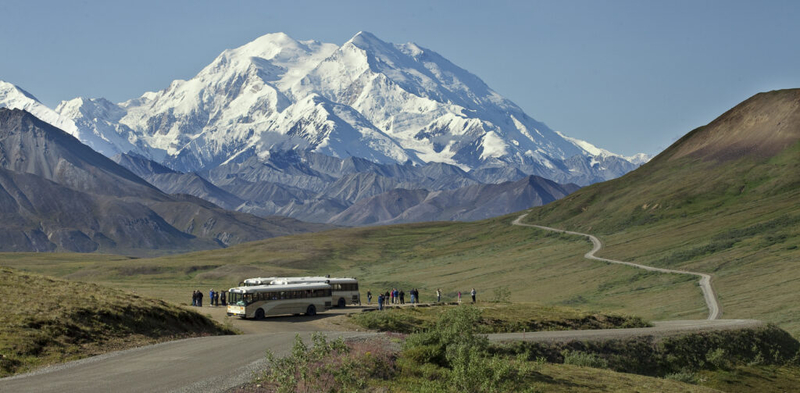
Denali National Park visitors, ferried by shuttle bus, take in a view of Denali, North America's tallest peak, on Aug. 9, 2012. Seen in the background is the sole road that runs through the park. Denali is unusual among U.S. national parks for its strict limits on vehicle traffic. Vehicle use is restricted beyond the first 15 miles of the park's 92-mile road, and most of it is by shuttle bus. A new rule will increase the number of vehicles allowed past the road's first 15 miles. (Photo by Jacob W. Frank/National Park Service)
More buses and cars will be allowed to travel on the sole road through Denali National Park, under a rule announced Thursday by the U.S. Department of the Interior and the National Park Service.
The new rule sets a limit of 160 permitted vehicles a day for the season that runs from the Saturday before Memorial Day to about a week after Labor Day. The current limit for that period is 10,512 vehicles in total, or about 100 a day.
The rule, which was proposed in May and subject to a public comment period, complies with a July 3, 2025, executive order issued by President Donald Trump and titled “Making American Beautiful Again By Improving Our National Parks.”
It includes a directive that the Secretary of Interior “review all of the Department’s recreational access rules and take steps to rescind any that unnecessarily restrict recreation in national parks,” with a special emphasis on restrictions imposed during the Biden administration.
Interior Secretary Doug Burgum, in a statement, said he had done that at Denali, which is one of Alaska’s top tourist destinations.
“America’s national parks belong to the American people, and we should be looking for every responsible opportunity to make these incredible places more accessible,” Burgum said in the statement. “At Denali, we’re cutting red tape, honoring a management plan shaped by years of public input, and expanding access while protecting the extraordinary landscape that makes this park so special.”
He noted that the new vehicle limit builds on the 2012 Denali vehicle management plan.
That plan produced the seasonal 10,512-vehicle limit, but it identified a daily cap of 160 vehicles as the maximum that could be allowed while preserving Denali’s qualities.
Denali is unusual among U.S. national parks because it has just one road running though it and strict limits on vehicle traffic. Most of the vehicle traffic is by shuttle bus. Travel is restricted beyond the road’s first 15 miles; the new rule applies to the portion of the road beyond that point.
The 161 written public comments submitted to the National Park Service by organizations and individuals showed mixed opinions about the new Trump administration rule.
Some commenters, such as the Alaska Travel Industry Association, said the change to a 160-vehicle daily limit would be positive.
“Given the statewide significance of Denali National Park in Alaska’s visitor infrastructure, ATIA appreciates the opportunity to support a policy which would thoughtfully manage and expand visitor access into the park while not compromising high quality visitor experiences,” the association said in its comment letter.
Other comments that favored the change said a daily limit is preferable to a seasonal limit.
But opponents – including the state of Alaska – said the impacts of the 160-vehicle-a-day cap had not been analyzed. Negative impacts could be myriad, the Alaska Department of Natural Resources said its comment letter, dated July 17.
“The State supports the sustainable management of park resources; however, we have concerns regarding the scientific justification for the strict 160-vehicle daily limit, its impact on Alaskan residents, statutory compliance with the Alaska National Interest Lands Conservation Act (ANILCA), and potential economic stagnation resulting from rigid vehicle caps,” the DNR comment letter said. “Given these concerns, the State of Alaska opposes the proposed rule as drafted because it lacks updated scientific justification, is inconsistent with statutory access requirements under ANILCA, and risks unnecessary limitations on inholder rights, subsistence activities, and public access.”
The Denali Citizens Council, a regional wildlife and wilderness advocacy group, said the 160-vehicle daily limit mentioned in the 2012 plan was based on modeling, “not from empirical before-after evidence of wildlife population response.”
Camp Denali, a historic wilderness lodge at the end of the park road, said lighter traffic that resulted from a five-year partial road closure has benefitted wildlife, and those benefits should be analyzed.
The 92-mile road was closed to vehicles at about its midway point in late 2021 after a landslide made it unsafe. The National Park Service has just completed construction of a new bridge allowing vehicles to avoid the continually sliding slope, and the road will reopen fully next year, officials announced last month.
Juneau