Lowndes commission approves $1.15 billion tax break for a data center despite pushback
Oct 15, 2026 | 6:01 am ET
Description
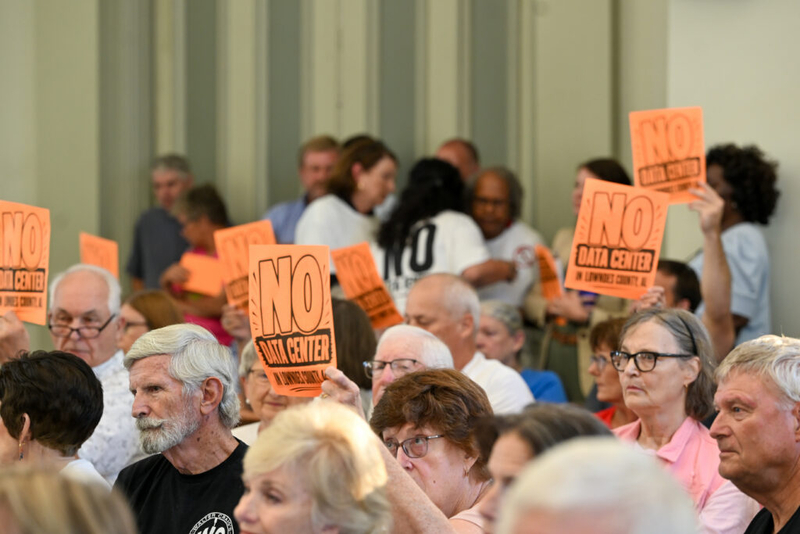
Residents of Lowndes County holding up signs that read "No Data Center" at a County Commission meeting on Aug. 24, 2026, in Hayneville, Alabama, in the Lowndes County Courthouse. The commission approved a project proposal and 20-year, $1.15 billion tax break for Alabama's largest planned data center on Tuesday amid pushback from residents. (Anna Barrett/Alabama Reflector)
The Lowndes County Commission unexpectedly approved a 20-year, $1.15 billion tax break for Alabama’s largest planned data center development Tuesday morning amid concerns and pushback from residents.
The vote came after what residents and environmental advocates describe as a “tense” question-and-answer session with the project’s developers on Friday. They’ve demanded transparency from the developer, Texas-based Cloverleaf Infrastructure, and from the commission but have been unsatisfied with the communication so far.
Commissioners did not respond to multiple messages seeking comment sent Tuesday and Wednesday.
The agenda for Tuesday morning’s meeting said that the commission would consider the adoption of Cloverleaf’s development and tax abatement agreement in a week on Oct. 20. Instead it approved both Tuesday morning.
Ryan Anderson, a staff attorney at the Southern Environmental Law Center, expected the commission to put the vote on its next meeting’s agenda.
“My perspective is that tax revenue is one of, if not the only, benefit that comes to communities from data center development. So we know that there’s not really any job creation associated with data centers, and we know that they place a strain on local infrastructure like power and water and roads,” she said in a phone interview on the way to the meeting.
Lowndes County residents demand transparency in hyperscale data center development
Residents have attended commission meetings to protest the development in recent months, forcing the commission to change locations to accommodate the audience size. Lowndes County District Judge and future neighbor of the data center Adrian Johnson attended Tuesday’s meeting and said in a phone interview that there were only about 40 people there.
“There were probably 150 people here on Friday for the public hearing. This morning there were probably only 40 people here for the regular scheduled county commission meeting because no one anticipated, based on the resolution that was on the table, that there would be any vote on this today,” Johnson said. “It’s continued to be this lack of transparency. None of those agreements were provided to the public.”
Thomas Ellis, chair of the Lowndes County Economic Development Commission, said in a statement that the data center is an “incredible opportunity” for the county.
“Through the revenue generated and jobs created, we’ll be able to support our schools, fund essential services, and improve the quality of life for our residents here,” he said after the tax break was approved.
The data center should bring about 225 permanent jobs, according to the project proposal, and at least 1,000 temporary construction jobs over a three-year period.
Johnson and other residents have asked for months who will run the data center after it’s built. He said they were met mostly with non-answers on Friday.
Dave Berry, co-founder and CEO of Cloverleaf Infrastructure, said in a phone interview Tuesday that transparency is important to him too, but there is only so much he can share, and he can’t share who will operate the data center right now.
He said Cloverleaf is close to finalizing the end user, and construction will not begin until then. Both should happen “soon,” he said.
“We still have some details to finalize, but once we have those details finalized, we’ll absolutely be able to share the identity of the end user. They’ll be involved in the community before we go start construction,” Berry said. “They’re not going to show up and just be a surprise.”
Despite the tax breaks, Berry said the project will generate $124 million in local tax revenue and $25 million in state revenue per year. The abatement — a 50% reduction in the non-educational county taxes that Cloverleaf is responsible for as a business — is about $57.5 million per year.
According to the agreement, Cloverleaf will be relieved from some county sales and use, property and other taxes. Under Alabama law, education taxes are not eligible for tax breaks.
According to the proposal, the project will be Alabama’s largest planned data center, operate 24/7, and it’s requested 1,500 megawatts of energy capacity from Alabama Power — enough to power roughly 1 million homes. The entire state of Alabama has about 2 million households and about 2.4 million housing units.
Its planned location is along U.S. Hwy 80 and Alabama Hwy 21 in unincorporated Lowndes County, which runs along the historic Selma to Montgomery trail.
Data centers emerge as top Alabama election issue as community concerns grow
Lowndes County, like many counties in the Black Belt, has seen a population decrease between 2010 and 2020. But the census tract at the proposed location of Project Red Clay via the U.S. Census Bureau shows that it is the most densely populated part of the county at 21.7 people per square mile. Other tracts in the county are 14.8, 12.3 and 9.7 people per square mile.
“It’s extremely frustrating for those of us who live in the area because we know what the impact is going to be, and it’s going to continue to exacerbate population loss. It’s going to continue to cause people to move outside the county and not drive people into the community,” Johnson said.
Because the location is unincorporated, the county does not have planning and zoning authority like cities do.
Berry said that because of the location of the development, Cloverleaf wanted to ensure that there were more regulations and restrictions for the facility than its other developments. That is why the company agreed to a 55 decibel cap and restrictions on vegetation destruction. The company also agreed to low water usage and to pay for water infrastructure improvements.
“We learn as we go, but we’ve learned a lot about how to do these projects in a way that they’re good neighbors and good citizens,” Berry said.
A spokesperson for Cloverleaf said Wednesday that the company has ongoing developments in Wisconsin and Oklahoma.
Lowndes County has struggled with wastewater issues for decades due to a combination of low population density and a heavy, clay soil that makes many septic tank systems ineffective.
The facilities, which store digital data in servers, are not new to Alabama. There are dozens across the state, according to Data Center Map, a website that tracks the facilities across the country. Berry said that the facilities have gotten more responsible, not less.
“I think good regulation has a place. Infrastructure projects need to build trust, and part of the way you do that is by having some restrictions,” Berry said. “I’m not expecting a pat on the back here, but we actually agreed on some restrictions and guidelines and limitations that legally we didn’t have to because it was the right thing to do.”
Anderson said that the regulations and restrictions that Berry and Cloverleaf have entered into with Project Red Clay are voluntary, and she wants to see a law on the books.
“I think we need some commonsense regulations about how much water they can use, what their wastewater discharges can look like, where they’re sited, and the public notice and opportunity to be heard around those citing decisions,” she said. “Those are all things that I think can and should be taken care of through state legislation.”
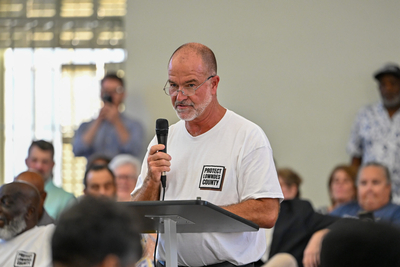
John Urquhart, another Lowndes County resident that neighbors the proposed data center site, said in a phone interview Tuesday afternoon that the commissioners approving these tax breaks “takes your breath away.”
He bought 230 acres of land in the county after retiring a few years ago and said it’s peaceful now.
“I grew up in Montgomery, and you just don’t have all that background noise. I’ve traveled all over the country with work, and it’s just so peaceful,” Urquhart said. “Certainly we didn’t put everything we’ve got into buying that to be parked beside a 3 million-square-foot data center. It certainly wasn’t in our plans for the future.”
Cloverleaf expects construction to begin within the first quarter of 2027, according to the project proposal.
Montgomery