Sand, Lahn debate plans to tackle state budget shortfall while funding schools
Oct 14, 2026 | 10:59 pm ET

Description
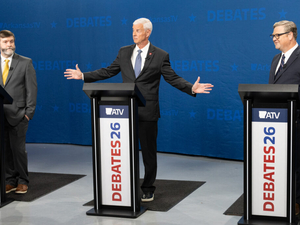
Iowa Auditor Rob Sand, a Democrat, and businessman Zach Lahn, a Republican, are competing to become Iowa governor in the 2026 election. (Photos by Robin Opsahl/Iowa Capital Dispatch, photo illustration via Canva)
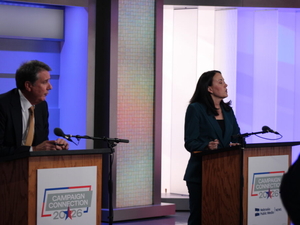
Iowa gubernatorial candidates Rob Sand and Zach Lahn contrasted their proposals Wednesday during a televised debate on how to fund Iowa priorities amid both a state budget deficit and high inflation rate.
The debate, hosted by KTIV-TV4 in Sioux City, was the second time the candidates met on stage as they seek to fill the seat held by Iowa Gov. Kim Reynolds, who is not seeking reelection in 2026.
Lahn and Sand spent less time focused on countering campaign ad attacks than during their first debate with KWQC, held at St. Ambrose University in Davenport, when Lahn, a Republican businessman who owns a farm in Belle Plaine, said his opponent was attacking his family and children by bringing his Iowa residency into question in campaign rhetoric.
At this debate, Lahn and Sand said they respected one another for their work as fathers and as people willing to take on the task of campaigning for Iowa governor. They also spent more time sharing their ideas, concerns and policy proposals on issues like education and taxes if elected.
Sand, a Democrat, repeated a pledge he made in the campaign to provide a 5% State Supplemental Aid rate increase for a K-12 funding in his first year in office. But he also sad he has told supporters and education activists that he “can’t promise that in year two.”
What to know as early voting begins in Iowa for 2026 general election
Sand said he could not make a promise for further increased funding in light of the state’s budget deficit. The Iowa Revenue Estimating Conference said in March that state revenues are expected to decrease by 9.3% from fiscal years 2025 to 2026, a greater drop than previously predicted. Republicans leaders, in control of both chambers in the Iowa Legislature, and Reynolds have said these revenue decreases were expected after changes were made to the state’s income tax system, but predicted that increased revenues through sales and use taxes, as well personal income taxes will offset the deficit in future years.
Sand was skeptical of this view of Iowa Republicans’ tax plan. He said he believed it was vital to provide a 5% increase to K-12 school funding in his first year in office, but being able to invest in the future — and in other programs he supports like “free school lunch,” would require the state to address the budget deficit and find new streams of revenue.
“We have to see where we’re going with the state’s budget,” Sand said. “That deficit, we’ve got to do something to address it. But, we could do that 5% increase, and if we are taking away tax deals for data centers, if we legalize cannabis, treat it like alcohol — the first year will probably see $50 million, but in years after that, we’ll be over $100 million.”
Lahn presented a different opinion on education funding. He said the State Board of Education should be given the ability to create “innovation zones” across the state, which he said would “give teachers and superintendents more opportunity to be able to teach in different ways to meet the needs of more students.”
“If you want to see what’s happening, just look at the rate at which teachers are leaving the profession in year one, two, or three,” Lahn said. “It’s just unacceptable. They want to help the next generation. So through innovative practices, we could actually create school choice within our public schools. We’ll have concurrent models of school that parents can opt into a more innovative method — not an experiment, something that’s been happening across the country for decades, oftentimes. That is an area that we really can focus in to increased funding.”
He also said “cultural issues” present a large problem for school teachers, who he said were being treated as behavioral specialists for some students.
“There’s 95% of their time is largely spent with 5% of the kids,” Lahn said. “And these are kids who, you know, from my own experience, having spent so many hours working with children, these are kids that are crying out for help. They’re looking for somebody to help them, even if they don’t know it. … We need to be the first state in the country to create non-punitive off ramps for these kids, to get them the one-on-one and small group help that they need.”
When the moderator asked if education spending increases must exceed the current national inflation rate of 3.7%, Lahn said the question was “not exactly the best governance question,” because work would need to be done to calculate how best to “bring more innovation into our classrooms.” He also said he did not believe measuring this cost against inflation was an effective way to ensure Iowa students are receiving the best education possible.
He pointed to phonics-based reading programs, a reversal from other reading curricula that taught students to identify and learn words using contextual clues, as an example of a way to improve Iowa schools without needing to put further money in the K-12 system.
“Making those changes really doesn’t cost us a whole lot more money at all to improve our rankings,” Lahn said. “There’s things that we can do that are very cost-effective to improve rankings. This is something I’m most excited about, is to work with our public schools to do that.”
Lahn also has called for fully eliminating the state’s personal income tax — and said he was interested in, over the long term, eliminating property taxes on primary resident, single-family homes. While Lahn has stated he would work to find inefficiencies that could reduce government spending to offset the loss in revenue from the tax, he also said there are other areas where revenue can be generated. He pointed to removing tax breaks for data centers — a proposal Sand also supports — and making more information on government spending publicly accessible online for Iowans to check and find inconsistencies.
“But I have heard people talk about, I think it’s a two-and-a-half cent increase in the sales tax would cover almost the entire burden of single family primary residences in the state,” Lahn said. “That is not my proposal, but it’s one option I’ve heard people float.”
Moderators added some levity into the debate by asking the candidates about personal preferences. Sand told the hosts his favorite flavor of pie was strawberry rhubarb while Lahn’s was Oreo cream pie. Both said pizza was their favorite school lunch.
Sand and Lahn will debate for a third and final time on “Iowa Press” Wednesday, Oct. 21.
Des Moines, IA