What to Know About the New York Governor’s Race
Oct 14, 2026 | 12:00 pm ET
Description
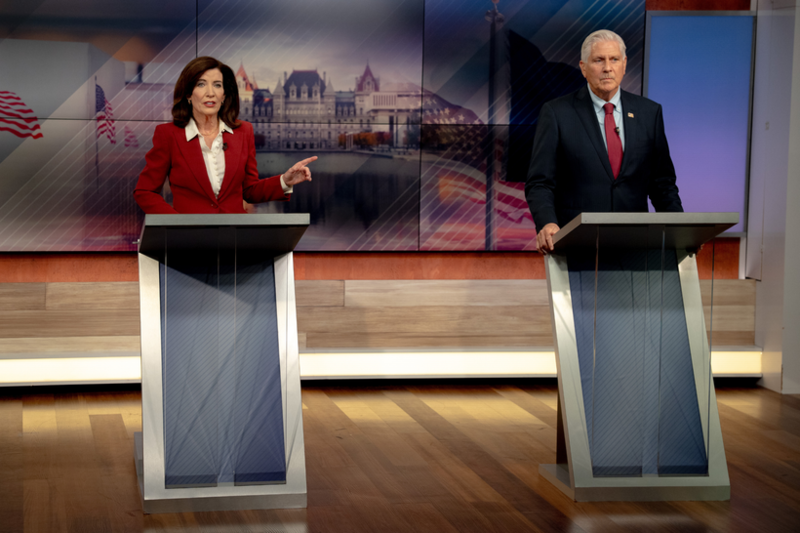
Photo courtesy of New York Focus
Who will run New York for the next four years? Governor Kathy Hochul, the incumbent Democrat, is seeking her second full term against Republican Bruce Blakeman, the Nassau County executive, in what even some Hochul allies consider to be an unexpectedly competitive race.
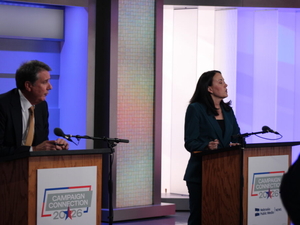
The lone debate between the two candidates on Oct. 13 was emblematic of the race overall: heavy on attacks and ideological differences, with relatively little talk of concrete policy.
Early voting starts Oct. 24 for the Nov. 3 general election. Millions of dollars in ads are currently airing from both candidates’ campaigns and the corporate-backed super PACs supporting each of them. Here’s what else to know about the contest.
What’s the state of the race?
It’s Hochul’s race to lose, as a blue-state Democrat running in what could be a historically bad year for Republicans nationally. She has led in every public poll, though her recent margins have ranged from single digits to 19 points.
Still, allies of the governor say they think the race could be close, pointing to strong anti-incumbent sentiment nationwide. Hochul’s approval rating among voters has been middling for much of her five-year tenure, mostly hovering a few points below 50 percent.
Democrats also have fresh memories of Hochul’s last race in 2022, when she eked out a 6-point win over Republican Lee Zeldin — like Blakeman, a Trump-friendly Republican running in what was otherwise a not-great year for the GOP.
“I expect it to be closer than some of the public polling has suggested,” said Basil Smikle, a political strategist and former executive director of the New York State Democratic Party. “But I think she wins in November.”
Blakeman, aware of his uphill climb, began Tuesday’s debate by encouraging voters to take a chance on him: “What do you have to lose?”
Who’s got the money?
Hochul has out-raised and outspent Blakeman, and the Republican is entering the home stretch of the election with very little cash on hand.
Hochul’s campaign had about $19 million banked through September, compared to a measly $178,000 for Blakeman. Although Blakeman has raised more money at this stage than Zeldin had four years ago, he has spent nearly all of it, according to the latest filings.
Blakeman, unlike Hochul, is participating in the state’s matching funds program, which gives candidates $6 in taxpayer money for every $1 they receive from eligible New York residents. Blakeman has gotten $2.4 million in matching funds, although New York Focus reported that he improperly sought matches for more than 2,600 ineligible donations; it’s not clear whether the state actually matched any of those contributions.
Both candidates have also raised money for state party committees — and taken advantage of what Gothamist dubbed a legal loophole by accepting millions of dollars from those party accounts, which allow donors to skirt campaign contribution limits. Individuals can give up to $138,600 to a party committee in a single year, compared to just $9,000 to a campaign for governor.
The New York State Democratic Party transferred a whopping $10 million to Hochul’s campaign last month, and still had about $11 million left in its main account through September. The Nassau County Republican Committee, meanwhile, gave Blakeman $1.3 million and had about $2.6 million on hand.
Outside super PACs — which can raise and spend unlimited sums of money but can’t coordinate with candidates — are set to spend heavily, especially for Hochul. About a half dozen so-called independent expenditure committees have spent money in support of each candidate, and the groups had spent about $13.2 million as of Oct. 9 — more than double the amount of super PAC spending through the same period in 2022.
Hochul has benefited from the lion’s share of that spending, thanks to support from big players like Uber, the Greater New York Hospital Association, and the New York Apartment Association, a landlord group. The biggest donors to pro-Blakeman committees have included Madison Square Garden owner James Dolan and casino mogul Stephen Wynn.
One big spender is noticeably absent: cosmetics heir Ronald Lauder, who spent about $11 million on pro-Zeldin super PACs four years ago, helping fuel the Republican’s campaign. This year, Lauder has spent nothing on local races.
Kathryn Wylde, a Hochul ally and former president of the Partnership for New York City business group, said wealthy businesspeople see little reason to support Blakeman. Hochul, who has stood firm against raising income taxes despite pressure from progressives, would likely have more leverage over the Democratic state legislature than a Republican governor who would spar with Senate and Assembly leaders, she said.
“Most of them feel that given the state legislature and likelihood of a [Democratic] supermajority there, they’re better off with a Democratic governor that is difficult to override,” Wylde said. “She’s got leverage since they’re all supposed to be on one team.”
Light on policy
The race has not been heavy on policy details. Blakeman spent much of the debate blaming Hochul for the state’s affordability crisis, while Hochul repeatedly tied Blakeman to President Donald Trump.
Blakeman has centered his campaign on a pledge to eliminate income taxes for individuals earning below $50,000 and married couples making under $100,000, as well as an across-the-board 10-percent tax cut for incomes below $250,000.
But Blakeman has offered few specifics on how he would pay for the tax cut, which his campaign estimates would cost $35 billion. Blakeman has been similarly vague about his pledge to cut electric bills “in half” in his first day in office — a promise that experts call unrealistic.
The Republican has blamed Hochul for rising utility bills and nicknamed her “High-Tax Hochul” — although Hochul has passed multiple tax cuts for middle-income filers during her tenure. Blakeman has also focused on tying Hochul to New York City Mayor Zohran Mamdani, whom he has repeatedly labeled a communist and an anti-Semite.
Although Blakeman consistently criticizes Hochul as a free-spending Democrat, some fiscal conservatives have faulted Blakeman for not presenting his own plan to constrain the state’s budget.
“Blakeman has inherited the problem that Albany Republicans created by being unserious about the state’s spending problems,” said Ken Girardin, a fellow at the conservative Manhattan Institute.
Hochul is running on her record — with her first television ads touting her record of tax cuts and the introduction of universal free school meals. She has also emphasized Blakeman’s coziness with Trump, who has an abysmal 29 percent approval rating in New York, according to a September Quinnipiac University poll.
The debate showcased stark differences on immigration policy. Blakeman condemned the Hochul-backed deal that limited state and local cooperation with federal authorities, while Hochul accused Blakeman of condoning recent violence committed by US Immigration and Customs Enforcement agents.
What do voters care about?
New Yorkers rank pocketbook issues far above all other concerns this election. The cost of living was the top issue named by 28 percent of likely voters in the Quinnipiac poll, followed by the economy at 21 percent; no other issue was higher than 11 percent.
Other seemingly hot-button topics are not at the front of most voters’ minds. Nine percent of voters ranked immigration as the top issue; energy costs and AI data centers each garnered 3 percent.
“The only thing is the affordability crisis,” said Josh Gold, senior director of public policy and communications for Uber. The rideshare company is spending $2.5 million to back Hochul through a super PAC after she pushed auto-insurance reforms through the state budget that Uber supported.
Voters’ priorities vary slightly in different parts of the state. Upstate and suburban residents were more likely to point to taxes and health care in the Quinnipiac poll, while slightly more New York City voters chose immigration and affordable housing.
Benjy Sachs contributed reporting.
Albany