Advocates again ask South Dakota governor to endorse summer food program operating in 39 states
Oct 13, 2026 | 1:55 pm ET
Description
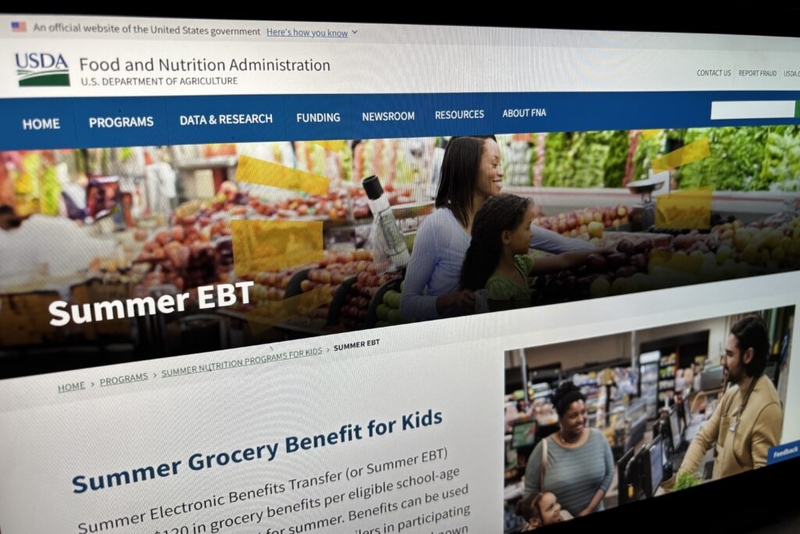
A U.S. Department of Agriculture webpage explains the Summer Electronic Benefits Transfer program, which provides grocery benefits for families with eligible school-age children. (Photo by South Dakota Searchlight)
Thirty-four South Dakota organizations and businesses have asked Gov. Larry Rhoden to support a program that offers debit cards for food to low-income families during the summer months.
The program is federally funded, but is administered by states.
The governor’s deputy secretary of education told South Dakota Searchlight that the administration is “taking another look at the program requirements and associated costs” after years of resistance to accepting the federal money. The costs to set up the program and run it each summer “remain a significant consideration,” Deputy Secretary Laura Scheibe said in a written statement.
The U.S. Department of Agriculture’s Summer Electronic Benefits Transfer program offers $120 per child, at $40 per month across three months, to help eligible families buy groceries during June, July and August. The money can’t be used for prepared food.
South Dakota would be in line for $6.8 million, according to the nonprofit Food Research and Action Center, enough to cover 57,000 kids.
Families could get the per-child stipend if they’re enrolled in the Supplemental Nutrition Assistance Program, Temporary Assistance for Needy Families, if they qualify for free or reduced price school lunches, or are enrolled in Medicaid, the federal health insurance program for people who have low incomes. The money would also be available for families who participate in the Food Distribution on Indian Reservations program, as well as for the families of kids without homes and those living in foster homes.
South Dakota is one of 11 states not offering the program this year. The other non-participating states are Alaska, Florida, Idaho, Indiana, Mississippi, Oklahoma, South Carolina, Tennessee, Texas and Utah, all of which, like South Dakota, have Republican governors.
Iowa had previously opted out, but opted in for summer 2026. Wyoming also took part this year, so every state bordering South Dakota now participates. Tennessee lawmakers voted to fund the program this spring, but families there won’t be able to access it until next summer.
To participate for the summer of 2027, South Dakota would need to signal its intention to do so by Jan. 1.
Groups call on Rhoden to participate
Bread for the World South Dakota is the local chapter of a Washington, D.C.-based Christian nonprofit organization.
The group sent a letter to Rhoden’s office last week asking him to participate in summer EBT next year. Among the 33 other signatories are the Salvation Army of Mitchell, the South Dakota Academy of Nutrition and Dietetics, South Dakota Kids Count, the League of Women Voters South Dakota and the South Dakota Advocacy Network for Women.
Support from governor means state will cover gap in reduced-price school meals
The letter urges Rhoden “to help ensure that every child in South Dakota has consistent access to the nutrition they need to grow, learn, and thrive” during the summer months through summer EBT.
Bread for the World sent a similar letter to former Gov. Kristi Noem in 2023, urging participation for 2024.
A handful of people and organizations reached out to Rhoden about the issue last year, Bread for the World’s Cathy Brechtelsbauer said, but the group wanted a more concerted effort this year, “because it’s ridiculous that we still don’t have it,” Brechtelsbauer said.
“Everybody in South Dakota is paying for it through our federal taxes,” Brechtelsbauer said. “Kids are hungry here, too.”
Federal money pays for on-site meals across South Dakota during the summer, but Brechtelsbauer said those meals feed only 1 in 7 kids who’d be eligible for summer EBT payments.
“Not everyone is able to get to school in the summer,” she said.
The EBT cards onto which the summer benefit payments are transferred can be used at grocers. Franklin Food Market of Sioux Falls and Team Buche Cares, the nonprofit arm of the Buche Foods chain of grocery and convenience stores, each signed the summer EBT letter of support.
State: Setup cost could be great
Earlier this year, Rhoden signed a bill into law covering the family portion of the price for reduced price school meals. His signature on the bill came after previous attempts to pass similar bills failed in earlier legislative sessions.
The federal government pays half of ongoing administrative costs for summer EBT, but Scheibe, Rhoden’s deputy education secretary, said the estimated setup cost in 2024 was between $500,000 and $700,000.
“IT programming and additional staffing would be required,” she said in a Monday email.
The state House of Representatives Education Committee endorsed a bill in 2024 that would have put $150,000 a year toward paying the state’s share of program administration for summer EBT. The Legislature’s budget committee voted the bill down.
Dan Ahlers, the Democrat running against Rhoden for governor in the Nov. 3 general election, said support for summer EBT would be a given if he were elected.
“Honestly, that’s not even a question,” said Ahlers, who supports state-funded school lunches for all South Dakota public school students. “Of course I’d support that.”
The setup and administrative costs associated with the program would be “negligible” compared to the benefit for hungry kids, Ahlers said.
“Even if it’s $150,000” a year to run the program, he said, “that’s nothing.”

Pierre, SD