Social Security, data centers and healthcare: Senate candidates exchange jabs while talking policy
Oct 12, 2026 | 9:30 am ET

Description
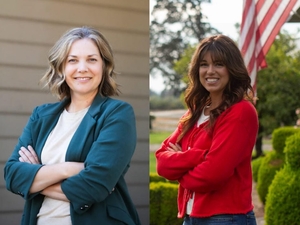
Democrat Annie Andrews, Republican Sen. Darline Graham and Libertarian Kasie Whitener prepare to debate Sunday, Oct. 11, 2026, at South Carolina ETV's studio in Columbia, S.C. (Photo by Katharine Wilson/SC Daily Gazette)
COLUMBIA — The candidates for U.S. Senate traded political digs as they answered policy questions Sunday in their likely only debate ahead of what’s predicted to be a close finish.
The debate featured an all-female stage, a first for a U.S. Senate seat in South Carolina, on the three-month anniversary of the shocking death of Lindsey Graham, which reset the race.
Democrat Annie Andrews, who’s seeking to flip a seat that’s been reliably red for decades, cast herself as “an independent voice” — twice noting she grew up in a Republican home — while saying the three-month incumbent has shown she’s “not up for the job.” Sen. Darline Graham, who was appointed to fulfill her late brother’s fourth term, touted herself as the only conservative in the race, while accusing Andrews of being a “radical liberal” who’s moderated her positions for the contest.
As the main party nominees exchanged barbs, Libertarian Kasie Whitener pointed to her skills as a small business owner and entrepreneurship professor at the University of South Carolina and a willingness to be “honest” about the nation’s fiscal woes.
A fourth candidate on the ballot, Mark Hackett with the Constitution Party, did not meet South Carolina ETV’s eligibility rules for the debate.
Here’s a look at their answers to questions on data centers, healthcare, Social Security and the war with Iran:
Data centers
One of the clearest policy divides during the debate involved data center growth.
Andrews proposes a two-year moratorium. Regulations developed during the pause should ensure data centers pay for themselves so that customers’ rates don’t go up. And she wants a “return to real local control,” she said, then accused “data center Darline” of only wanting to build data centers “faster and faster.”
In response, Graham said she too wants local control of decisions.
She noted co-sponsoring the Ratepayer Protection Act, which directed state regulators to consider standards aimed at protecting communities. The proposal easily cleared the House 417-3 in September but was blocked by Democrats in the Senate, who criticized it as a toothless, pre-election gimmick.
Graham called Andrews’ plan dangerous to national security.
A two-year hold on development means “China is going to be so far ahead. We are going to be in so much trouble,” Graham said. She also characterized Andrews’ proposal as putting the federal government, rather than communities, in charge of data center decisions.
Seeming to echo that argument, Whitener said communities don’t need the federal government’s permission to figure out what’s best for them.
Social Security
Congress must do something over the next six years to avoid an automatic drop-off in Social Security benefits, according to the latest update on the Old Age and Survivors Insurance Trust Fund, the formal name of the program providing benefits to retirees, people with disabilities, and — like the Graham siblings — children of deceased parents. More than 70 million Americans receive Social Security benefits, according to the Social Security Administration.
The 2032 timeline happens to coincide with the six-year Senate term of whoever wins in November.
Asked what needs to be done to keep the program solvent, Andrews said the obvious answer is to raise the cap on wages “so that the very wealthiest among us pay more into the system.”
Under the law’s calculations, which are adjusted annually, workers contribute a maximum of $11,439 of their paycheck this year in Social Security taxes, an amount matched by their employer. That’s because the maximum taxable income is $184,500.
Last year, Lindsey Graham took heat for saying people should work longer in order to collect full Social Security benefits, which has been 67 since the Reagan administration.
Andrews said she would never support raising the retirement age.
Calling Social Security’s collapse an imminent threat, Whitener said the best way to solve the problem is by creating a bipartisan study committee to make recommendations, similar to the Base Realignment and Closure process that decided which military bases to close after the Cold War ended. Young people should be allowed to opt out entirely and invest their own money for retirement, she said.
She also disagreed with Andrews’ proposal to raise the wage cap to increase federal collections, saying that’s only “giving more money to the people who can’t be trusted to spend it.”
Darline Graham, who was 13 when she lost both parents, noted she and brother relied on Social Security to live, as does a 91-year-old aunt.
But she didn’t give any proposal for keeping the system solvent.
Asked about it after the debate, campaign spokesman T.W. Arrighi said Graham doesn’t have a stance on changing the age but is open to discussions, while adding that she wouldn’t vote to impact older Americans.
“No one who’s nearing retirement age will ever be impacted by what Sen. Graham decides to do,” he said.
Healthcare
On stage, Graham used her allotted time on the Social Security question to again accuse Andrews of wanting “government-funded healthcare for all,” saying that would only drive up the nation’s debt and further jeopardize Social Security.
Throughout the debate, Andrews refuted that she supports “Medicare for all,” a term used by progressives including U.S. Sen. Bernie Sanders of Vermont in his unsuccessful bids for president to advocate for a healthcare system fully run by the federal government. On the campaign trail, Andrews has called that single-payer proposal outdated.
The pediatrician, who’s made healthcare central to her campaign, instead proposes allowing people to buy a government-run health insurance plan, in conjunction with expanding Medicaid eligibility and restoring the enhanced federal subsidies that helped people afford private insurance on the federal Obamacare marketplace. Congress allowed those enhancements, created as part of a pandemic relief package, to expire at the end of last year, making private insurance too expensive for many.
Andrews’ plan would let people buy a discounted government plan. She believes the competition would cause private insurers to lower their rates.
“Over time, there will be a domino effect as more and more Americans are happy with their public option,” Andrews told reporters after the debate.
The Democrat also supports reversing the changes to Medicaid under the “One Big Beautiful Bill” passed by Republicans in Congress last year — which, as Graham repeatedly pointed out, Andrews called the “ugly” bill.
Those changes include phasing out a program authorized in 2016 that allowed states to use federal taxes to boost Medicaid reimbursement rates to hospitals. In South Carolina, where the program’s use since 2023 has hiked payments to hospitals by an average of 70%, hospitals stand to lose $150 million annually over 15 years, according to the state hospital association.
Andrews contends that further threatens already struggling rural hospitals. Graham, meanwhile, pointed to the $50 billion over five years the law provided nationwide for rural healthcare. South Carolina was allotted $167 million for the first year of the program.
Andrews also wants to undo changes making Medicaid more expensive in states that expanded coverage to all adults up to 138% of the federal poverty level. South Carolina is among the 10 states that never did. So those required changes don’t apply to the Palmetto State. That includes a requirement that people verify they’re working, volunteering, or attending school at least 80 hours a month, or that they qualify for an exemption, such as caring for a young child.
Andrews accused Graham of supporting the law’s gutting of Medicaid.
In response, Graham said if that’s a reference to the law requiring “able-bodied people to work or train for 20 years a week to receive Medicaid, then yes, count me in. I’m all for it.”
Her ideas for bringing down healthcare costs include “more transparency in pricing to help create competition.” She also noted co-sponsoring a bill allowing small businesses to buy insurance at cheaper rates given to larger companies.
Whitener said healthcare costs keep increasing because of government regulations and scarcity of doctors and providers. Government regulations and billing complexities have created multiple layers of administrators who far outnumber doctors, she said. “They want to address the costs, but what we really have to address is the scarcity problem,” she said.
War with Iran
The nation’s continued war with Iran since February also brought a heated exchange.
Under the 1973 War Powers Resolution, Congress can force the president to end military action it hasn’t authorized.
Resolutions to do so have failed repeatedly in the Senate.
Andrews, who opposes the war, noted Graham was among the “no” votes three times. The Democrat also used the chance to bring up Graham’s flub to a question about Taiwan during the pre-GOP runoff debate in August.
In her only other debate Graham admitted she wasn’t informed on the issue: “I’m not a polished politician. National security is not my thing, not my area of expertise,” she said.
Andrews pointed to that answer to accuse Graham of being unserious and unqualified: “If your surgeon said that appendectomies aren’t really his thing, would you still hand him a scalpel? No. So why would we hand Darlene Graham a full term in the U.S. Senate?” Andrews said.
She said money spent on war would have been better invested in healthcare, infrastructure and public education. “The war is the exact reason we now have record-high gas and diesel prices,” Andrews said.
Graham said she wants the war to end but not by Congress while Iran is “still dangerous,” saying she believes victory against a weakened Iran is close. She touted her role in last month’s passage of sanctions against Russia as negotiated and championed by her brother.
Whitener said she opposes preemptive wars and aggression toward other countries. She said that national security should be maintained through diplomacy, free trade and cultural exchange.
Names
While answering a question on U.S. policy towards Israel, Graham said Andrews would not stand up to the “socialist Democratic party.”
In response, Andrews reminded viewers she predicted in her opening statement that Graham would call her a socialist.
“But the truth is, my name is Annie Andrews, and there shouldn’t be any confusion about that because, unlike my opponent, I haven’t changed my name recently,” she said, adding that she would stand up to members of her party.
Graham has sometimes used the last name of her husband, Larry Nordone. Campaign fliers supporting Lindsey Graham ahead of the June primary referred to her as Darline Graham Nordone, prompting accusations from critics on the right and left that she switched her name to run for office.
But Graham has consistently said her legal name is Darline Graham.
She said she used Nordone on a social media account so the “volleyball moms would recognize me,” but Graham has always been what she signs on all legal documents.
“Just so that you and everyone else knows,” she said. “It has always been Graham, and — you know why it’s Graham? — because I lost my parents when I was a little girl, and I kept the name Graham so that I felt connected to them.”
It’s highly unlikely there will be another U.S. Senate debate.
Saying voters need to hear more about their differences, Andrews asked Graham twice to commit to at least two more debates before Nov. 3.
Graham she’d rather use her time meeting with voters than standing on a debate stage.

Columbia