How Homeland Security infiltrated anti-ICE organizations during Operation Metro Surge
Oct 12, 2026 | 7:00 am ET
Description
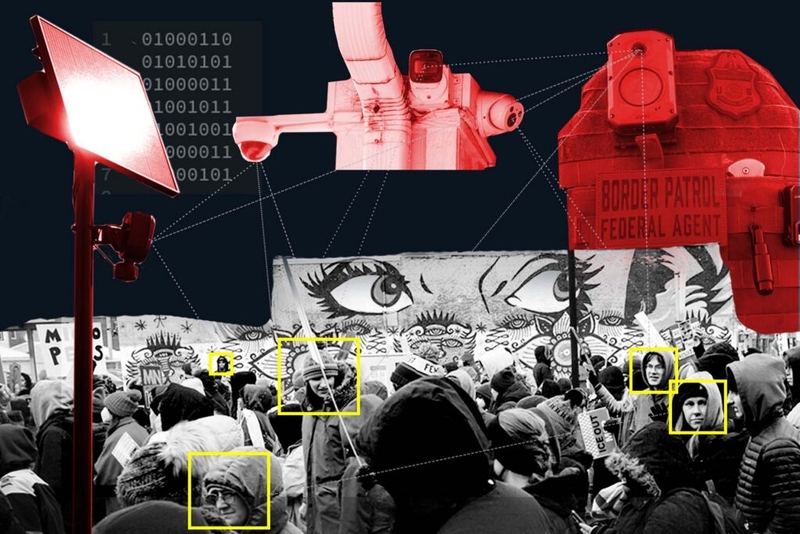
(Photos and illustration by Nicole Neri/Minnesota Reformer)
The Signal username “peanutbutterjelly” blended in among the silly monikers used by fellow members of Minneapolis chats dedicated to protesting immigration agents during the government’s aggressive winter deportation campaign. She attended an “upstander” training and anti-Immigration and Customs Enforcement planning meetings and regularly messaged with others doing the same.
“…v interested in the financial organizing piece (I like numbers and data) & marrying that together with propaganda so would love to work on both sides of these groups!!” she messaged a group of activists in a chat called “art/money/comms club.”
But peanutbutterjelly wasn’t interested in advancing the group’s aims. She was actually undercover agent 9843, a Department of Homeland Security officer ingratiating herself into the world of anti-ICE activists, looking for evidence of crimes.
Agent 9843 was just one arm of the broad surveillance campaign launched by the federal government during Operation Metro Surge, focused on “identifying and disrupting sophisticated, organized campaigns supporting and engaging in” violence, destruction of property, intimidation of federal officers and employees, and attempts to impede federal operations, according to a synopsis of the case in internal Department of Homeland Security documents, which are now part of court records in the case of 15 Minnesotans charged with conspiracy to harm or impede federal agents.
The documents highlight the vast surveillance dragnet the federal government created alongside the immigration crackdown. Which means even as immigrants were being rounded up and deported and people of color routinely racially profiled, the thousands of Minnesotans who sought to help them face consequences of their own — they’ve been swept into a burgeoning surveillance state.
Whether any of the surveillance was illegal could determine the outcomes for dozens of Minnesotans facing criminal charges for their anti-ICE protests — the Minnesota 15 and the Cities Church protesters, all of whom have pleaded not guilty.
“ICE is committed to protecting the public’s constitutional rights, including the rights to free speech and peaceful assembly, while carrying out its law enforcement mission,” a Homeland Security spokesperson said in response to emailed questions from the Reformer.
Undercover agents’ attendance at publicly-advertised meetings, or in large group chats, is legal — people in those settings have no expectation of privacy, said Jessica West, director of the First Amendment Activism clinic at the Mitchell Hamline School of Law. Private companies, including telecommunications firms and financial institutions, generally share users’ information with the government upon request, given that most terms and conditions agreements allow for such sharing, West said.
But, if agents were to search protesters’ phones without a warrant, using some of the spyware tools immigration agents have access to — that would be illegal, and the evidence not admissible in court. No evidence has emerged in court to suggest that agents used such tools to spy on defendants. They did use technology to record messages in Signal chats that agents joined on their undercover phones, according to court documents.
It’s lawful under certain circumstances for the police to make arrests, to use crowd control weapons, to charge people with crimes, to seek information, to go to people’s houses and knock on their doors and ask questions, said Kevin Riach, an attorney for one of the 15 Minnesotans charged with conspiracy to harm or impede federal agents.
“But if the purpose is to chill someone’s First Amendment speech, to prevent them from exercising their First Amendment rights — then it becomes illegal,” Riach said.
West, the First Amendment lawyer, said the extent of federal surveillance during Operation Metro Surge is indicative of the failure of privacy laws to keep up with new technologies.
“It just hasn’t developed in a way that reflects and is responsive to true needs for protection around surveillance,” West said.
ICE used customs law to request personal data
Federal law grants ICE the power to issue summonses for the purposes of “ascertaining the correctness of any entry” and determining what customs fees, taxes or fines may be due upon entry to the country — for example, the summons can be used to investigate whether an importer paid the appropriate fees on their merchandise.
During Operation Metro Surge, however, Homeland Security used this customs law to gather vast amounts of information on unions, left-wing organizations and journalists.
ICE agents used the customs law to send summonses to FedWire, a money transfer service run by the Federal Reserve, for financial records of Service Employees International Union, Communication Workers of America, Sunrise Movement, the International Federation of Professional and Technical Engineers.
They sent similar summonses to PayPal and Venmo to get the addresses, phone numbers and transactions for the people associated with Voices for Racial Justice, whose website — as described in agents’ reports — “boasts several articles on ‘ICE OUT’ and or ‘Truth, Freedom and ICE out of MN.’”
In the case of the 39 people charged with disrupting a January service at Cities Church, where a senior ICE official serves as a pastor, Homeland Security issued 92 such summonses. Three journalists were among the people charged.
The government sought and received call and text records for defendants, including independent journalist Georgia Fort. They sent summonses for flight and rental car records and information associated with social media accounts, according to court documents.
And, on March 5, agents sent a customs summons to REI, the outdoor brand, seeking transaction information for everyone who purchased a particular beanie in the Twin Cities area since January 2024, according to a motion filed by defense attorneys in the Cities Church case, which in its title calls the use of the customs summons “outrageous.”
Attorneys in both the Minnesota 15 and Cities Church cases are arguing that the federal law does not grant the feds the power to use its summonses to investigate crimes unrelated to customs enforcement.
The government argued in court filings that there is “nothing unusual about the summonses.”
“It is a tool in the (Homelands Security Investigations) investigatory toolbox that is regularly used to obtain third-party information in which defendants do not have a Fourth Amendment privacy interest,” prosecutors wrote in a filing in the Cities Church case.
The validity of such summons to investigate crimes unrelated to customs duties has come under question before.
In 2017, during the first Trump administration, U.S. Customs and Border Protection issued a summons to Twitter for the personal information of the user behind @ALT_USCIS, an anonymous account criticizing the president’s immigration policy. Twitter refused to provide the information and sued the federal government, but before the case could be decided by a judge, CBP rescinded its request and Twitter dropped the lawsuit.
An internal Homeland Security watchdog investigated the incident and found that the agency improperly used the summons and repeatedly violated department policy. Homeland Security leadership agreed with the findings, and promised to take corrective action.
But a 2023 Wired investigation found that the Department of Homeland Security issued more than 170,000 summonses from 2016 through mid-August 2022 — including to an abortion provider, an elementary school and journalists.
Tracking cars
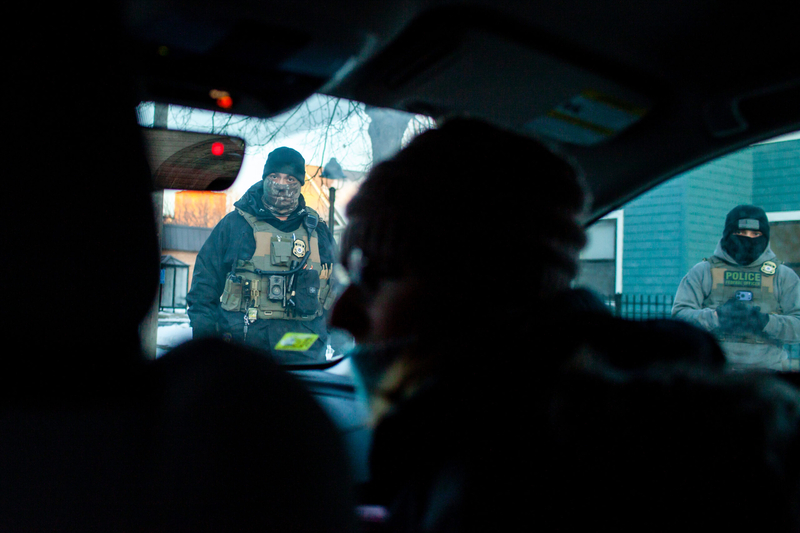
During Operation Metro Surge, neighbors coordinated with one another to track ICE activity in their neighborhoods. Some patrolled in cars, following suspected ICE vehicles through cities and suburbs, reporting their locations and distracting the agents from their mission.
Patrollers noted that the federal agents seemed to be photographing their license plates, and in some cases, their faces. In January, one patroller told the Reformer, “if my plate wasn’t in their database, it is now,” after agents boxed in her car and warned her to stop following them.
Court documents provide some clues as to how that information may have been used.
Agent 9843 — peanutbutterjelly — participated in a February meeting of anti-ICE activists at Prince of Peace Lutheran Church in Roseville, while other agents scanned the license plates in the parking lot outside to add to their database.
Agents then used the license plate photos to obtain the names of the attendees, search social media for pictures, and compile an “intel workup” that included addresses, family and employment information and vehicle registration information, according to a filing by Riach in the Minnesota 15 case.
Agents also ran photographs of protesters through Clearview AI — a facial recognition software — to compile photo dossiers of activists and protesters, including many who were not charged. In at least one case, the software misidentified the person in the photograph, linking him to an unrelated person.
“Our use of Clearview AI and other facial recognition technology is governed by applicable DHS and ICE policy, privacy compliance documentation, rules of behavior, and required training,” the Department of Homeland Security said in its emailed statement.
The Star Tribune reported in July that around 30 state, county and federal agencies across the country searched Flock camera data in at least eight Twin Cities suburbs for immigration enforcement between November and March, including the Mille Lacs County Sheriff’s Office, which collaborates with ICE.
The Department of Homeland Security told the Star Tribune that it doesn’t have a contract with Flock, and did not answer a follow-up question about whether it relied on local law enforcement agencies to access the data on their behalf.
The surveilled
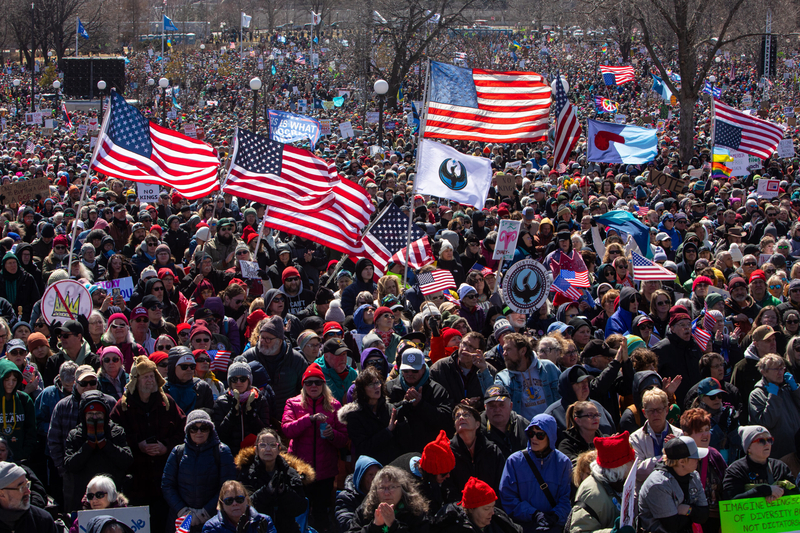
On Feb. 2, Drew Harmon arrived at the Augsburg Park Library in Richfield to lead the monthly gathering of members of Minnesota 50501, the state chapter of the anti-Trump group that organized the massive “Hands Off” and “No Kings” protests nationwide.
The meeting and those like it, Harmon told the Reformer in a recent interview, are “for anyone in the public who’s interested in what we’re doing and who wants to get involved, or for anyone who’s already involved who has questions for the leadership of the organization.”
During the February meeting, he gave an overview of 50501 and the Minnesota chapter, which in those days was focused on getting ICE out of Minnesota. Then, Nick Benson, who tracks deportation flights out of the Minneapolis-St. Paul International Airport, provided an update on his work and urged attendees to pressure Delta for more information on its facilitation of deportations.
Later in the meeting, participants discussed the possibility of ICE agents infiltrating their organization.
An attorney warned attendees not to put anything in writing that they wouldn’t want to be seen in court.
“We may be thinking we want all ICE agents to die, but don’t put those statements in writing,” the attorney said, according to notes from an undercover agent who was sitting in the audience.
“People would say stuff like that, and I’d roll my eyes and be like, you know, they’re listening to everything we do,” Harmon said. “There was already some evidence at this point that we were being infiltrated, because we saw their cars everywhere.”
And, on Jan. 17, the day right-wing provocateur Jake Lang held a sparsely-attended anti-Islam rally in downtown Minneapolis, video emerged that appeared to show federal agents picking up a man off the street, who many viewers assumed was an undercover agent. (The Reformer has been unable to verify who the man was and whether he was a government agent.)
The assumption that undercover agents were in meetings and group chats was ubiquitous among participants, leading to extensive debate over the “operational security” or “op-sec” measures necessary to protect the groups’ activities. One measure that most agreed on was using nicknames in Signal chats.
Harmon, like many members of the Minnesota 15, pointed out that the use of government resources to surveil left-wing groups coincided with the Department of Justice’s refusal to investigate the killings of two Americans and other abuses by federal agents.
Gabriel Van De Water, an artist and community organizer who is among the Minnesota 15, said at an August press conference that the killers of Renee Good and Alex Pretti, “have been hidden away and protected, while DHS turns its attention towards spying on union members, civil rights organizations, churches and individuals who stood up for their community in whatever ways they were able.”
Riach, the defense attorney, is trying to force the government to turn over more records related to spying — even on organizations and individuals who are not implicated in the case.
If he’s successful in convincing the judge that those records are relevant to the defense of his client, the public may soon learn more about the surveillance campaign.

Saint Paul, MN