Pennsylvania’s GOP members of Congress are failing us on measles.
Oct 12, 2026 | 2:48 am ET
Description
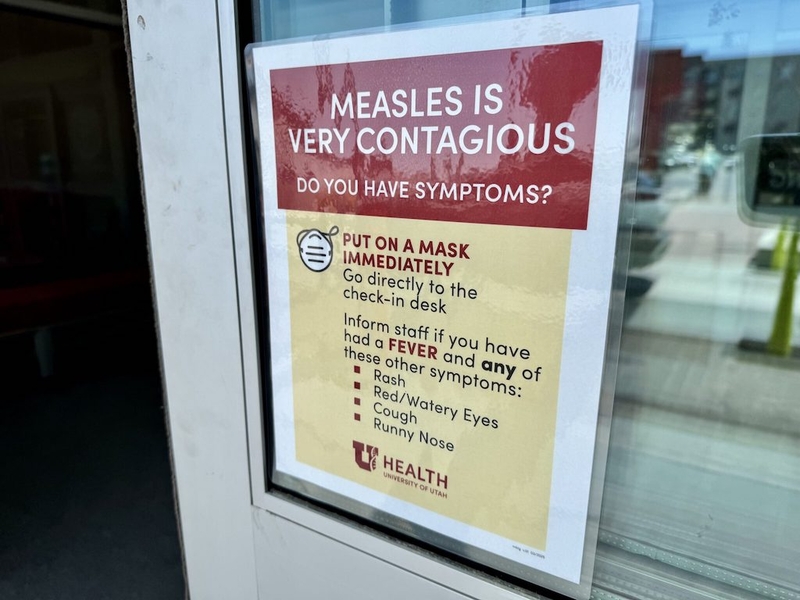
A sign at a University of Utah health clinic warns visitors about the spread of measles. Under the Trump administration, federal health officials have cut back the number of recommended vaccines, and more states are offering exemptions for parents who don't want to vaccinate children entering public schools. (Photo by McKenzie Romero/Utah News Dispatch)
Tragically, more than 1,000 people in Pennsylvania have been infected with measles in 2026, now associated with 198 hospitalizations and five deaths. In neighboring New York, Gov. Kathy Hochul just declared a statewide health emergency as cases surge in rural counties.
Yet of Pennsylvania’s 1,078 cases in 41 counties (as of last Thursday), less than one percent occurred in fully vaccinated individuals even though measles is largely preventable with the (MMR) vaccine, the single best protection against measles.
Much has been made about how Secretary of Health and Human Services Robert F. Kennedy, Jr. has actively dismantled vaccine infrastructure and spread false information about vaccines, contributing to the highest number of measles cases in 35 years.
However, Congress has also played a significant role in weakening the public health infrastructure needed to prevent and contain outbreaks, threatening an increase in serious, preventable diseases like measles.
Last summer, Pennsylvania U.S. Representatives John Joyce, Mike Kelly, Dan Meuser, Scott Perry, Guy Reschenthaler, Glenn Thompson, Lloyd Smucker, Rob Bresnahan, and Ryan Mackenzie, along with U.S. Senator Dave McCormick — every Pennsylvania Republican in Congress except Brian Fitzpatrick — voted for the One Big Beautiful Bill Act (OBBBA). The OBBBA is causing millions of Americans to lose health care coverage while giving tax breaks to the wealthiest.
By cutting funding and imposing systemic barriers, this legislation makes healthcare harder to afford and access, including vaccines.
People with health insurance are much more likely to receive recommended vaccinations than uninsured individuals. In one study, adults with private or public insurance were two to three times more likely to be vaccinated against influenza, pneumococcal, shingles, and HPV compared to those without insurance.
And we know when parents are uninsured, their children are less likely to visit the doctor, including for well-child visits where vaccinations are routinely provided.
The Affordable Care Act (ACA) requires all insurance plans — including Medicare, Medicaid, and private health insurers — to cover certain recommended vaccines at no out-of-pocket cost. Additionally, the Vaccines for Children Program provides recommended vaccines free of charge to low-income children. For those who lack health insurance, however, a two-dose series of the MMR vaccine costs between $180 and $250 on average.
By the end of June, more than 55,000 Pennsylvanians had lost Medicaid or CHIP coverage. By September, more than 200,000 Pennsylvanians had disenrolled from Pennie, the state’s ACA marketplace, following the expiration of premium tax credits. Some reported dropping coverage as costs rose just to be able to keep paying for food, rent, and utilities. People who lost their health insurance are now forced to pay out-of-pocket for vaccines; if they can’t, they risk facing serious illness and massive, uncovered expenses for measles treatment.
Real leaders prioritize dependable, affordable healthcare for all individuals and families, without forcing them to compromise their family budgets. They invest in hospitals and clinics so that all constituents can access care, regardless of insurance type. And they protect public health by creating conditions where people can stay healthy and thrive.
For highly contagious and possibly life-threatening diseases like measles, vaccination protects more than just the individual; it shields entire communities. In the case of measles, achieving “herd immunity” requires a 95% vaccination rate, which reduces spread and protects vulnerable people who cannot be vaccinated or have compromised immune systems, like cancer patients. Supporting evidence-based recommendations and reducing barriers to vaccination are vital steps to stopping the transmission of preventable diseases.
Pennsylvania Republicans’ votes for the OBBBA have contributed to making Pennsylvanians more vulnerable to measles as well as future preventable outbreaks. No one should have to endure the pain of losing a family member to a preventable illness simply because they can’t afford care or because they were fed false information about vaccines by the federal government.

Harrisburg, PA