Prediction markets ‘undermine’ Oklahoma tribal gaming compacts, association says
Oct 09, 2026 | 3:36 pm ET
Description
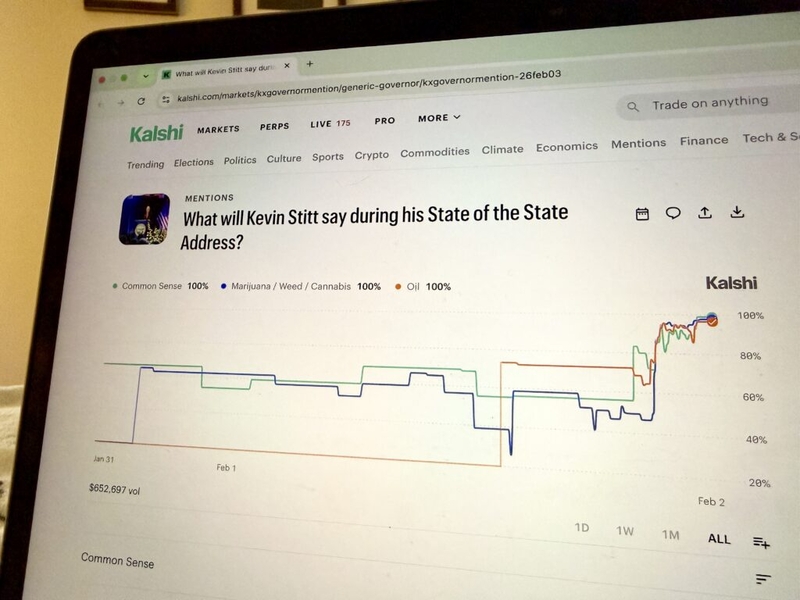
A Kalshi prediction market is pictured that allowed people to wager on what Oklahoma Gov. Kevin Stitt would mention during his 2026 State of the State speech. (Photo by Emma Murphy/Oklahoma Voice)
OKLAHOMA CITY — Prediction markets are infringing on the gaming exclusivity rights and revenue of Oklahoma’s tribal nations, a state gaming association said.
Matthew Morgan, chair of the Oklahoma Indian Gaming Association, said prediction markets, which allow people to trade on the outcomes of virtually anything, are undermining the state’s existing gaming compacts. Conversations, meanwhile, have stalled in the state Legislature over legalizing sports betting and how tribal exclusivity should fit into that.
“We view sports prediction market apps as undermining the Indian Gaming Regulatory Act and Oklahoma/Tribal State compacts by allowing illegal Class III gaming to infringe upon the sovereignty of Tribal nations, and as undermining revenue streams that are critical to Tribal government programs and services,” he said of the association’s 25 member tribes.
In exchange for having the exclusive right to offer gaming, Oklahoma tribes that have entered into compacts with the state pay a monthly fee to operate some electronic and table, which are classified as Class III, games. In the 2025 budget year, those fees generated over $221 million in revenue.
A growing number of states though have said the prediction market industry is skirting existing sports gambling regulations. The prediction market companies, such as Kalshi and Polymarket, have spent millions of dollars lobbying at the federal and state levels this year.
The platforms allow people to wager on the outcomes of anything, including the outcomes of sports games and Oklahoma elections, the weather, pop culture and even what Gov. Kevin Stitt would say in his final State of the State address.
Morgan said that while the association is aware that a few of the 575 federally recognized tribes across the nation have signed contracts to offer Kalshi-backed sports prediction markets, none are member tribes of the Oklahoma Indian Gaming Association.
Sen. Bill Coleman, R-Ponca City, said Friday that while he hasn’t spoken to tribal nations about this issue, he has had conversations with Kalshi to discuss what other state shares of their transaction fees look like.
“If traditional sports betting comes around in the state of Oklahoma and Kalshi and Polymarket still exist, it’ll be competitive and right now the prediction markets have the competitive edge because they’re active and the tribes aren’t,” he said.
Coleman has spent years in the Legislature working to find a consensus to legalize sports betting in Oklahoma. But he said he’s not yet sure what regulation of prediction markets could look like in Oklahoma.
“I think we’re just gonna have to wait and see this go through the court system and see what the Supreme Court’s final ruling would be,” Coleman said. “Whether or not the predictions markets can continue as they are, or will they need to be changed or regulated or just made illegal.”
Coleman said he’s concerned about young people being able to use prediction markets before they’re 21 years old.
But because prediction markets seem to be a federal issue, not many state lawmakers have expressed interest in regulating them, he said.
“I don’t know what we as a state can do to legislate the prediction markets,” Coleman said.
Tarek Mansour, CEO of Kalshi, in September wrote in an open letter that tribal gaming has generated record revenue alongside the growth of prediction markets.
“The reason is that these are fundamentally different products serving different kinds of economic activity,” he wrote. “Tribal gaming is a destination and hospitality experience. Prediction markets are digital financial exchanges where participants trade positions on future events. One does not need to displace the other.”
Among the tribal groups that have launched Kalshi-backed prediction markets are the Tunica-Biloxi Tribe of Louisiana, the Alabama-Quassarte Tribal Town based in Wetumka, Oklahoma, the Greenville Rancheria in California, the economic development arm of the federally recognized Kletsel Dehe Wintun Nation in California and the Alturas Indian Rancheria in California, according to a Kalshi news release.
Jacki McGavick, a Kalshi spokesperson, said prediction markets fall under exclusive federal jurisdiction and Kalshi is always willing to “engage constructively” with lawmakers.
Oklahoma City, OK