Supreme Court denies request to extend deadline for skill games
Oct 09, 2026 | 3:06 pm ET
Description
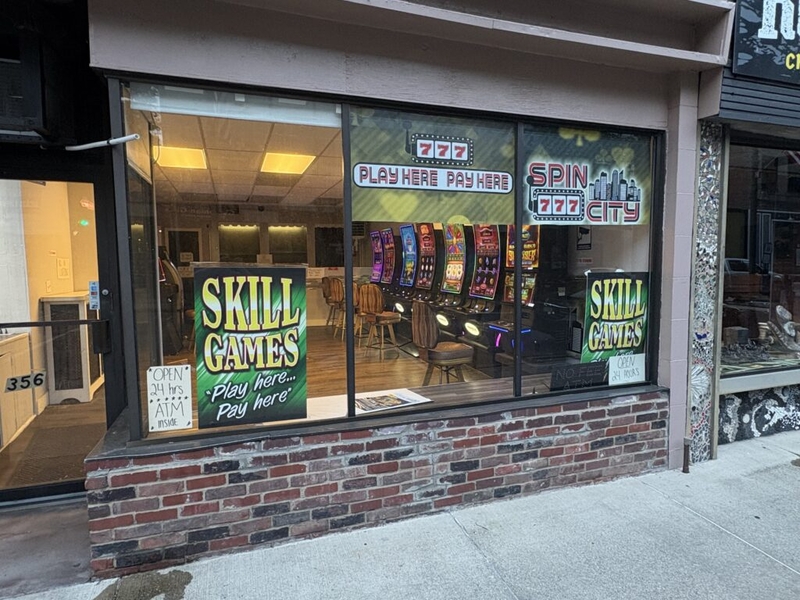
A skill games parlor in Williamsport, Pa. (Photo by Peter Hall/Capital-Star)
(This article was updated at 3:30 p.m., Friday, Oct. 9, 2026, to include the Supreme Court’s decision.)
The state Supreme Court on Friday denied requests to extend the deadline Tuesday to remove skill games from establishments across the commonwealth.
In a pair of one-page orders, the court denied petitions asking the court to allow the slot machine-like games to remain in operation until Feb. 10 while state lawmakers work to pass a regulatory and taxing scheme for the industry.
The decisions followed Attorney General Dave Sunday’s office asking the court to reject a request from a trio of state lawmakers who want to delay enforcement of the court’s decision that the machines are subject to the state Gaming Act and Crimes Code.
In a letter to the court late Thursday, Chief Deputy Attorney General Susan E. Affronti noted the request from three state lawmakers came only two business days before the deadline after which the slot machine-like games will become illegal.
That deadline is the result of a 120-day stay the Supreme Court placed on its June 15 decision that resolved more than a decade of ambiguity over the machines, which the state argued are functionally equivalent to casino slot machines. As a result, the machines and operators must be licensed by the state Gaming Control Board.
“Because this petition comes too late, because these three legislators lack standing to obtain the relief they seek, and because the equities weigh against them, the Court should deny the King’s Bench petition,” Affronti wrote.
As the state’s high court, the Supreme Court may use its extraordinary King’s Bench power – derived from English courts – to take immediate, direct control of a case or legal issue in a crisis.
State Sens. Gene Yaw (R-Lycoming) and Anthony Williams (D-Philadelphia) and Rep. Jonathan Fritz (R-Wayne) filed, withdrew and refiled a petition this week asking the Supreme Court to use its emergency powers to extend the Wednesday deadline so the Pennsylvania General Assembly can pass legislation legalizing skill games. One of the companies involved in the manufacturing of skill games is in Yaw’s district.
Friday’s orders denied the lawmakers’ request and one made by 20 charitable organizations that host skill games.
In its June decision, the high court said it’s up to the General Assembly to determine whether the machines should be legal. It stayed the effect of its decision to give the legislature time to act and avoid the upheaval an immediate ban would cause.
Pace-O-Matic (POM), which produces the software at the heart of the machines, and a group called the Skill Games Business Consortium have also made filings in support of extending the stay.
Skill games are commonly found in small businesses such as taverns, restaurants, convenience stores and fraternal organizations such as Veterans of Foreign Wars posts and volunteer fire companies. Proprietors of those establishments say banning skill games will take away revenue that keeps them financially afloat.
The attorney general’s office argued the Georgia-based company should have requested a reargument before the court if it believed the four-month stay was too short.
Affronti noted that the lawmakers did not explain why they waited to ask for an extension. The General Assembly has known since the court agreed to hear the case in June 2024 that it might result in a ruling declaring the machines illegal.
She also argued that lawmakers lack standing to request that the court reopen its ruling. The Supreme Court has ruled previously that individual lawmakers have standing only when their ability to participate in the voting process is impaired or they’re deprived of their official powers as legislators.
“While petitioners wish to propose legislation, there is no allegation, or any other reason to believe, that failing to extend the stay will block their ‘ability to participate’ once the ruling takes effect,” the letter said.
Skill games have been the subject of several court rulings as they proliferated across the commonwealth in the last decade. The Supreme Court’s ruling overturned a lower Commonwealth Court precedent that the machines were distinct from gambling devices.
POM and the Lycoming County business that produces the Pennsylvania Skill machines that run the software, Miele Manufacturing, argued in the Supreme Court that skill games differ from gambling machines because skill game players have an opportunity to win back their bets.
The attorney general’s office said, in practice, few players bother to go through the lengthy, laborious process of completing the skill portion of the game. Most simply make another bet in hopes of winning a jackpot.
Harrisburg, PA