Dan Ahlers: Democrat seeking South Dakota’s top office says he knows how to win uphill battles
Oct 09, 2026 | 11:09 am ET
Description
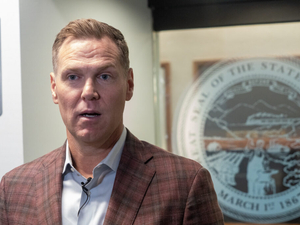
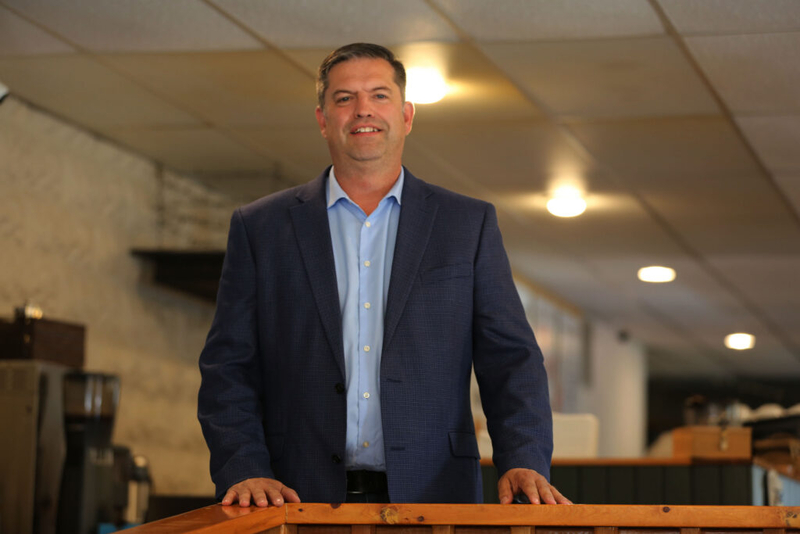
Dan Ahlers, a Democrat running for governor of South Dakota, stands in a building he owns that houses a coffee shop in Dell Rapids, South Dakota. (Photo by Meghan O'Brien/South Dakota Searchlight)
Listen to an audio version of this story produced by reporter Meghan O’Brien. Broadcasters: See below for a downloadable version with a host intro script.
DELL RAPIDS — In a coffee shop on his hometown’s main thoroughfare, Dan Ahlers thinks back on his first run for elected office 20 years ago.
There was a different Democrat running who needed to drop out, local party leaders said, and they wanted Ahlers as a replacement.
“‘Don’t worry, it won’t be a big deal. You won’t win anyways,’” Ahlers recalled them saying. “But I took that as a challenge, and I won.”
As a 32-year-old Democrat in a district where Democrats were outnumbered by Republicans, Ahlers was elected to one of the district’s two House seats. He went on to win election to the Legislature two more times and served a total of six years.
Larry Rhoden: Rancher, welder and three-decade politician makes his case to earn SD’s trust
By the time of his first campaign, Ahlers said, he was accustomed to exceeding expectations. He ran long distance track at Augustana University, after the team’s head coach told him he wouldn’t make the team.
“My sophomore fall semester, I took a PE class, and he saw me running, and he called me over,” Ahlers said. The coach asked why Ahlers wasn’t out for track, to which Ahlers responded, “‘Because you said I was too big.’ He said, ‘Be at practice at 4.’”
After graduating with a degree in government and international relations, Ahlers couldn’t find many South Dakota jobs that fit what he’d studied, but he wanted to stay close to home.
He decided to open a VHS video rental store in Dell Rapids, where he remembers a loan officer telling him the business wouldn’t last.
“And I remember the day that he signed up as a customer in my third store,” Ahlers said. “Not too bad for something that wasn’t going to work.”
Now Ahlers, 52, is running for governor — an office Democrats in the state haven’t held for 47 years, since 1979 — against Republican Gov. Larry Rhoden.
Ahlers faces an uphill battle running against a sitting governor in a state where Republicans outnumber Democrats. He said that doesn’t bother him.
“Whether it was business or running for the Legislature, over and over, I’ve been told that things are not possible,” Ahlers said.
Roots in local business, community
Ahlers opened his first video rental store in 1999 in Dell Rapids, a town of about 4,000 people located 20 miles north of Sioux Falls in eastern South Dakota.
He eventually added stores in Hartford and Tea, which he later sold. Ahlers maintained his Dell Rapids store until 2019 but closed it as it became increasingly difficult to get DVDs from studios.
Less than a decade after getting his video rental business off the ground, Ahlers purchased a building in downtown Dell Rapids.
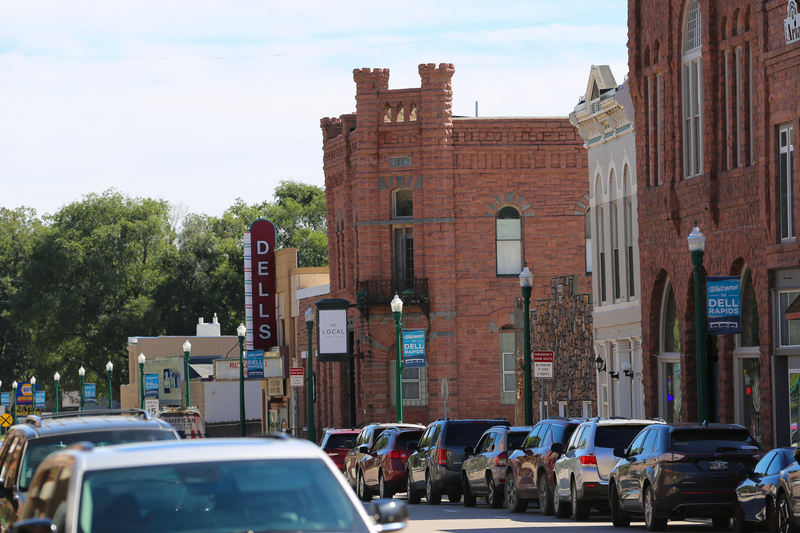
A small business loan officer told him a coffee shop wouldn’t sustain itself in a small town, Ahlers said, but authorized a $50,000 loan. That wouldn’t cover paying for the building, renovations and the equipment needed to get a coffee shop running, Ahlers said. So, he used profits from his video stores.
“That other business that they said would never succeed helped pay for it,” Ahlers said.
He was determined to make the coffee shop a success.
“I enjoy proving people wrong,” he said. “I think that I take those things as a challenge.”
For the next two years, he repaired the building’s damaged foundation and renovated the space before opening the shop in 2008. It became The Jabberwock — a coffee shop that also welcomed local musical acts, wedding receptions and graduation parties.
He sold the business a few years later, but still owns the building. He has also been a substitute teacher and led Dell Rapids’ before- and after-school program, and its Chamber of Commerce. Ahlers was hired in 2023 as the executive director of the state Democratic Party, but has taken a step back from his duties while on the campaign trail.
Ahlers lives in Dell Rapids with his wife of 28 years, Amy, and their two sons. He said the decision to run for governor came down to what his family thought of it.
“My wife, I mean, she had to think very hard on this,” Ahlers said. “She’s very thoughtful, very deliberative, and she eventually said, ‘I think you need to do this.’”
Democrats ask, ‘Why not now?’
Republican former Gov. Kristi Noem ignited the race to succeed her in January 2025 when she resigned to accept a job in President Donald Trump’s administration. Her lieutenant governor, Rhoden, was automatically elevated to fill the remainder of her second and final term.
While serving as executive director for the Democratic Party, Ahlers asked other Democrats to put their names on the ballot for local and state offices. People around him asked why he wasn’t doing the same, he said.
Shane Merrill, chair of the state Democratic Party, was one of those voices.
“It just made total sense,” Merrill said, mentioning Ahlers’ legislative career and community experience.
Ahlers said his focus was on recruiting. He didn’t set out to run for governor.
“I think those opportunities for public service call you,” Ahlers said. “Some people do plan them. I mean, they go, ‘I’m going to do this, and then I’m going to do that.’ I’m a Democrat in a Republican state. I don’t have the luxury of laying out a plan like that.”
Ahlers was the last candidate for governor to throw his hat in the ring when he announced his campaign in February. By then, four Republican candidates were running, setting up a primary election that ended in South Dakota’s first-ever statewide runoff election, won by Rhoden in July.
“I spent a lot of time listening, watching, doing the town halls, doing all that type of legwork to prepare for what was going to be a very quick, fast election cycle,” Ahlers said.
Merrill said a momentum shift toward Democratic candidates in other Midwestern states tells him that now might be the time for one to take office in the Mount Rushmore State.
“I think that the Democrats are poised to do very well,” he said. “It’s still South Dakota, it’s still a red state. It’s been 50 years, but eventually, in my lifetime, I guarantee it’s going to happen, and why not now?”
The Democratic Party hasn’t held a majority in either chamber of the South Dakota Legislature since the 1990s. Democrats had eight members in the 105-member lawmaking body this year.
Ahlers said he’s ready to work with Republicans.
“People will tell you we just don’t share the same values. I don’t believe that,” Ahlers said. “I don’t know a single Republican that says, ‘I want a bad education system for my kids or grandkids.’ I don’t know a Republican that says, ‘I want terrible healthcare,’ or ‘I love potholes in my roads.’”
Education an ‘incredibly important’ part of platform
Ahlers spent parts of his childhood in Dell Rapids and Rapid City, before his family moved to Gillette, Wyoming, where he spent the majority of his younger years. As a student of the public school system, Ahlers said an eighth-grade civics class caught his attention.
“I was inspired by a group of people from different backgrounds, with different ideas, who were able to come together and create something special like this country,” he said. “I want to be part of that. I want to go out and make life better, and have a positive impact for people.”
He returned to Dell Rapids as a senior in high school, but his time as a student in Wyoming taught him that “we can do better with education,” he said. There, students had more opportunities in STEM, or to prepare for skilled labor jobs after high school, he said.
“Education is incredibly important to me,” Ahlers said. “I know that when people get a good quality education, regardless of their abilities, they are better off in life, and we’re all better off for it.”
As a student in the school lunch line, he remembers carrying a different lunch ticket from the kids around him, because he’d receive a reduced-price meal.
“We didn’t ask to be where we were financially. It was a recession,” Ahlers said. “But walking up with a different-colored ticket said somehow that I was less than other people.”
He doesn’t want South Dakota students to feel singled out at lunch time.
“I don’t think that families should be charged for school lunches at all. I don’t understand why we treat it like an extracurricular activity,” Ahlers said. “It’s part of the day, you’re required to be there. Why aren’t we just feeding them?”
South Dakota lawmakers this year approved spending about $600,000 annually to cover the family share of reduced-price meals for students enrolled in the federal program. The legislation came from a Sioux Falls Democrat, Rep. Kadyn Wittman.
Legislative victories like those, Ahlers said, come from a willingness — and a need — to work with the majority party in the Legislature.
Ahlers ‘willing to learn’
As a freshman lawmaker, Ahlers said he was excited to use what he’d studied in college. He looked to more experienced lawmakers, like Paul Dennert, a Democrat from Columbia who served as assistant minority leader.
“He came in as a young man, was awestruck, like everybody,” Dennert said of Ahlers. “But, he was that young businessman from Dell Rapids, and was willing to learn and willing to ask a lot of questions to get familiar with the process.”
Ahlers was a member of the joint budgeting committee as a state senator in 2009 and 2010, and during his latest term in the House from 2017 to 2018. Also on that panel was Republican former Rep. Hugh Bartels, of Watertown, who ultimately served as speaker of the House.
Though he won’t be voting for Ahlers in the governor race, Bartels remembers Ahlers’ work on the committee favorably.
“He worked across the aisle,” Bartels said. “He knew appropriations is one of those areas where there’s only so much money to go around, and he realized that as an appropriator, and worked to get things through.”

Ahlers said most of his legislation came from constituents, including parents from the community who shared their concerns about their children enrolled in special education programs.
During his most recent House term, Ahlers sponsored successful legislation that created an advisory committee of parents, educators and experts to improve language development for children who are deaf or hard of hearing before they enter kindergarten.
The state Department of Education initially spoke in opposition to the legislation, and no members of the majority party signed on as co-sponsors. But Ahlers “did the footwork” to get it passed, according to former state legislator Julie Bartling, a Democrat from Gregory.
He brought in students who would be impacted by the changes and experts in education and advocacy to show how the changes could benefit students who are deaf or hard of hearing, Bartling said.
“It was really pretty neat to watch how he could just start from something so simple,” she said, “and just take it all the way to the top.”
Ahlers remembers the day then-Gov. Dennis Daugaard signed the bill, making South Dakota one of the first states in the nation to enact such a law.
“It was great. It was a good day for those families. It was a good day for bipartisanship,” he said. “That’s when you get the best of what government can offer, when you find those moments where we can all figure out how to work on things together.”
As he looks at the path ahead of him, Ahlers considers everything else in his life that was, at one point, an uphill battle: a college track career, long-lived businesses, a legislative race he wasn’t supposed to win.
“I think those types of challenges drive me,” Ahlers said. “When people say that there are things that we just can’t fix, things that are too far gone, I’m like, ‘No, I know that we can do it.’”

Pierre, SD