Melanie Stinnett and Betsy Fogle square off in competitive Missouri Senate race in Springfield
Oct 09, 2026 | 10:00 am ET
Description
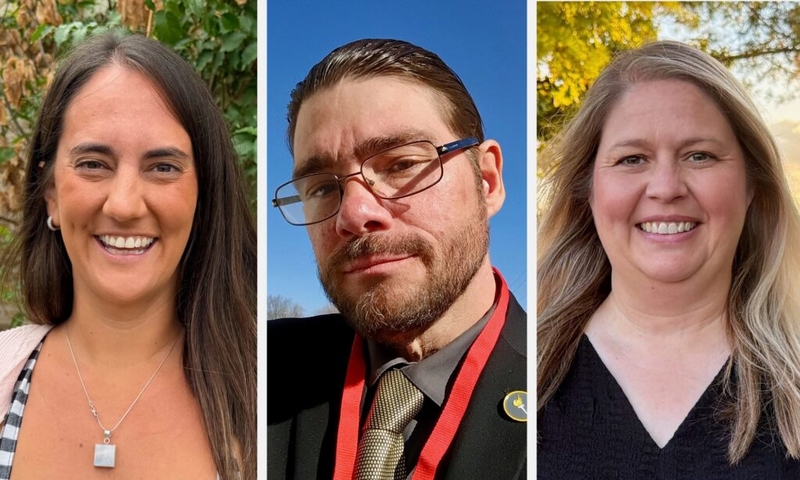
Democratic state Rep. Betsy Fogle, Libertarian nominee Cecil Ince and Republican state Rep. Melanie Stinnett are running to replace term-limited Republican state Sen. Lincoln Hough in state Senate District 30, which is almost entirely enclosed by the boundaries of Springfield (photos submitted and by Steph Quinn/Missouri Independent).
SPRINGFIELD — Melanie Stinnett and Betsy Fogle have more in common than their political affiliations might suggest.
Both came to politics after careers helping Missourians navigate a complicated healthcare system. Both have made improving access to services for people with disabilities a priority. And both worked this year to restore proposed cuts to funding that helps people with disabilities stay in their homes and communities.
But the two state representatives are now competing for a Springfield-based Missouri Senate seat that Democrats haven’t won in 80 years.
Stinnett, a Republican, and Fogle, a Democrat, are vying to replace term-limited Republican state Sen. Lincoln Hough in the 30th District. Libertarian Cecil Ince is also on the ballot.
The contest comes at an unusual political moment. Missouri voters overwhelmingly rejected two Republican-backed constitutional amendments in August, including one that would have made it harder for citizens to change the state constitution and another aimed at eliminating the state income tax.
Whether that dissatisfaction will extend to Republican candidates in November remains uncertain. But Democrats hope it creates an opening in Springfield, where a victory would bring them one seat closer to breaking the GOP’s two-thirds supermajority in the Missouri Senate.
The key differences between Stinnett and Fogle were on display during competing events on a warm September evening in Springfield.
About a dozen protesters gathered outside Phoenix Home Care & Hospice, carrying hand-lettered signs criticizing Stinnett’s records. Inside, Stinnett was hosting a panel discussion on healthcare access.
At the press conference outside, held by the Will of the People PAC — which has endorsed Fogle — speakers drew a connection between high healthcare costs and Stinnett’s support for Amendment 5, which would have given lawmakers five years to introduce new sales taxes or raise existing sales tax rates to replace income tax revenues. Fogle opposed Amendment 5, describing it as a cost of living increase for constituents.
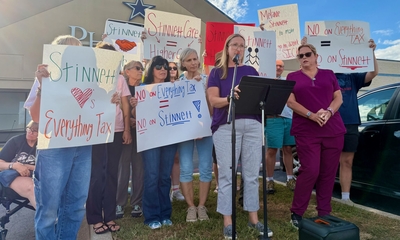
Melanie Donnell, a kindergarten teacher from Springfield, told those gathered about her family’s medical costs: $10,000 a year, with insurance, to treat her rheumatoid arthritis and her daughter’s cystic fibrosis. If Amendment 5 had passed, Donnell said, those expenses might have risen even higher.
“It’s already so hard to afford the care our families need,” she said. “Why would Melanie Stinnett and Mike Kehoe want to make it even harder?”
Barriers to healthcare were no less prominent in discussions inside, but no one mentioned the state tax code as the problem or solution.
One panelist, Rachel Adams, a speech language pathologist in Ozark, said it’s become so expensive for her clinic to provide insurance to employees that it has switched to a direct care model, which bypasses insurance companies by directly paying providers a flat fee for primary care.
“The whole business is now paying for our employees to have direct primary care access,” Adams said. “It’s more affordable. They’re getting more out of their doctors.”
A Democratic opening?
Both parties have invested heavily in the race, and Stinnett and Fogle are neck and neck in fundraising.
As of Sept. 3, Stinnett’s campaign had raised $559,709, while Fogle’s campaign had raised $554,056. With less than a month to go before the election, Stinnett has more cash on hand than Fogle — $480,225 compared to $341,799. But Fogle has outspent Stinnett, including on ads.
Though Stinnett’s campaign has slightly outraised Fogle’s, the independent PAC supporting Fogle has raised more than one supporting Stinnett. Forward PAC, which supports Fogle, had raised $423,973 with $401,187 on hand as of Sept. 2, while Heart of SGF, supporting Stinnett, had raised $369,250 with $341,863 on hand as of Sept. 3.
Democrats also saw an encouraging sign in August’s primary turnout. That included state Senate District 30, where Fogle netted 14,417 votes and Stinnett got 12,494 votes. Both candidates were running unopposed in the primaries.
Cecil Ince, running as a Libertarian in the district, won 265 votes.
And state GOP leaders have expressed concern that November ballot measures will bring out Democratic and independent voters in the kind of numbers that defeated Amendments 4 and 5 in August.
Amendment 4 lost 80-20 statewide and 81-19 in Greene County, while Amendment 5 lost 83-17 statewide and 84-16 in Greene County.
November ballot measures include Amendment 6, which would require an 80% threshold for lawmakers to overturn voter-approved legislation and prohibit lawmakers from weakening the initiative petition process.
Dan Ponder, a professor of political science at Drury University, said voter turnout might be higher than expected for an election with only one statewide race, for auditor. But he cautioned that while opposition to Amendments 4 and 5 might have increased turnout for Fogle in August, that might not be enough to help Democrats in the 30th District.
“Clearly, in a Republican area, with both of those things going down with over 80% of the vote, there’s obviously quite a few Republicans who are going to vote Republican, or people who voted for a Republican but also voted against these (measures),” Ponder said.
Fogle told The Independent she supports Amendment 6, saying she would “welcome a generational shift of power away from elected officials and back into the hands of the people who sent us there.”
Stinnett told The Independent that while she thinks the 80% threshold in Amendment 6 is too high, she would support strengthening voters’ voice by putting a moratorium on legislative changes to voter-approved measures in the first few years after their passage.
“Whether we pass as law as legislators or people pass things in a citizen-led initiative, there can always be unintended consequences that weren’t foreseen,” Stinnett said. “…So I think that is the legislature’s role: to really review current statute, review things that are currently in place and ensure that it’s really providing the best outcomes for the state as a whole.”
Ince called Amendment 6 a “wolf in sheep’s clothing,” saying it “bypasses the rule of law and institutes majority rule” and that the initiative petition process should remain in its current form.
Different paths to Jefferson City
Fogle started her career at Jordan Valley Community Health Center, where she helped low-income patients navigate state government to gain access to services.
“My job was to address all the non-clinical needs of my patients,” Fogle told The Independent. “So I did Medicaid applications, food stamps, helped with transportation, childcare — all of the things state government plays a role in.”
Fogle recalled working with a patient who struggled with substance use. When the patient became pregnant, Fogle said, she did everything she could to prepare to be a mom.
“I helped her apply for Medicaid,” Fogle said. “She got clean. She would come in every single day to see me and check in and make sure she was holding herself accountable.”
But the patient delivered her baby before Missouri expanded Medicaid coverage for postpartum mothers from 60 days to a year in 2023, and she relapsed and died shortly after giving birth.
“That was a shocking reality of how policy passed in Jefferson City or policy not passed in Jefferson City directly impacts the lives of people back home that we care about,” Fogle said.
“In that moment,” Fogle added, “I just thought, ‘Man, people just deserve better.’”
Fogle, who has served on the House Budget Committee since 2021 and was ranking Democrat on the committee in 2025 and 2026, said her priority has been “passing a fiscally responsible budget that makes the right investments in our state.”
Committee members from both parties this year worked to restore $80.7 million in cuts proposed by Kehoe to Medicaid services that help people with disabilities live safely in their homes and participate in their communities.
Fogle said that while “it was an honor” to work to reinstate that funding, the state is likely to continue facing cuts to Medicaid, as well as education.
“I would imagine we’ll see an intent from the majority party to cut services there, and it would be disingenuous for me not to tie that directly to revenue,” Fogle said. “You have to have dollars to pay your bills.”
Stinnett also worked to restore the proposed disability services funding, though she pursued a different approach.
She sponsored a measure that would have put proceeds from a proposed annual $250 fee levied on video lottery machines toward the services, but the video lottery bill ultimately did not pass.
Stinnett, a licensed speech pathologist and chair of the House Health and Mental Health Committee, told The Independent she started doing legislative advocacy in 2016 because she noticed coverage gaps while working in her practice, which she founded in 2014.
Alongside the Columbia-based group of moms who formed the nonprofit Missouri Disability Empowerment, Stinnett advocated for a 2019 law requiring commercial insurance companies to cover services such as speech and occupational therapies for children with developmental or physical disabilities. An existing mandate had only included children diagnosed with autism.
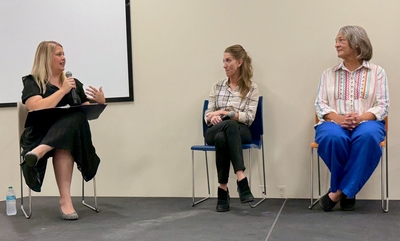
Stinnett said her experience interacting with insurance companies helped her work alongside lawmakers to draft the legislation. It’s part of what convinced her to run for the Missouri House, and she was first elected in 2022.
“Over the years, it really became apparent to me…that the things I had done in my life leading up to that point had prepared me with the skill set and knowledge base to really impact positive change,” Stinnett said.
Stinnett said one of her proudest achievements was her work on 2023 legislation that expanded Medicaid eligibility through Missouri’s Ticket to Work program for people with disabilities who are employed.
Stinnett said the legislation allows people with disabilities to access services that are difficult to find outside of Medicaid, such as personal care assistance.
“What that does for individuals with disabilities in our community is open up an opportunity for them to work and contribute something productive in their community, find ways to thrive with whatever skill set or things that they love in their work,” Stinnett said.
Unlike Stinnett and Fogle, Ince’s political involvement began outside the two major parties.
Ince, who has worked as an actor, told The Independent he first heard about the Libertarian Party in 2000 from former Springfield City Councilman Doug Burlison, who was petitioning at the time to put the party’s presidential candidate, Harry Browne, on the ballot in Missouri.
Since then, Ince has run for various public offices but hasn’t been elected. He netted 4.6% of the vote in Missouri’s 2016 Libertarian presidential primary.
“A lot of people see things in black and white,” Ince said. “They don’t realize that there are other options or other approaches to problems, issues and situations that really need to be discussed rather than just A or B.”
Party lines
Although Stinnett and Fogle have found common ground on disability services, their legislative records reveal differences that have become central to the campaign.
Will of the People, the PAC that hosted the press conference criticizing Stinnett’s record on Amendment 5, has targeted Stinnett and other Republicans for supporting efforts to reverse voter-approved measures.
Stinnett voted for measures overturning the abortion rights amendment and paid sick leave initiative approved by voters in 2024.
But Stinnett broke with her party in May, by voting to return a budget bill to conference because it relied partly on uncertain lottery revenues to fund schools. She was one of 16 Republicans to do so. That effort failed.
Ponder said that even though the hill Democrats have to climb in the district is “flatter than has been the case” in the past, it’s “a very competitive seat.”
“Who knows how it’s going to come out?” Ponder said. “I wouldn’t want to bet on the outcome.”

Jefferson City, MO