Railroad tie stacks raise stink in Laramie’s West Side neighborhood
Oct 09, 2026 | 6:22 am ET
Description
Photo courtesy of WyoFile
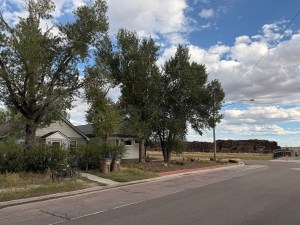
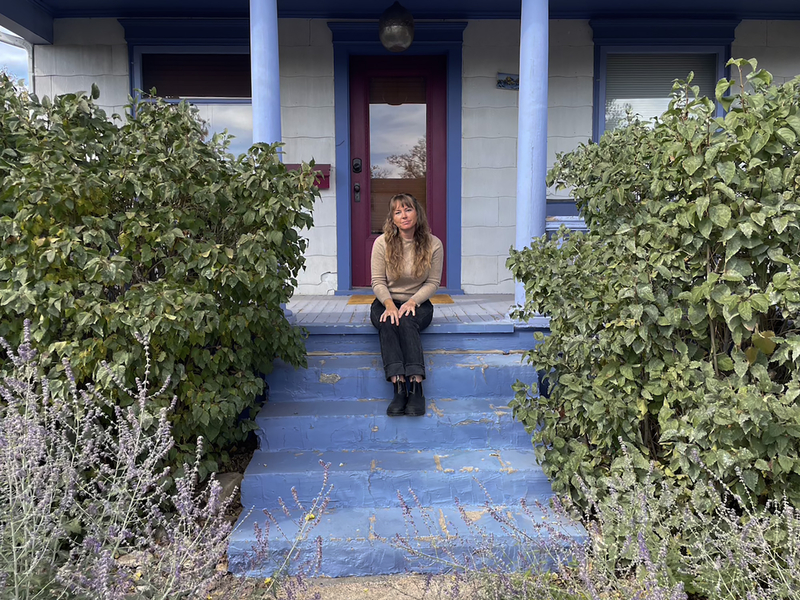
LARAMIE—In the eight years since Kylene Claar and her family moved into a house with a brown picket fence on this city’s historic West Side, they’ve watched the Greenbelt, a river park adjacent to their block, come alive.
“It’s been transformed,” Claar told WyoFile, giving credit to the local beavers for their riparian diligence.
The family also regularly spots skunks, foxes and deer from the Greenbelt’s walking path that darts between cottonwoods and aspens as the trail crisscrosses the Laramie River. It’s a great place for Claar and her husband to raise their three sons, she said, including their adventurous 8-year-old, who rides his bicycle around the neighborhood.
“He plays outside every day, and he’s outside all the time,” Claar said. “So I really worry about him and the toxic, pungent creosote smell. It’s overwhelming at times.”
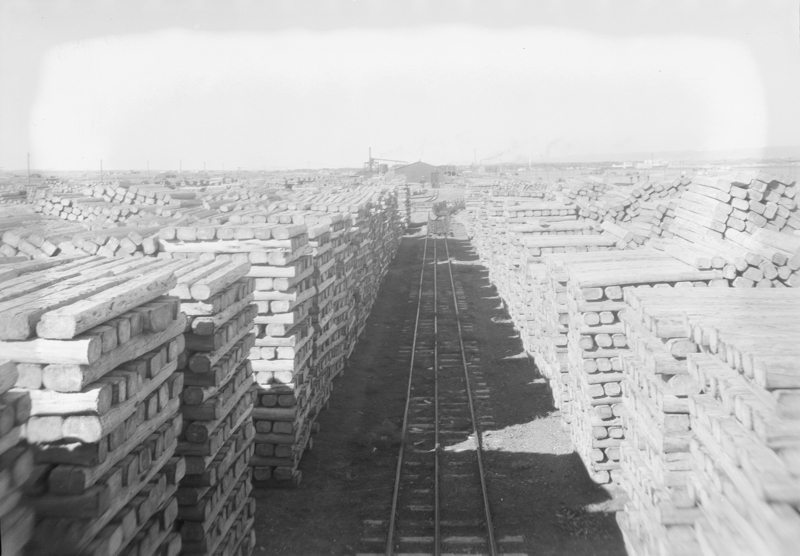
This summer, Union Pacific Railroad began stacking creosote-soaked railroad ties on its property adjacent to the river and the West Side, a historic, working-class neighborhood sandwiched between the train tracks and Interstate 80. There’s now a small mountain of more than a thousand ties, according to estimates by locals.
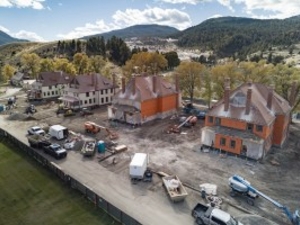
In this aerial photo provided to WyoFile, stacks of rail ties can be seen on Union Pacific Railroad property just east of the Laramie River and the city’s Greenbelt Trail. (Martha Jenkins)
Railroads, dating back to the 1800s, have used the pungent preservative creosote to protect wooden ties from succumbing to natural decay and pests. The stench, particularly on blistering days in July and August, raised concerns across the neighborhood. Residents, like Claar, say they want answers.
“[Union Pacific] has tons of money. They own tons of land. Why are they stacking it right next to the river, right next to residential neighborhoods?” Claar said. “It seems like there’s a lot of other places they could put this. To me, it’s an outrage that they decided that this might be a good place.”
For now, the fate of the rail tie stockpile, as well as consensus on the possible risks it poses, is the subject of intense posturing among myriad interests that include residents, local and state officials, the Union Pacific Railroad, its contractor/lessee Omaha Track (represented by powerhouse law firm Holland and Hart) and the Wyoming Department of Environmental Quality.
It appears that, for now, stockpiling has ceased. However, a handful of residents formed Healthy Neighborhoods, a nonprofit that has threatened to sue Union Pacific and Omaha Track if the companies don’t remove the ties. The firms, meanwhile, are negotiating with DEQ over a disagreement about applicable regulations and permitting requirements.
“Why here?” Martha Jenkins, founder of Healthy Neighborhoods, told WyoFile. “Why somewhere surrounded on three sides by waterways on our little greenbelt where our beavers are, where our kids play, where people fish and swim?”
“Our main concern right now,” she said, “is we need to get these moved.”
The rail tie stacks, DEQ has said, may violate state “solid and hazardous waste” statutes, requiring a multistep review process that would impose extra measures and monitoring to protect against toxins entering soils and waters. It’s unclear whether such scrutiny might force actions to address the odor and air quality concerns.
Omaha Track, however, maintains it doesn’t need a permit.
“We understand the concerns about the ties at Laramie and have been working with various state and local officials and Union Pacific to ensure that we are in compliance,” Omaha Track President Jay Gowan told WyoFile via email. “As those conversations are ongoing, we cannot comment further until there is a resolution.”
Rail yard’s long history of creosote
The pestering odor is produced by creosote, a mixture of polycyclic aromatic hydrocarbons “derived from the distillation of tar from wood or coal,” according to the U.S. Environmental Protection Agency. Depending on exposure levels, it poses health risks, including cancer. It can linger in soils and pollute water.
Union Pacific used the Laramie rail yard to treat railroad ties with creosote from 1886 to 1983. Because of creosote contamination, the Baxter/Union Pacific Tie Treating grounds along the Laramie River were deemed an EPA Superfund site in 1983, initiating forced cleanup and environmental remediation overseen by the EPA and the Wyoming Department of Environmental Quality. It was removed from EPA’s superfund “priority” list in 1999.

Despite that history, initial inquiries to Union Pacific, local and state officials about what might be done to address concerns were somewhat dismissive, said West Side resident and Democratic House District 45 Rep. Karlee Provenza. Union Pacific appears unmoved by locals’ concerns, she said.
“Union Pacific is like its own country,” Provenza told WyoFile. “They have their own police force, essentially. They have all the power in the world. I just get the impression that they don’t feel like they need to answer to the people of Laramie, and it bums me out.”
‘Truly depressing’
Jim Sparks, who lives directly across the street from the rail tie stack, said he doesn’t feel like he has many options to deal with the problem.
Sparks recently retired as a city garbage collector, and has lived in the same home for the last two decades. But the rail ties have made him consider moving. Otherwise, he said, “that’s railroad property. And you can’t fight the railroad.”
This summer, the creosote smell gave Sparks regular headaches, he said, while dust was another problem.
“I don’t have central air conditioning, so my windows were open,” Sparks said. “The dust and the smell is there constantly.”
Sparks now wipes down the stove before he puts on a pot to boil, he said, “because the dust can be that bad at times.”

The arrival of the rail ties didn’t immediately worry Sparks, he said, but when he started noticing the smell and reading about creosote-soaked, rail tie piles catching fire, he started to worry.
“Then Martha [Jenkins] approached me about getting together to start a nonprofit to try and get a lawyer to work on it,” Sparks said.
Reed Zars, an attorney for the nonprofit, notified Union Pacific and Omaha Track in an Aug. 31 letter that the group intended to file suit if action was not taken. As of publishing time, the nonprofit had not yet received a written response, Zars told WyoFile.
Jenkins said she can remember a morning this summer when the creosote smell woke her from a deep sleep in the early hours of the day.
“It was truly depressing,” she said. “It was so beautiful in August, but we felt like you could smell it in our kitchen. You could smell it in the bedroom.”
Aside from the potential health effects, Jenkins said she also worries about the fire hazard the ties pose to the West Side.
“It’s so close to the houses that, I mean, with this wind, the West Side would burn down,” she said.

That’s something that also worries Robert Roybal. His house, where he’s lived for the last 43 years, is several blocks down from the ties, so he only really notices the smell when he walks his Scottie dog around the neighborhood, he said.
Roybal, however, worries what would happen if “some stupid punk, or somebody,” threw a firework, or some kind of flare over the fence surrounding the ties.
“If there’s a fire, it could go that way. It could go this way,” Roybal said.
Like his neighbors, Roybal said, “for the life of me, I don’t understand why they brought them over here.”
Regulatory stink
Provenza said she was stunned by initial responses from local and state authorities. Union Pacific, in addition to being a significant cog in the local economy, is a generous donor to community causes and events, one elected official told her. DEQ’s first response to her inquiries, Provenza said, was that the rail tie stockpile didn’t appear to violate any rules or pose risks beyond the agency’s on-the-books regulatory authority.
“The [DEQ Air Quality Division] has no regulations regarding the storage of used railroad ties,” DEQ officials wrote in a June 29 internal memo obtained by WyoFile. “The only applicable [air quality] regulations would be if Union Pacific begins burning the railroad ties, or if an excessive odor is noticed past the property line.”
That same month, a DEQ inspector “walked the entire length of the trail where railroad ties were present and attempted to scent any noxious odors,” but “noticed no odors from the facility,” according to DEQ. “No concerns were noted for the facility at that time. Should concerns regarding odor continue, the [DEQ Air Quality Division] will revisit the facility for further investigation.”
Also based on initial inspections, the agency “determined that there is no immediate water quality threat to surface waters of the state from the stacked ties.”

But there’s a question about whether the rail tie stack qualifies as solid waste, requiring a solid and hazardous waste permit. Wyoming DEQ in July met with city officials and representatives from Union Pacific and Omaha Track. Agency staff learned that not only did Omaha Track ultimately plan to stockpile about 5,000 ties, it proposes to shred the bulk of them to sell as fuel for industrial boilers and kilns.
“Based on the discussion, it appears that the current operation may violate the Environmental Quality Act and Solid Waste Rules,” the agency said in a July 27 letter to Omaha Track and Union Pacific representatives. DEQ added it “advises that no additional scrap railroad ties should be stored at the facility or at other unpermitted locations, and that no treatment (chipping/shredding, processing, etc.) of scrap railroad ties occurs until a solid waste management permit is obtained.”
Omaha Track, via its lawyers, asserted that its intent to reuse the rail ties as a commodity precludes the stockpile and grinding operation from regulation under DEQ’s solid and hazardous waste program. “Omaha Track respectfully requests DEQ reconsider its determination that Omaha Track must obtain a solid waste management permit,” Holland and Hart attorney Jeffrey Pope wrote in a Sept. 16 letter to DEQ.
Reached by WyoFile, DEQ said it is still evaluating its positions on the situation. The agency declined WyoFile’s request for an interview, it said, because the matter is under review.
“DEQ is working with Union Pacific and Omaha Track to evaluate applicable regulatory requirements and determine what permits, if any, may be required through the Solid and Hazardous Waste, Air Quality, and Water Quality divisions,” Public Information Officer Jillian Scott told WyoFile via email. “DEQ continues to review information provided by the parties and assess the appropriate regulatory path forward.”

Though aspects of the rail yard, including the handling of creosote-treated railroad ties, are subject to federal environmental laws, Wyoming DEQ has been granted “primacy,” or delegated authority from EPA, to enforce many of the federal environmental programs.
“Wyoming Department of Environmental Quality is the lead agency for governing the management and disposal of solid and hazardous waste under the Resource Conservation and Recovery Act in Wyoming,” EPA Region 8 Public Affairs Director Katherine Jenkins told WyoFile via email. “EPA has provided and will continue to provide [Wyoming] DEQ regulatory and technical support in this matter.”
There is a federal regulation that applies specifically to railroad ties, EPA’s Jenkins added. Under federal code 40 CFR 241.4(a), “Railroad ties may be defined as non-waste fuel when they are processed according to the regulatory provisions and burned in specific types of combustion units,” Jenkins said. “That said, railroad ties are not exempt from regulation altogether and remain subject to applicable federal, state and local requirements.”
If the EPA is not satisfied with DEQ’s management of a particular federal program or environmental law, it can step in and override the state agency — an assurance that Provenza said she received from her former Wyoming legislative colleague Cyrus Western, who now serves as EPA’s Region 8 administrator.
Western was unavailable for an interview for this story, Jenkins said.
‘Not a fun endeavor’
For all the debate among powerful authorities and companies, and deflection that Provenza and others have felt along the way, residents have no choice but to follow their instincts and demand that the railroad — physically and culturally ingrained in the community — be a good neighbor, she told WyoFile.
“What we’re seeing is people acting courageously with the powers that they have,” Provenza said. “And, you know, I get it: Taking on Union Pacific is not a fun endeavor. But my neighbors and the people who walk on the Greenbelt, and anybody who’s invested in the health of the river — there’s just a million reasons not to have [the rail tie stack] there. Union Pacific has plenty of land elsewhere that isn’t going to have the same impacts on people.”
And if state and federal regulatory officials decide that the letter-of-the-law provides legal space to allow what West Side residents and Greenbelt users have already endured, Provenza said, then changes are due.
“If this is fine,” Provenza said, “and yet there’s evidence — like scientific evidence — it is harmful, then it’s my job as a state representative to figure out, ‘Do we need to hold the agency [DEQ] accountable?'”
DEQ is to be commended for its evolving role on the issue, she added.
“I’m pointing fingers at Union Pacific and Omaha Track to be better neighbors. We’ll use whatever regulatory pathway that might be available to try to protect the people of my community.”
Provenza and Healthy Neighborhoods are also pressing city of Laramie and Albany County officials.
“There are ordinances you can put in place to stop the grinding,” Provenza said, “because while the ties are a problem just sitting there, we also know they become an even greater threat to the community if they start grinding up that wood.”
Provenza said she and others have implored local officials to hold a public meeting and make their positions clear to their constituents. But so far, the city has not done so.
“This is where the push and pull of being a city councilor versus also a community member comes into play,” Laramie City Council Member Will Bowling, who represents the southern half of the West Side, said.
To Bowling, it’s plain that the ties need to be dealt with.
“As a neighbor and as a community member and as a concerned person, I’m like, ‘Those shouldn’t be as close to homes as they are, and they shouldn’t be as close to a water source, as they are,’” he said. “That’s pretty obvious.
“Not only is that unsightly in this space, but we’re also talking about stuff that is soaked in creosote and can be environmentally hazardous,” Bowling said. “Then as a council member, I’m like, ‘let’s address all of those things,’ while also having to understand that currently, based on where they are, it’s industrial zoning, and under state statute, city ordinance, and according to DEQ, they’re not doing anything that they shouldn’t be doing,” he said.
The city is waiting on an updated site plan, Bowling said, that may include moving the ties, “south of town, possibly into county land that’s down by the cement plant.”
After the ties are relocated, Bowling said, then comes the question of disposal and “what does that look like, and how is that done with the utmost concern for public safety and health in mind?”
Ultimately, he said, “I think it behooves a transnational, multi-billion dollar corporation to want to maybe listen to public concern.”
In an email to West Side resident Martha Jenkins and her husband Mark, Laramie Mayor Sharon Cumbie wrote “The City is willing to fight, which may include significant legal fees.”
“Our greatest concern is the next phase of this operation; the grinding of the rail ties,” Cumbie wrote. “We believe that presents a significant risk to the health and wellbeing of the City of Laramie, especially the West Side and Downtown area.”
Still, Cumbie wrote, the city believes “there is a compromise: move the storage south closer to Mountain Cement. Then, any grinding activity must be housed in an enclosed warehouse with an advanced ventilation system that sucks out the particulate matter into receptacles, where the contents can be properly disposed of.”

But West Side resident Kylene Claar worries the damage has already been done.
“The problem with the health thing is, we see this over and over, whenever there’s exposure to a toxin or chemical vapor, or things like that, it seems like it affects a person’s life down the road,” she said.
In the meantime, she said her family has already been dealing with headaches, nausea and other symptoms that Claar worries are related to living two houses down from the ties. She also has lingering questions beyond the decision to store the ties on the West Side. She said she’d like to know whether there’s a neighborhood evacuation plan in case the ties catch fire.
“I just feel like there’s no plan in place for how to deal with something if there were a huge emergency,” Claar said.
From her family’s front porch, Claar can see a pole with a set of cameras that she said appeared this summer on the edge of the railyard. At night, she said, the pole’s flashing blue lights cast through her home’s windows, which feels “really invasive.”
“Here’s the problem,” she said. “Instead of moving a dangerous, toxic fire hazard away from our children, whoever it is that’s putting in this camera is instead deciding to put our family under surveillance instead of just moving the railyard ties.
“It’s that simple. That’s all we want done.”
Cheyenne, WY