Alabama Ethics Commission: Campaign funds can be used for civil lawsuits
Oct 09, 2026 | 6:01 am ET
Description
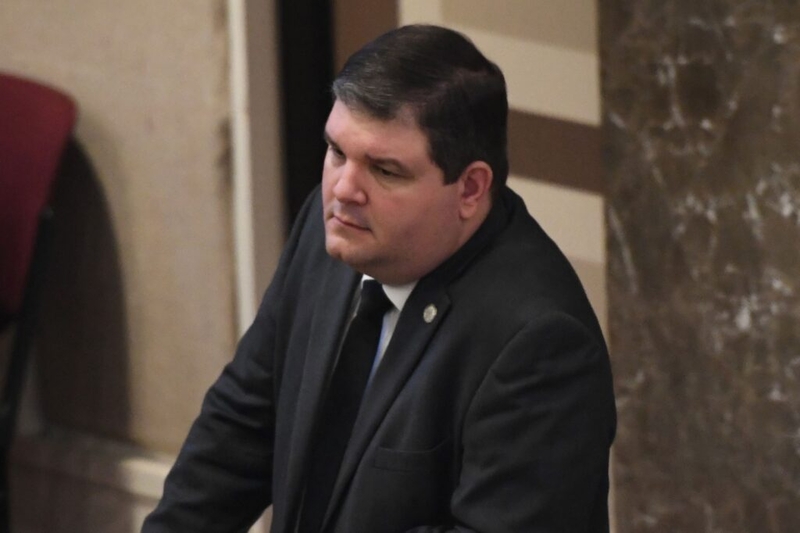
Rep. Matt Simpson, R-Daphne, stands on the floor of the Alabama House of Representatives on Feb. 8, 2024 in Montgomery, Alabama. The Alabama Ethics Commission said in an opinion issued Wednesday and in response to an inquiry from Simpson that campaign contributions can be used for civil lawsuits related to conduct in office. (Brian Lyman/Alabama Reflector)
The Alabama Ethics Commission Wednesday unanimously approved an advisory opinion that said state law from staff that state law allows campaign funds raised by a candidate to pay legal fees for a civil lawsuit if it is related to the job duties while in office.
The opinion came at the request of Rep. Matt Simpson, R-Daphne, who has threatened legal action against a political action committee that targeted the state represenative ahead of May’s Republican primary in his House district. Simpson asked if he was permitted to use campaign contributions to help pay for costs associated with litigation under the state’s Fair Campaigns Practice Act .
“Campaign funds can be used for legal fees and costs associated with any civil action, criminal prosecution or investigation related to conduct reasonably related to performing the duties of the office held,” said Brian Paterson, chief counsel of the Alabama Ethics Commission.
Simpson said in an interview Thursday he has not yet filed a lawsuit and is considering his options.
“I feel a lawsuit is warranted because you have these groups that come in and say absolute false statements and lies,” Simpson said. “They put them in mailers and messages out in the community in advertisements and other things saying that I voted for a bill I voted no on, they said I voted no on a bill I voted yes on.”
He also said he “wanted to hold them accountable” for the alleged false statements they made.
In May, Simpson sent a cease-and-desist letter to Alabama Values PAC, a political organization that targeted him with negative advertising prior to the May primary. Simpson demanded the PAC retract a flyer that falsely claimed Simpson voted to prioritize free college for immigrants without legal status.
Simpson in 2024 voted against HB 210, sponsored by Rep. Reed Ingram, R-Pike Road, which would have allowed students without legal status to attend Alabama postsecondary schools if they had applied for legal status or earned a diploma or GED after attending a high school for at least three years. The bill did not become law.
Alabama Values PAC was created in March by former Sen. Dell Hill. It listed Thomas Datwyler, a Wisconsin-based political consultant who claims to have “guided” 400 political action committees, as its chairperson and CEO. Hill said in a statement in March that the PAC would defend “traditional Christian principles that have made Alabama the best place to raise a family, start a business, and build strong communities.”
Hill accused “our so-called conservative leaders” of voting for in-state tuition for immigrants without status; parole for violent offenders; supporting gambling legislation and voting for restrictions on guns or property rights. The statement did not provide specific examples.
Messages seeking comment were sent to Alabama Values PAC and Datwyler on Wednesday.
The PAC told al.com in May that the allegation against Simpson was due to a “printing error” but did not elaborate. Simpson narrowly lost the May primary to Danielle Duggar.
According to its website, Alabama Values PAC also targeted Reps. Phillip Pettus, R-Florence and Frances Holk-Jones, R-Foley, and Sens. Greg Albritton, R-Atmore and Andrew Jones, R-Centre. Pettus and Albritton lost their respective primaries; Holk-Jones was pushed to a runoff but won, and Jones won his primary.
According to the opinion, the law does not limit the use of campaign funds to pay legal fees to defend an elected official from a lawsuit that was filed and does not prevent elected officials from using the money to initiate a civil claim for defamation.
The opinion states that the Ethics Act prohibits people from using campaign contributions to pay legal fees associated with a personal injury claim. That means that if a candidate decides to use campaign funds to pay for legal fees associated with actions of the public office, any compensation from the lawsuit cannot go directly to the official for personal use.
“If campaign funds are used for legal fees and associated costs, then any and all damages that result would need to be paid to the public official’s PCC (principal campaign committee) rather than to the candidate personally,” Paterson said.
That complicates the issue because the FCPA prohibits a candidate from receiving payment of damages from a lawsuit against a political action committee beyond the 12 months prior to an election in which the person intends to be a candidate.
Montgomery