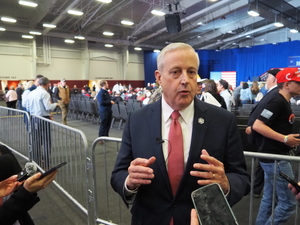
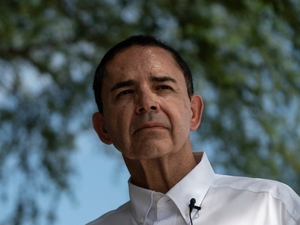
Warner, Mizusawa outline competing approaches to disability policy
Oct 08, 2026 | 1:22 pm ET

Description
A caregiver feeds a disabled man in a wheelchair. (Photo by Getty Images)
U.S. Sen. Mark Warner, D-Va., called for federal artificial intelligence regulations and stronger healthcare funding Wednesday as he and Republican challenger Bert Mizusawa outlined competing approaches to protecting Virginians with disabilities at a virtual candidate forum.
Mizusawa emphasized enforcing existing discrimination laws and cracking down on waste in federal programs.
Both candidates said they support helping people remain in their homes and improving voting access for people with disabilities. But they differed over mail voting, with Warner opposing restrictions sought by President Donald Trump’s administration and Mizusawa raising concerns about potential fraud in ballots cast outside of polling places.
The candidates answered similar questions during the 2026 Statewide Candidate Forum with the Disability Community, hosted by REV UP Virginia, The Arc of Virginia, The Arc of Northern Virginia and the Autism Society of Northern Virginia.
The nonpartisan, 80-minute program combined live and prerecorded segments, giving voters a chance to compare the candidates’ answers after AARP Virginia’s planned Oct. 7 debate in Richmond was canceled because Warner could not commit, citing uncertainty over his Senate schedule. Mizusawa had accepted the invitation.
Early voting is underway ahead of the Nov. 3 election. Organizers said people with disabilities represent about 15% of Virginia’s eligible voters. Questions addressed AI, Medicaid, education, housing and independent living.
Medicaid pays for more than health insurance, covering caregivers and community services that help people with disabilities to receive care at home. KFF estimates that the 2025 federal tax-and-spending law will cut federal Medicaid spending by $911 billion over 10 years, raising concerns over funding for those services.
Mizusawa stresses accountability and home care
A retired U.S. Army major general, Mizusawa drew on his military service and experience helping veterans navigate disability benefits, saying federal resources should prioritize Americans who need assistance.
On AI, he argued employers should remain responsible for discriminatory decisions made by software and should examine their systems for hidden bias. He emphasized enforcing the Americans with Disabilities Act rather than explicitly endorsing new federal AI regulation.
“The ADA is one of the important laws that we need to enforce,” he said.
Mizusawa’s position reflects an existing legal obligation. Federal employment guidance says discrimination protections and accommodation requirements apply when employers use AI.

Asked about Medicaid reductions, Mizusawa repeatedly pointed to fraud, waste and abuse, arguing that stronger oversight could free money for disability services and long-term care. However, he also acknowledged those efforts would not solve every funding problem and said broader reforms should protect people with legitimate needs.
“The reforms shouldn’t just be aimed at cutting,” he said.
Mizusawa questioned the U.S. Justice Department’s involvement in community-living policy, which he described as generally a state responsibility unless federal spending was involved. But he supported helping people receive care where they want to live.
Discussing caregiver shortages and proposed increases in federal funding, he cited his 95-year-old mother-in-law’s care at home, supporting care in comfortable surroundings when doing so is cost-neutral, without explicitly endorsing the HCBS Relief Act.
The legislation would temporarily increase federal Medicaid support for home- and community-based services.
On voting, Mizusawa said his overseas military service shaped his appreciation for ballot access. He supported reasonable accommodations, including mail voting and special opportunities at polling places, while calling for safeguards to verify voter eligibility.
Asked about federal benefit rules that penalize some people for getting married, he described existing rules as antiquated but did not specify legislation he would support.
He also backed accommodations and opportunities for students with disabilities to learn alongside their peers.
On housing, he proposed eliminating capital gains taxes on principal-home sales to encourage owners to sell, and making disability-related home modifications easier to deduct for people who do not itemize.
Mizusawa praised Virginia’s Blue Envelope Program, which helps people with autism communicate their needs during police encounters, and supported recurring training for officers.
Warner calls for AI rules and stronger federal support
Warner gave an unequivocal answer when asked whether federal AI regulation is necessary.
“Yes, we have to have federal regulations,” he said. “You wouldn’t climb on an airplane if it wasn’t checked by the industry.”
He said AI could expand opportunities but also displace workers, and pledged to ensure disability communities benefit from the technology. His proposed safeguards extend to data center impacts, children’s safety and national security.
Warner also linked AI-related job disruption to caregiver shortages, calling for technology companies and the federal government to help workers to move into healthcare and direct-care careers.
On health coverage, Warner said he would fight for universal healthcare and seek to stop Medicaid cuts, warning that reduced funding could threaten hospitals and other providers. He supported increasing the federal Medicaid matching rate for home- and community-based services.
“No Virginians should lose coverage because they lose a job,” he said. “And no one should have to choose between groceries, rent, and medicine.”
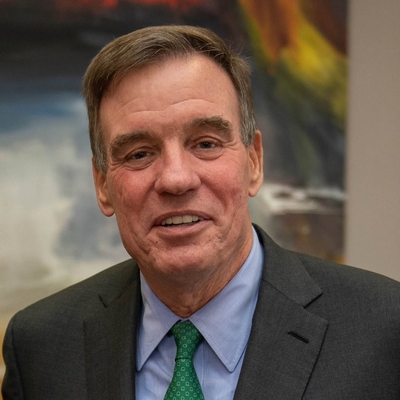
Warner criticized the Trump administration’s retreat from the ADA’s community-integration protections. A June Justice Department legal opinion concluded federal disability statutes do not impose the broad integration mandate the department previously enforced. The opinion does not overturn the U.S. Supreme Court’s 1999 Olmstead decision.
Virginia’s work to expand community services remains governed by a permanent injunction that replaced its Justice Department settlement in January 2025.
On voting, Warner said he opposed White House restrictions on mail and absentee ballots and co-sponsored the Absentee and Mail Voter Protection Act, which would repeal the administration’s election executive order.
“We should not restrict that right going forward,” he said.
When asked about marriage penalties, Warner cited his support for disability savings accounts under the ABLE Act but favored comprehensive reforms to Social Security, Medicare and Medicaid over individual benefit expansions. He did not commit to specific marriage-penalty legislation.
Warner also backed the IDEA Full Funding Act and opposed moving special education and civil rights enforcement out of the Education Department.
He supported expanding the Blue Envelope Program and federal de-escalation training.
On housing, he emphasized increasing affordable, accessible supply, including through grants to communities that remove barriers to building housing on underused religious properties. He also highlighted home-based primary care, infusion treatments and telehealth as ways to help people receive care without entering institutions.
“The hospital or nursing home is not the right option for every patient,” Warner said.
Virginians will decide which candidate will represent them in the U.S. Senate for the next six years on Election Day, Nov. 3.

Richmond, VA