Gas tax, party switch are undercurrents in North Coast Oregon House race
Oct 08, 2026 | 9:00 am ET
Description
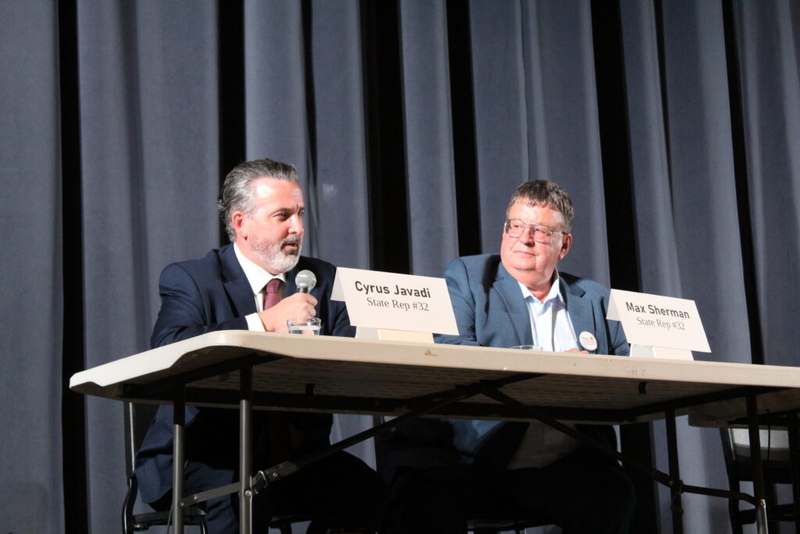
Rep. Cyrus Javadi, D-Tillamook, and Republican Max Sherman, of Hebo, speak at a candidate forum at Astoria High School on Wednesday Oct. 7, 2026. (Photo by Mia Maldonado/Oregon Capital Chronicle)
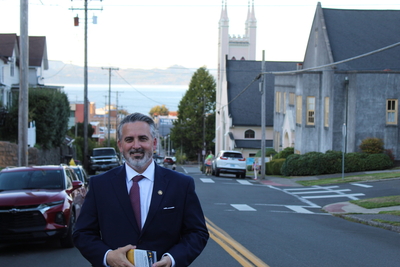
ASTORIA — Marcus Estes was the first person to answer Rep. Cyrus Javadi’s door knock Tuesday evening as the lawmaker made his usual rounds canvassing registered voters in his district.
Estes, a software business owner who lives in a Victorian-style home in the town’s hillside neighborhood overlooking the Columbia River, lived in Portland for 20 years and recently moved to the port town out of frustration with the level of homelessness in Oregon’s largest city, he told the Tillamook Democrat.
He’s also frustrated with how hard Oregon’s corporate activity tax is hitting his small business, and he’s disappointed that state lawmakers tried to raise the gas tax last year. The corporate tax applies only to businesses with more than $1 million in sales or other commercial activity, and it costs $250 plus 0.57% of taxable commercial activity exceeding $1 million.
“I am a lifelong registered Democrat,” Estes said. “I’m going to vote Republican for the governor because of the Democratic management of the state… I love Oregon, but I don’t love it enough. Oregon is too busted to be this expensive.”
Estes represents one of the 55,000 registered voters living in Oregon’s 32nd House District that Javadi would have to sway to win a third term representing the North Coast. About 38% of registered voters in the district are nonaffiliated, followed by 29% Democrats and 26% Republicans.
In November, Javadi will face Republican Max Sherman, a retired teacher and farmer.
The gas tax vote
Estes, who was perched against his door frame wearing a yellow sweatshirt, asked Javadi if in 2025 he voted in favor of increasing the gas tax by 6 cents.
“I voted for it,” Javadi said, explaining that he was a Republican at the time.
Javadi said he made that vote with the coastal Oregon Route 6 and U.S. Highway 26 in mind, as well as the families like his who rely on those roads to get to school, work and health clinics. An increase to the gas tax would have provided coastal towns with much-needed money to repair the deteriorating roads strained by tourism that locals rely on, he said at Estes’ doorstep.
“I think that was a good, reasonable answer,” Estes said.
Still, many of Javadi’s constituents don’t trust him after that vote and his decision to switch parties.
“Go home, she ain’t gonna vote for you!” a woman yelled at Javadi from across the street as he knocked on a different door.
Javadi chuckled and walked away, saying he doesn’t take her remarks personally and respects the constituents who are angry with him.
His vote on the gas tax is also what inspired Sherman to run for office, Sherman told the Capital Chronicle at a cafe in Tillamook earlier in the day, where the cashier immediately recognized him as his former high school welding teacher.
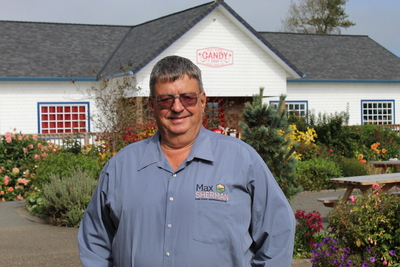
Sherman is a familiar face to many North Coast residents who took his agricultural science classes at Tillamook High School for 11 years before retiring in 2015. His teaching career spanned 35 years between Tillamook and Canby high schools — the same school he attended growing up and where he met his wife.
Sherman and his wife helped collect signatures for the ballot initiative that killed the increase to the gas tax, and he was one of the three dozen plaintiffs who unsuccessfully pushed to keep the vote on that referendum in November.
In between the campaign trail, he’s busy harvesting produce, poultry and pigs, most of which he donates to the local food pantry and community members.
This will be Sherman’s second time running for the state Legislature. In 2020, before redistricting, he ran against incumbent Rep. David Gomberg, an Otis Democrat, losing by 5 percentage points, or nearly 2,000 votes.
After taking a few years to focus on his family, Sherman said he’s ready to run again. This time he’s backed by major political groups including Oregon Right to Life, Oregon Coalition of Police and Sheriffs as well as the Oregon Farm Bureau, Oregon Dairy Farmers Association and the Oregon Association of Nurseries.
Sherman criticized the increase in state government spending, saying it hasn’t kept up with the cost of wages.
A tool built by the Oregon Journalism Project shows state spending has nearly doubled from $26.8 billion in 2016 to $50 billion in 2025, far outpacing the rate of inflation and population growth.
“I think people are justified in asking, ‘Am I getting twice the services from the state I did 10 years ago? Are our roads twice as good? Are our schools twice as good?’ Unfortunately, the answer is no,” he told the Capital Chronicle.
John Parks, a North Coast resident, said Sherman has his household’s vote.
“Javadi had my vote the last time,” he said in a text. “Not now. He is a traitor to the party that elected him before.”
Candidates make their pitches
Javadi and Sherman took to the stage to make their pitch to voters at a candidate forum in Astoria High School’s auditorium with at least 200 people in attendance, according to event volunteers.
“The North Coast needs a representative that is willing to put aside party labels and focus on whatever the issues are at hand and willing to say no to their own party to get things done for the North Coast,” Javadi said. He identified housing, healthcare and safe roads as some of his top priorities.
Sherman said he’s running because he’s concerned about the direction of the state.
Some GOP constituents call him a RINO. Other Oregonians are starting to trust him.
“We have some of the highest gas prices in the nation, and high cost of living and housing. We have overburdened regulations that our businesses are struggling with, and our school test scores are among the lowest in the nation,” he said. “What we’ve been doing hasn’t been working.”
The first question from moderator Craig Hoppes, superintendent of Astoria School District, asked the candidates which federal policies affecting Oregon they support and oppose.
Sherman went first, saying he opposes the tariffs impacting the farm industry, and the importation of more Argentine beef. He supports no tax on overtime and new tax rules that let businesses accelerate asset write-offs and invest.
Javadi agreed with eliminating taxes on tips and overtime, but it’s hard to find a recent federal law or regulation he supports, he said.
“I oppose almost everything I see the federal government doing right now,” he said. “They cut our health care. They cut funding for our schools. They cut funding for food benefits for people who don’t have enough to eat. They cut funding for housing. They cut funding for the hospital that we had to fight tooth and nail over to get, so that we’ll have a hospital when the big one hits.”
Javadi received the louder applause from the audience at the end of each of the five questions Hoppes asked, which touched on data centers, community college and transportation funding.
“(Javadi’s) values are in the right place, and if he had to change his parties to get there, that’s fine with me,” Astoria resident Kathleen Sullivan told the Capital Chronicle.
Salem, OR