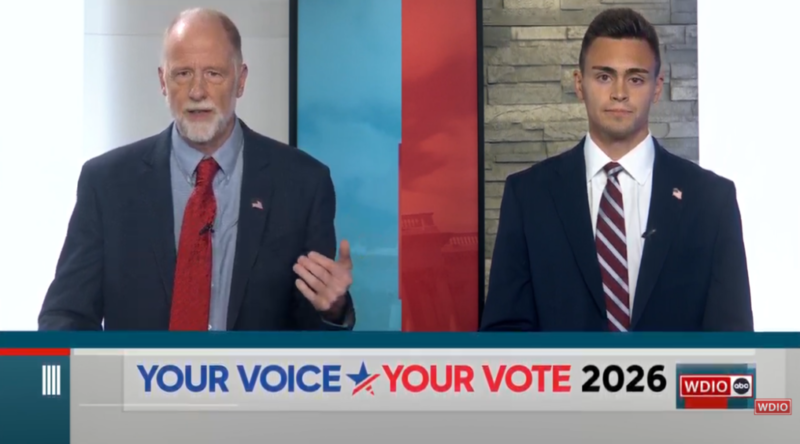
7th CD candidates Republican Michael Alfonso and Democrat Fred Clark debate
Oct 08, 2026 | 4:30 am ET
Description
Wisconsin 7th Congressional District candidates Democrat Fred Clark, a conservationist and former state lawmaker, and Republican Michael Alfonso, the son-in-law of U.S. Transportation Secretary Sean Duffy, faced off Wednesday night in a debate. (Screenshot via WDIO YouTube)
Republican Michael Alfonso, the son-in-law of U.S. Transportation Secretary Sean Duffy, and Democrat Fred Clark, a conservationist and former state lawmaker, faced off Wednesday night in the only scheduled debate in the race for Wisconsin’s 7th Congressional District.
The district, which represents the Northwoods, is currently represented by U.S. Rep. Tom Tiffany, who is running for governor. He was first elected in a 2020 special election after Duffy resigned the seat, saying he wanted to focus on his family.
Duffy, who President Donald Trump appointed transportation secretary last year, has helped bankroll and provide support for his 26-year-old son-in-law’s campaign.
Alfonso, who is married to Evita Duffy, has spent much of the campaign touting an endorsement from Trump and faced criticism about his lack of work experience. After he went to college, he worked for as a producer on Dan Bongino’s podcast in Florida for about a year. He said during the Republican primary that he has worked as an accountant for a church since moving back to Wisconsin.
Clark, a 67-year-old forester, is looking to flip the seat for the first time in 16 years, though it will be an uphill battle. Prior to Tiffany and Duffy, the seat was held from 1969 to 2011 by Democrat Dave Obey, the longest serving U.S. House member in Wisconsin history.
Wednesday’s debate covered an array of issues, including the cost of housing and gas, data centers, the Enbridge Line 5 pipeline and how northern Wisconsin can keep its residents from leaving. Throughout, Alfonso staked out positions that leaned towards cutting regulation and reducing government involvement, while Clark advocated for a balance of government investments and regulations.
One of the first topics was affordability as well as helping support residents in the 7th Congressional District. Alfonso brought up gas prices and argued that the U.S. needs to be more energy independent.
“We cannot be relying on nations that hate us for stability in our oil prices,” Alfonso said. “Now, it’s very simple. We need to make sure that we are drilling here and that we’re producing energy here in a safe manner.”
Diesel prices have risen to record highs, in part due to the war in Iran launched by the Trump administration. Clark called for better foreign policy to help address the rising cost of fuel.
“As Michael Alfonso pointed out, gas prices and diesel prices are through the roof high as a result of this administration’s war in Iran, which was started without a plan with no plan to get out, but the reality here is that oil prices are a global commodity, and what happens in the Middle East affects oil prices here at home, no matter how much we pump,” Clark said. “We’ve got to get smart about a trade policy and a foreign policy that reduces the risk and the chaos that we’ve been experiencing in the last 18 months.”
The war in Iran also came up later in the debate.
Clark said that Congress needs to take seriously its job of deciding whether the country should go to war.
Alfonso said that the U.S. needs to stop acting as the world’s “policeman” and needs to stop being involved in foreign conflict altogether — but then pivoted to defending Trump’s decisions in Iran.
“We are not going to bring peace to the Middle East, but what we can do is stop them from having a nuclear weapon. Iran is a country that has hated us for decades. President Trump had the bravery to step in and make sure that these people do not have a nuclear bomb to use against us,” Alfonso said.
One of Trump’s justifications for launching a war in Iran was to prevent it from developing a nuclear weapon. According to Reuters, there was no credible indication of Iran having a coordinated weapons program in the leadup to the beginning of the conflict, though Iran was enriching uranium.
Alfonso said that he supports Line 5, a 645-mile petroleum pipeline owned and operated by Enbridge that runs through Wisconsin. He criticized Clark for not being supportive of the pipeline.
“Line 5 is one of these things that brings costs down for every single family in Northern Wisconsin,” Alfonso said. “How can you not support it?”
Clark said that he doesn’t want to shut down Line 5, but said there needs to be some federal guardrails on setting lines. In August, Line 5 had a leak that is the largest oil and gas pipeline spill reported in Wisconsin in more than 50 years.
“The risk of a spill in the Lake Superior watershed, in the river watershed and Lake Superior is extraordinarily high, and the environmental impact of that would affect this area for generations, but it also brings natural gas liquids here to Wisconsin and Michigan,” Clark said. “I’ve not called for it to be shut down, but we do need a law at the federal level to allow basically the opportunity to cite these lines. Right now, nowhere in federal law is there any law or any agency that oversees line setting where these things are placed, and we need that just the same way that we needed for transmission lines and other public utilities. I want to see that change.”
Both candidates also discussed bringing down the cost of housing, though their approaches were starkly different.
Alfonso said the government should cut regulations on home building.
“The number one thing we can do is cut red tape, especially around housing,” Alfonso said. “I worked in construction, and I know that it costs almost $50,000 before you can even break ground on a new home. If you want to make housing more affordable and have young families move back to the district, that’s a great step to take.”
Clark said there needs to be programs to help people looking to buy their first home as well as support from the government and private sector that can make manufacturing more affordable, including by using wood from Wisconsin.
“We need to be smart about it,” Clark said. “It isn’t just eliminating all the rules and regulations.”
Alfonso worked in construction while in school at the University of Wisconsin-Madison. During the debate, Alfonso criticized “these ridiculous public universities that do nothing but indoctrinate our students” and called for taking away funding from them and putting it towards trade schools, saying that that would help keep young people from moving away.
“We need to be pushing our young people towards trade schools that will actually teach them a useful skill in sending instead of sending them off to a crazy wealth university that will do nothing but indoctrinate them and put them deeper into debt, so it’s even more difficult to buy your first home,” Alfonso said. “The best part about trade schools is the students that graduate from these trade schools stay in Wisconsin.”
Clark said that he has heard from mayors and small town leaders from across northern Wisconsin that young people aren’t staying in their communities due to a lack of affordable housing, childcare and public investments, which “make people want to live in a place.”
“Until we change that… our economies are not going to be able to thrive,” Clark said. “There is a smart role for government to do that. It doesn’t mean more regulation. It means the right investments in the right places. It means helping make housing more affordable. It means helping families afford childcare.”
On the topic of education, Alfonso said he also supports eliminating the Department of Education, saying that he doesn’t think the agency should have any say over what is happening in local Wisconsin schools.
Alfonso then pivoted the question to being about bathrooms. Alfonso has used the issue of bathrooms being used by transgender students as an issue throughout his campaign.
“So you know what the Department of Education is responsible for? Boys and girls bathrooms,” Alfonso said, mentioning the New Richmond school district, where the Department of Education had launched an investigation over its policies surrounding bathrooms.
Alfonso asked if Clark supports the federal agency on that issue.
“I don’t think the federal government needs to be deciding what bathrooms” students use, Clark said. “I trust teachers and school administrators and parents make that decision in their community schools.”
The candidates also answered questions about data centers, which across the country have become major issues in political campaigns.
Alfonso said that data centers should use “closed loop” water systems, that they should not raise energy costs and that local communities should have control over whether data centers are built. He said the federal government should not be stepping in to decide those matters.
“If you were to ask me, do I want a data center in Hayward, Wisconsin, where I live? Absolutely not, but I’ll tell you what the federal government does not have a role in stepping in,” Alfonso said.
In response, Clark asked Alfonso, “Are you willing to tell the president that he’s wrong to want to preempt states from having regulations around artificial intelligence and that he’s wrong to let Mark Zuckerberg and Jeff Bezos basically run the table wherever they want to when it comes to AI and data centers?”
A provision in Trump’s “One Big Beautiful Bill” Law in 2025 that passed the U.S. House, but was removed in the Senate would have prevented states from being able to regulate AI for 10 years and limited states’ ability to restrict or tax AI data centers. Trump has also signed executive orders aimed at discouraging states from regulating AI.
“President Trump was actually very clear with this. He said, if you’re a local municipality and you don’t want one, you don’t need one. President Trump truly listens to the people, I mean, we look at issues like the data center issue. It’s very clear people in northern Wisconsin don’t want it, but I can’t say the same for Kansas. I’ve never been there if they want one. It’s not the federal government’s job to step in and say, no, it’s the state or local government,” Alfonso said.
Trump recently said that communities that don’t want data centers will “end up being backwards and poor.”
In his closing statement, Alfonso said that the election would be about “common sense versus crazy.”
“I support getting the government out of the way of business so that we can lower costs for Wisconsin families. That’s my number one priority,” Alfonso said. “I want to work to make sure that everyone in Wisconsin can afford healthcare. I want to make sure that every small business owner is able to grow, and I also want to make sure that the young people that are born in northern Wisconsin have a northern Wisconsin that they can come back to.”
Clark said in his closing statement that northern Wisconsin has “everything we need to lead good lives with prosperous businesses,” and that its farms, forests, water and tourism are assets.
“For that to work for all of us, we need a government that works that sets fair rules of the game, and that allows us businesses to grow and make the right investments to help make that happen,” Clark said. “We’re not going to see people moving back to Northern Wisconsin if that doesn’t happen. We’re not going to see businesses thrive and survive. There’s a partnership there that has to work.”
Madison, WI