Ohio Election Integrity Unit finds ‘no violation’ with Ramaswamy’s campaign credit card reporting
Oct 07, 2026 | 3:55 am ET
Description
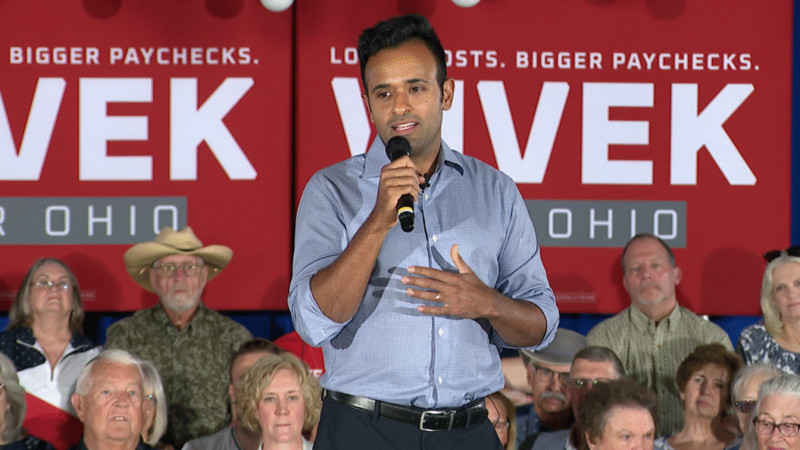
Ohio Republican candidate for governor Vivek Ramaswamy. (Photo by WEWS)
Last month, the Ohio Election Integrity Unit under the Ohio Secretary of State’s Office issued a finding of “no violation” for Vivek Ramaswamy’s campaign credit card reporting. Ohio state Sen. Kent Smith, D-Euclid, filed the complaint and is weighing an appeal.
In June, the Ohio Capital Journal reported the Ramaswamy campaign had racked up nearly half a million dollars on a credit card without reporting details about the expenditures.
Since then, Ramaswamy’s team has revised its campaign finance reports. Expenditures previously obscured behind a single credit card reimbursement are now broken down into individual line items.
The secretary’s office has also fulfilled Ohio Capital Journal’s public records request for supporting documentation related to the campaign’s reports.
Ohio GOP candidate for governor has put $500,000 on the campaign credit card
Despite that, there’s room to quibble with the no violation finding, Smith said. The revised reports, for instance, list the payees and amounts, but instead of reporting those transactions on the date they occurred, each one is listed on the date the campaign paid its credit card statement.
Smith is also frustrated the secretary’s office still hasn’t responded to his request for correspondence with Ramaswamy’s campaign.
“There’s one of two conclusions,” Smith said. “(Ohio Secretary of State Frank) LaRose is letting the billionaire candidate skate on the rules, or LaRose and his office, to the best of their ability, are trying to make Ramaswamy come into compliance, and he’s completely ignoring it.”
“You would think that the correspondence between the offices would satisfy that curiosity,” he added.
The Capital Journal sought comment from the Secretary of State’s office and Vivek Ramaswmay’s campaign for this story. Neither responded.
The background
Starting with its very first campaign finance report in 2025, Ramaswamy’s campaign reported thousands of dollars in monthly campaign expenditures as a single credit card reimbursement.
Early on, those expenditures were relatively small. In April of 2025, for instance, the campaign reported about $6,700 on its American Express card.
A year later, the campaign reported more than $96,000 on its credit card in one month.
State law requires campaigns to report what they spent, who they paid, what they purchased and when it happened. By reporting its monthly credit card statement, the campaign was able to obscure nearly all those reporting requirements.
The Ohio Capital Journal first reported the campaign’s unusual credit card use in April ahead of the primary election and filed a public records request with the Secretary of State’s office.
The Ramaswamy campaign’s pattern of credit card use continued on its post-primary campaign finance report in June.
The Capital Journal again requested public records from the Secretary of State and asked a series of questions about his office’s efforts to correct the campaign’s reporting.
Ohio Republican Vivek Ramaswamy holds big cash lead over Democrat Amy Acton after $25 million loan
In August, the secretary’s office responded to the records request with supporting documents for the campaign’s reports. The secretary never responded to the Ohio Capital Journal’s questions.
The complaint process
Following the Capital Journal’s story, Sen. Smith filed complaints with the Ohio Election Integrity Unit and requested correspondence between the secretary and the Ramaswamy campaign.
He described getting pushback to his complaint from the secretary’s office, explaining that Ramaswamy’s team was correcting its reports.
Smith didn’t retract his complaints, and on Sept. 16, the Ohio Election Integrity Unit sent him its findings of “no violation.”
Unlike the Ohio Elections Commission, which was a politically independent body charged with overseeing campaign finance law, the Ohio Election Integrity Unit operates within the secretary’s office.
The Ohio Elections Commission was eliminated by Republican state lawmakers and the new unit was put under the partisan elected office of the Secretary of State.
The letters emphasize the secretary’s role in the decision.
“After careful consideration of the evidence,” they read, “the Election Integrity Unit has recommended, and the Secretary of State adopted, the following finding(s).”
LaRose, who is running as the Republican candidate for state auditor this November, has endorsed Ramaswamy and appeared alongside him at several campaign events.
Catherine Turcer from the government watchdog group Common Cause Ohio, doesn’t see a problem with the unit’s finding.
The goal of campaign finance law, she explained, often isn’t to penalize committees who get their filings wrong — it’s to get them to fix the problem.
“It makes sense for the Secretary of State’s office to alert them as soon as possible,” Turcer said, “and to try to get the information as quickly as possible, so that voters actually have information when they can use it.”
Under the previous system, she said, audits or commission decisions could come a year or more after the fact. Turcer also has no immediate issue with the secretary’s role in the decision-making process.
“I always appreciate when it’s honest,” she said. “It makes it very clear that at the end of the day, the secretary of state is deciding — that the unit made a recommendation, the secretary of state is making a decision.”
“What is a problem,” she added, “is that it’s not clear that the person who complained can actually appeal this to the commission.”
When lawmakers nixed the Ohio Election Commission they replaced it with a new five member Ohio Election Integrity Commission. The secretary chooses the commission chair, and majority and minority leaders in the General Assembly each get one nominee.
While the secretary’s election integrity unit investigates, and the secretary decides on fines or referrals to county prosecutors, the new commission has the final say if a complainant appeals.
The letter Smith received makes no mention of an appeal. Instead, it advises that “no further action is needed from you” and includes contact information if he has questions.
“If it’s not clear that, hey, the next step is you could go to the commission with an appeal, well that’s a problem,” Turcer said.
Appeal coming?
For Smith, the gaps in Ramaswamy’s campaign finance reports are less concerning than what those gaps might suggest.
“Has my campaign lost receipts over 25 years? Oh God, yes,” Smith said. “Has everybody lost receipts? Of course. Should any candidate be prosecuted for lost receipts? No.”
“But again,” he continued, “when the problem gets egregiously worse, that says to me the problem was never corrected. And that is either a failure of the Secretary of State’s office to tell the Ramaswamy campaign, no, you can’t do this, or the Ramaswamy campaign has been told and they’re ignoring it.”
Smith says he’s still “considering every additional option” but has yet to formally appeal the secretary’s decision.
Follow Ohio Capital Journal Reporter Nick Evans on X or on Bluesky.

Columbus, OH