Three criminal cases involving ICE hit the Supreme Judicial Court
Oct 06, 2026 | 9:21 am ET
Description
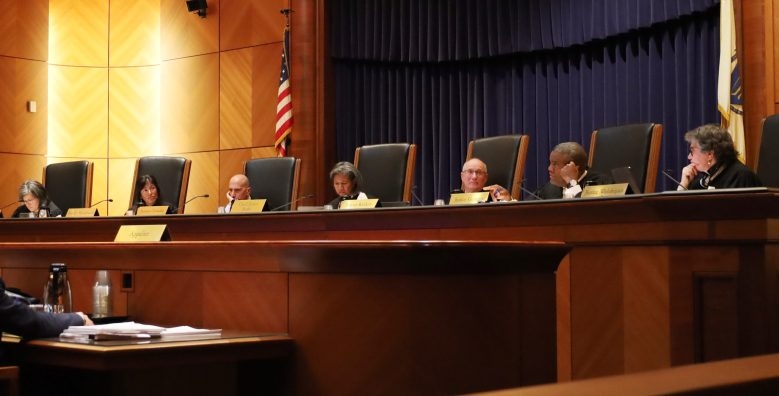
The Massachusetts Supreme Judicial Court Justices at the John Adams Courthouse in Boston.
WHEN MASSACHUSETTS’S criminal justice system collides with federal immigration actions, the fingers start pointing.
Justices of the Supreme Judicial Court spent most of Monday’s oral arguments trying to work out whether prosecutors have any duty to tell judges if their defendants could be arrested by US Immigration and Customs Enforcement, and what power, if any, state judges have to order immigration officials to bring a person back into the state so they can face trial.
If it turns into federal versus state “standoff,” as several justices put it, what then?
Lawyers for three men detained by ICE during their Massachusetts criminal prosecutions argue that judges and prosecutors can do more to prevent immigration proceedings from derailing the normal course of justice.
In a case that sparked a political conflagration between the Suffolk County district attorney’s office and federal prosecutors last year, Dominican national Wilson Martell-Lebron was arrested outside the courthouse mid-trial by an immigration agent who had been slated as a prosecution witness. Martell-Lebron was charged with providing false information on a license application.
The judge in the case, Mark Summerville, accused ICE agent Brian Sullivan of violating Martell-Lebron’s rights to due process and a fair trial, and concluded that two state troopers involved in the case and communicating with the ICE agent knew about plans to detain the man. Summerville dismissed the case against Martell-Lebron, ruling there had been egregious prosecutorial misconduct.
The Suffolk County district attorney’s office appealed Summerville’s decision.
Justices on Monday were openly skeptical of claims that prosecutors had no special knowledge that their defendant would be detained, given that the ICE agent who directed the detention was part of the prosecution before the trial.
“I’m not buying your argument that he’s not a member of the prosecution team after the discovery stage,” Justice Frank Gaziano said, referring to the period of time before trial where both sides exchange relevant information.
A member of the prosecution team is not allowed to do anything to derail the prosecution — that would be prosecutorial misconduct, said Justice Gabrielle Wolohojian, who noted that the ICE agent was a member of the prosecution team “and he caused the defendant’s unavailability for trial.”
State officials have no jurisdiction over federal immigration enforcement operations. Assistant District Attorney Elisabeth Martino told the justices that the ICE agent was conducting a “separate, sovereign, federal action.”
Martino acknowledged that the ICE agent had said throughout the proceedings that his agency was interested in taking the defendant into custody at some point. But she claimed the understanding was that meant at the end of the trial.
“Why wouldn’t the prosecution give the judge the information it has,” asked Chief Justice Kimberly Budd. “I understand you’re saying they have no power to do anything, but they have the power to let the court know what’s happening.”
The district attorney’s office argued that prosecutors should not have to inform the court about possible immigration enforcement action, in part because federal agents might try to hold prosecutors responsible if they scare the defendant into fleeing.
Under the law at the time of Martell-Lebron’s trial, the burden was on federal agents to inform the court if they plan to arrest a defendant.
And the PROTECT Act, which was passed this year and creates new guidelines for how federal agents should operate in “sensitive locations” like courthouses or schools, does not instruct prosecutors to inform the courts if there may be an immigration action.
There are consequences for failing to follow the new rules, like being sued by the state attorney general, but those remedies are aimed at the ICE agent rather than prosecutors.
The Martell-Lebron case, like the two other immigration cases before the high court on Monday, also considered what power state judges have to make sure a defendant is able to appear in court.
Once Martell-Lebron was taken into ICE custody, Martino said, prosecutors asked for a writ of habeas corpus, which is an order demanding that the government bring a detained person to court. ICE told the prosecution that the initial writ did not have the correct language, and Judge Summerville refused to issue a second one with corrected language.
That seemed to trouble the high court. Dismissing a case with prejudice, Gaziano noted, was an “extreme remedy, and before getting there [a judge] should exhaust the process that’s available to him properly, and that didn’t happen.”
Even if the judge was skeptical that ICE would comply, SJC justices suggested, he should have gone through the process of correcting the writ. Martino said that is “the absolute, major problem in this case.”
In the case of Freslet Noralus, charged with assault with a dangerous weapon and taken into ICE custody in May 2025, a state district court judge wouldn’t issue a writ of habeas corpus to immigration officials at all.
After consulting with the Fall River District Court clerk-magistrate, Judge David Sorrenti concluded he did not have the authority to issue the writ after learning that Noralus was being held at a detention facility in Kentucky.
The court denied a motion to dismiss and issued a default — or failure to meet a legal obligation — because Noralus was not present, along with a warrant for “a man it knew was in a cell in Kentucky,” attorney David Rassoul Rangaviz said. This effectively punished him for not being there, an absence that was “guaranteed” by the court refusing to sign off on the writ of habeas corpus, Rangaviz added.
Noralus has now been deported to Haiti. Rangaviz told the court that this means the state wants to keep the charge open indefinitely “against a man that its own inaction helped to deport.”
Rangaviz asked the SJC to hold that the courts can issue writs of habeas corpus even if the defendant has been moved out of state and that there cannot be a default against a defendant who the court knows is absent because of being detained by ICE. He also argued that the case must be dismissed with prejudice, meaning the defendant can’t be retried, if the state does not “do the work” of trying to get the person to trial.
The defendants’ attorney, prosecutors, and the attorney general agree that the trial judge should have issued the writ in Noralus’s case. Even though state writs can’t be enforced on the federal level, there are several instances where federal officials have respected the court order anyway, Rangaviz said.
In a brief, the ACLU of Massachusetts said the process is well-established. A state trial court can issue a state writ to bring the person to the next court appearance, and if federal officials don’t recognize it, state prosecutors can request that the US District of Massachusetts issue a supplemental federal writ to accompany the state one.
If ICE chooses not to comply with the writ or deports the defendants, that creates another legal quagmire. At least 30 Massachusetts criminal cases are in the same holding pattern, Rangaviz noted in his brief, with “outstanding default warrants, absent defendants, no end in sight.”
Jaime Loredo, who was arrested on drug charges in 2025, was detained by ICE right after his family posted bail.
Loredo is a messy example of writs in action, as he was moved from ICE detention in Massachusetts to Virgina. ICE ignored at least one state writ to have Loredo appear virtually, and honored multiple others. The state prosecutor did not file a federal writ to have him appear in person, and the federal government deported Loredo before trial. Like the Noralus case, the court similarly declined to dismiss Loredo’s charges and issued a default warrant.
Loredo then came back into the United States and was arrested again.
Keeping cases and defaults open can punish defendants for absences beyond their control and complicate immigration or asylum proceedings. This puts them in a “terrible limbo,” said Michaela Martin Strout, Loredo’s attorney.
Norales and Loredo’s attorneys argued that defaults issued when someone is unable to appear due to ICE action violates defendants’ constitutional right to due process. But justices suggested in some cases, “the default serves a practical purpose for a person who doesn’t deserve to be let off scot-free,” said Justice Scott Kafker.
Rulings from the high court are supposed to be handed down within 130 days of the oral arguments but can take longer.
Amid the thorny questions of prosecutors reporting immigration action or the mixed incentives of defaults and open warrants targeting people well outside the state’s jurisdiction, justices appeared most clear on one takeaway — if judges can act, they should.
“You have to try,” said Justice Dalila Wendlandt of the Suffolk judge’s refusal to submit a corrected writ to ICE. “I’m not just making that up. I think it’s the case law.”

Boston