Morrisey’s administration now competing with Justice’s for title of least transparent
Oct 06, 2026 | 5:55 am ET
Description
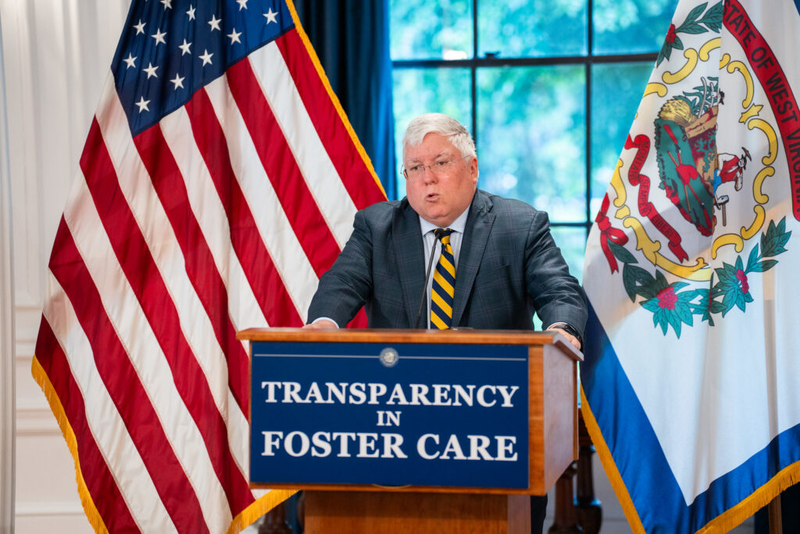
Gov. Patrick Morrisey speaks at a news conference about foster care on May 28, 2025. (Photo courtesy of the West Virginia Office of Gov. Patrick Morrisey)
Gov. Patrick Morrisey bragged a lot about how transparent he was with the press when he first took office. He’d take questions from reporters at in-person news conferences, which felt like an improvement after Gov. Jim Justice, who only did virtual press conferences and didn’t allow follow up questions from the few reporters he took questions from. But that really is the bare minimum. The government should answer to the people and the press.
In September, the governor took questions at only three of the 25 press events that are archived on his YouTube channel.
When media are invited to a press conference, it gives them the opportunity to take photos or video, and ask follow up questions to the governor’s announcement of a new initiative or policy. Typically a couple of hours after the presser, Morrisey’s office will email a news release with the information, and a few quotes from the governor. Allowing reporters to ask questions during the event gives the governor and his staff the opportunity to answer questions once instead of multiple times when the release may have had confusing wording or left out certain information.
If he’s not going to take questions at his events, why should a reporter waste one to two hours of their day attending the event when they’ll have the same information in a news release just a few hours later?
At the end of a news conference, Morrisey used to ask the media if they had any questions for him or other officials who might have been present. Sometimes he’d ask the media to keep their questions related to the current announcement, but this is a great opportunity for reporters to get a quote straight from the governor instead of his spokesperson. So yes, they want to ask questions about other issues as well.
Not only has he stopped taking questions, but it seems Morrisey’s office doesn’t want the media to be able to plan to attend his pressers. Often, his office announces an event the morning of the speech or the night before, after 5 p.m.
Ogden reporter Steven Allen Adams posted on X last week that Morrisey was “preparing to have a last-minute press conference announcing home energy rebate programs.”
The governor responded to the post that the presser had “been scheduled for some time so it’s not last minute.” However, as Adams pointed out, the email announcing the press conference was sent at 7:16 a.m., less than three hours before the event. That doesn’t leave time for reporters to plan to attend.
This has become a strange pattern with Morrisey. He won’t take questions, his office won’t respond to comments, but he’ll respond to reporters on social media if they don’t reach out to his office.
Just last week, he attacked the reporting of Gazette-Mail reporter Mike Tony over his coverage of West Virginia’s application to become a nuclear development hub.
Morrisey lashed out at the Gazette-Mail and Tony on X: “The Gazette got it wrong. This Friday’s story intentionally misrepresented my administration’s energy plans without giving me a chance to address their claims and slanted coverage.”
Tony obtained the state’s application through a public records request, and it stated that the state offered to store nuclear waste and listed potential sites in Boone, Jackson and Jefferson counties.
Morrisey’s post continued, “But West Virginia will not be a dumping ground for nuclear waste. Period.”
Which is true, because the Morrisey’s administration quietly withdrew its application Wednesday night, according to reporting by Adams.
When reporters can’t get officials to respond to them, they often turn to public records requests, and the Morrisey administration’s handling of these is even more frustrating than the lack of comments.
Under the Freedom of Information Act, everyone has the right to request a copy of any public record of any public body in West Virginia. The state then has a maximum of five days, not including weekends or holidays, to provide the documents or give a reason for denying the request.
It’s not uncommon for the Morrisey administration to respond to a reporter’s FOIA request with a notice that their response will be delayed.
It took West Virginia Watch reporter Amelia Ferrell Knisely months to write a story on the state piloting a new system for how Child Protective Services workers make decisions about foster children’s cases because the state took 77 business days to respond to her request. She sent her original request on Nov. 19, 2025, and received the documents on March 13, 2026.
Lori Kersey waited three weeks on a records request before giving up and reporting a story about Aaron Siri, a lawyer who represented the plaintiff in the state’s vaccine lawsuit, who also represented RFK Jr. and an anti-vaccine group. Eight months after the story was published, she received the documents, which didn’t include anything worth using. If she had waited, the story would have been delayed eight months for no reason.
WV MetroNews reporter Brad McElhinny showed exactly how maddening the cycle is in his story about what happened with the state’s SNAP waiver for hot, healthy foods.
On Aug. 21, 2025, McElhinny sent his first FOIA request to the West Virginia Department of Human Services, Bureau for Family Assistance, asking for copies of public records related to the state’s waiver request allowing for hot, healthy foods to qualify as SNAP purchases.
The state responded the next day to say they expected to have a formal response to him no later than Sept. 29, 2025.
“But then, every month for the past 12 months, the state has responded with an email saying, ‘We are still researching to determine if we are in custody of any responsive documents regarding your request.’” McElhinny wrote. “That was the response last September, then in October, twice in November, a break for December, turned the calendar to January, blustered through February, blew into March, poured into April, then May, June, July and finally circled back to a year in August.”
There are so many stories that reporters want to write, but they can’t because they can’t get the supporting documents from the state. I’ve seen questions from people wondering why the media isn’t covering a certain subject and in most cases, this is why.
We’re working on so much, and we get so many tips, but when the governor and his administration don’t cooperate with us, it makes it very difficult to report.
Government transparency is necessary for the press to be able to tell the stories of how decisions made by our government officials are affecting or could affect West Virginians. Unfortunately, Gov. Morrisey and his administration rarely cooperate with us, making it very difficult to publish these important reports. Please know that we’re persevering.
Charleston, WV