Utah’s top election chief says Trump admin’s ‘gamesmanship’ with voting keeps her up at night
Oct 05, 2026 | 7:03 am ET
Description
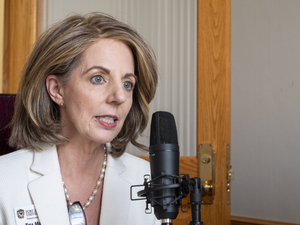
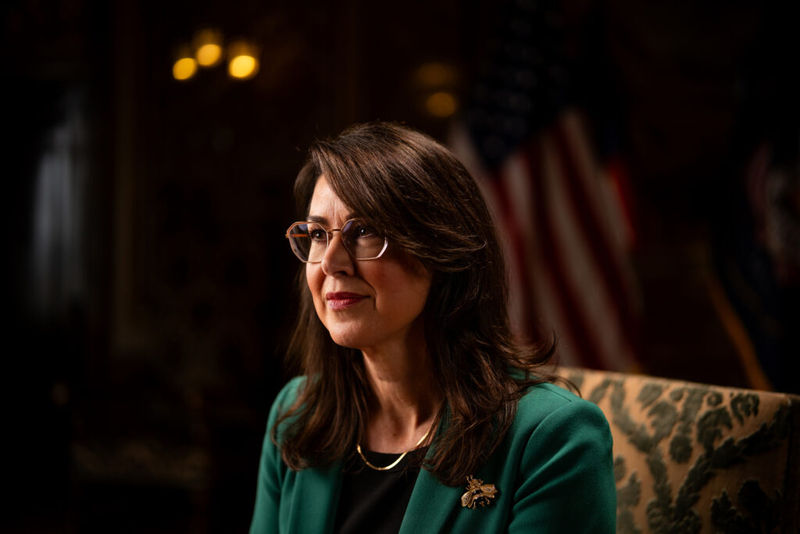
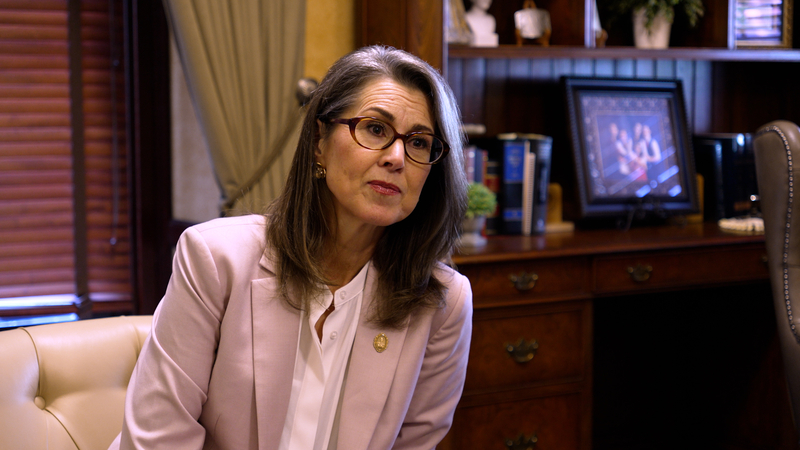
Lt. Gov. Deidre Henderson poses for a photo in the Gold Room at the Capitol in Salt Lake City on Thursday, Feb. 15, 2024. (Photo by Spenser Heaps for Utah News Dispatch)
Editor’s note: This story is part of We Vote Utah, a partnership between KUER, PBS Utah and Utah News Dispatch to cover Utah’s 2026 elections.
The top election official in the red state of Utah has been loud and clear — on and off social media — about her concerns with the Trump administration when it comes to voting rights.

Utah Lt. Gov. Deidre Henderson has refused to release private voter data despite threats of criminal prosecution by the U.S. Department of Justice. Last month, she learned the DOJ was investigating her as a result of her refusal.
She’s also pushed hard against President Donald Trump’s executive order seeking to change how the U.S. Postal Service processes mail-in ballots. That rule would have mandated states collect information from voters and send that information to the federal government while also banning the Postal Service from delivering or collecting mail-in ballots from people who haven’t been confirmed as eligible voters.
That rule has since been tied up in the courts — but had it been allowed to take effect so close to this year’s election, Henderson has said it would be an “unmitigated disaster.”
Henderson has also heavily criticized Sen. Mike Lee’s proposed SAVE Act as legislation that would “hurt Utah voters and preempt state laws in ways that don’t make sense” while being “impossible to implement.”
She doesn’t mince words. Even though she shares her Republican party affiliation with Lee and the president, she’s been a fierce advocate against their efforts, which she has said would erode voting rights.
Utah clerks don’t expect lawsuits over Trump’s mail-in voting rule to impact elections this year
In Utah, voting by mail has a long history, and has long been lauded as a safe and secure method by the state’s leaders across the political spectrum, Republicans and Democrats alike. In recent years, however, as Trump has continued rhetoric of widespread fraud without evidence, Utah lawmakers have made moves to slowly pull back on universal, automatic voting by mail by enacting more ID requirements and requiring voters to opt in to receive a by-mail ballot by 2029.
The Republican-controlled Utah Legislature started allowing counties to conduct elections entirely by mail nearly 15 years ago. Since 2018, nearly all of Utah’s counties have run their elections primarily by mail while also providing in-person voting options. Since 2020, it’s been the state’s default voting method, with all registered voters automatically sent a ballot. As voting by mail has gotten more popular, so has voter turnout, according to research by the conservative think tank Sutherland Institute.
As the political winds have changed, Henderson has remained a firm advocate for voting by mail, defending Utah’s system as one that’s highly secure — and accessible — while also supporting efforts to improve wherever possible.
In a recent sit-down interview with KUER, PBS Utah and Utah News Dispatch as part of the We Vote Utah partnership, Henderson discussed what it’s like to push back against the Trump administration and Lee’s efforts to change how Americans vote.
In that interview, Henderson said the effort to implement the SAVE Act immediately — rather than providing a longer runway for such drastic changes — only has one purpose, and “that is just to disenfranchise people.”
“And that’s crappy,” she said. “That should not happen. That’s despicable.”
To Utah’s chief election officer’s surprise, the DOJ says it has been investigating her since 2025
She also said the Trump administration’s “gamesmanship” with voting rights for political gain is what keeps her up at night.
“It is hard because there are so many forces — forces much greater than me, greater than the Legislature, greater than our state — that are trying to muck things up for our voters,” Henderson said. “And I take Utahns’ voting rights very, very seriously. They are sacred, and they ought to be protected, and they ought to be preserved, and they shouldn’t be mucked around with for political purposes.”
Henderson said she also doesn’t know what the “end game” is for all of these efforts “because I am not creative enough, maybe — or devious enough — to think about what in the world the motivation could be.”
“But I don’t think it matters, even if the motivations are really good, right?” Henderson said. “The chaos and confusion that’s being created, the guardrails that are being destroyed — it’s not worth any motivation.”
Below is a transcript of the interview with reporter Sean Higgins for KUER’s State Street podcast. It was edited for length and clarity.
Interview transcript
You’ve been a vocal defender of Utah’s election system for years now. You’ve also been under a lot of pressure from the Trump administration, the DOJ, and elsewhere this year, and are now under investigation. How are you feeling all of this right now?
Henderson: I feel fine, everything’s fine.
You know, I’m just doing my job. Honestly, there are days where it’s hard, and it’s like, ‘What? One more thing? Like, can we just have a day that doesn’t have some big catastrophe and crazing thing coming from the federal government?’ But I’m just doing my job.
Is there a scenario where you would comply with some version of the DOJ’s request for voter rolls?
Henderson: Well, I’ll comply with anything that’s lawful, of course. I don’t think their request is lawful, and 23 courts now have agreed with me. So, if for some reason, you know, it ends up that a court orders me to do that, and we have no other alternatives, obviously, of course, I will comply with that.”
Outside of a court order, was there anything else in the order or the request that would need to change for you to say, ‘Oh maybe there is a legal case for me to give this information?’
Henderson: We offered to send them the public version of our voter rolls, and you know, we can do that, but that’s not what they want.
You signed onto a brief with election officials from both red and blue states, asking the court to preserve mail-in ballot processes for this election. What does that bipartisan coalition tell you about how officials who actually run elections view this fight maybe differently from politicians who just talk about it?
Henderson: Well, the big difference is election officials don’t have the luxury of just talking about stuff. We actually have to do stuff, and this is not a partisan issue. We can’t change tack like this and implement this rule.
We would have to reprint all the ballots. We’ve got our overseas and military ballots going out … Some states have already sent out their early ballots. We just, we just can’t do it. And the bipartisan coalition just shows that this is not just a partisan thing, where one party doesn’t like the party that’s in power. This is an actual practicality thing as well.
I want to turn to your relationship with Sen. Mike Lee now. You and Lee co-wrote a 2022 op-ed defending Utah’s election system as a federalism model that the rest of the country could look to. What do you think changed for him between then and now?
Henderson: That’s a question you’re going to have to ask Sen. Lee. I have no idea.
Want to elaborate at all?
Henderson: Sen. Lee is doing the job the way he wants to do it and the way he sees fit. I’m doing my job the way I see fit, and I really can’t elaborate on that.
You wrote, I believe this was back in March, that you can count on zero fingers the time that Sen. Lee consulted you before pushing the Save Act. Has that changed at all since March? Have you spoken with him specifically about what’s going on now with the DOJ, what’s in the Supreme Court, or the SAVE Act since then?
Henderson: The only time I hear about Sen. Lee is when he tweets about me.
If mail-in voting is eliminated or heavily restricted nationally after this cycle, what would happen in Utah specifically? We’ve built this whole system since 2018 that’s hinged on vote by mail. What would actually happen to the way the state conducts elections?
Henderson: Well, I mean, if this rule is allowed to go into effect, it’s going to have a much broader impact than just Utah not being able to do vote by mail. It really will change the dynamic between what’s in the Constitution and what is actually being practiced by a federal executive branch.
I think the implications will be far-reaching and incredibly negative. If Congress wants to pass a law to alter a vote by mail or to restrict it or somehow enforce it in certain ways, that’s up to Congress to do. They represent the people. They have the authority in the Constitution to change election laws. Otherwise, it’s up to the states, and that’s in our U.S. Constitution. So, I think there are much broader implications if this rule goes into effect than just how Utah will have to scramble and do balloting, voting differently.
Taking this out of the nitty gritty of policy and the way things are written and the way the courts interpret things, what is this really about, in your opinion? What is trying to be accomplished here?
More than 5,000 Utah voters need to provide proof of citizenship under new state law
Henderson: It’s a good question. I don’t know what the end game is, and probably most of the reason I don’t know what the end game is is because I am not creative enough, maybe — or devious enough — to think about what in the world the motivation could be.
But I don’t think it matters, even if the motivations are really good, right? The chaos and confusion that’s being created, the guardrails that are being destroyed — it’s not worth any motivation. Even someone who thinks they have good motivations, and I’m sure some of the people who are supportive of this think they have good motivations. But in my mind, it doesn’t matter because this is not what the Constitution says, it’s not what Congress has authorized, and it’s not what our state legislature has authorized.”
What do you think Utahns need the most this election cycle, from either from you or from the powers that be in Washington D.C.?
Henderson: When it comes to elections, Utahns need confidence. They need a chaos-free election. They need to know that the motivations, at least of their election officials, are good, and that … we’re not trying to put our thumb on any scale. What we want is for every eligible voter to be able to cast a ballot and know that that ballot will be counted accurately. That’s what Utahns need to know.
Looking at this issue a little bit more broadly, Utah passed its own citizenship verification law last year, but it doesn’t kick in fully until 2029. Either the Save Act or what’s happening right now with the Department of Justice or the USPS ahead of these midterms, does it almost ignore the exact lesson Utah tried to teach with implementing its own law?
Henderson: Yes. … One of the reasons that I started our own citizenship review of our voter list last year was because of all of these questions. Everybody was asking. People were throwing around wild numbers, saying that there was this huge, huge, widespread problem. And I’m a pragmatist, and if there’s a problem, I want to know about it. I want to know exactly what the problem is, and then work on solving it.
‘Not a widespread problem’: Lt. gov. releases early findings from voter citizenship review
So we did this review, and we did find some areas that could be improved. We did find little places that we can tweak and and and do better, and that was a really good thing. We also found a few noncitizens on our voter rolls, and a few of those that we found actually had voted. Very, very, very, very few. So what we found was, yep, room for improvement. We made a few tweaks and modifications, and there’s no big, huge problem.
And that is not a narrative, unfortunately, that the federal government wanted to hear. I learned a long time ago that, like they don’t want to know that we’re doing things OK. They don’t want to know that things are going well, because it goes against a narrative that is being pounded relentlessly of mass fraud or ineligible people voting.
And the facts just don’t support that narrative, and one would think that that would be relief to people. ‘Oh, phew. OK, we thought there was this problem, but now we see that there isn’t this problem.’ Well, that’s not what’s happening, unfortunately, with some people, and they’re just doubling down and creating problems where none exist, and that’s frustrating.
If we strip away all the personalities from this conversation, is there some version of federal election integrity legislation that you would actually support, and what would that look like?
Henderson: Well, yeah, of course, there are some versions of federal legislation that I would support.
Traditionally, at least in the last 50 years, the federal legislation … the motivation behind it, or the purpose of it, has been to help expand access to voting for eligible voters because states were being naughty. There were states that were actually restricting the right for eligible citizens to vote, especially in the South, and that’s why there needed to be federal legislation to expand it. I would be very supportive of legislation that helped preserve and protect people’s constitutional voting rights.
I would also be in favor of some sort of federal ID requirement. Most states have these ID requirements. Utah certainly does, or even documented proof of citizenship. If there is enough leeway for people to actually get their documents — having something like the SAVE Act that’s implemented effective immediately, the purpose of that is just to disenfranchise people, and that’s crappy. That should not happen. That’s despicable.
But if you really want, in good faith, to say we should have a national ID or we should have, you know, documented proof of citizenship in a federal requirement, those are valid conversations to have if people from both sides of the aisle can come together in good faith and figure out how to actually solve that problem without creating a whole bunch of new ones.
What keeps you up at night about all of this?
Henderson: Look, I am grateful to be in the spot I’m in. It’s an honor. I never expected to be here. I certainly don’t want to complain about any of the challenges. I’m happy to bear those challenges, but it is a burden to be the one person in the state that has the responsibility to be over elections right now.
It is hard because there are so many forces — forces much greater than me, greater than the Legislature, greater than our state — that are trying to muck things up for our voters. And I take Utahns’ voting rights very, very seriously. They are sacred, and they ought to be protected, and they ought to be preserved, and they shouldn’t be mucked around with for political purposes.”
Politics is part of our country, but politics is sharing ideas, debating ideas, making sure that your side is articulating what you want to do. Politics should not be messing around with the rules of the game to benefit one side or another. That should never happen, and that gamesmanship keeps me up at night.
What would success look like for you at the end of all of this?
Henderson: Success at the end of all of this, to me, looks like a very boring election, right? Not only on Nov. 3, but in the days leading up, in early voting, and then, you know, we’ve got a couple of weeks after where we canvass the results. The counties canvass their results. They conduct audits. If there’s a close race, they do recounts, and then the boards of canvassers certify the results. Like all of that happening and being very boring and having absolutely no news stories about any of it, to me, that would be success.
Salt Lake City, UT