Issue spotlight: North Dakota US House candidates discuss AI regulation, data centers
Oct 05, 2026 | 6:00 am ET

Description
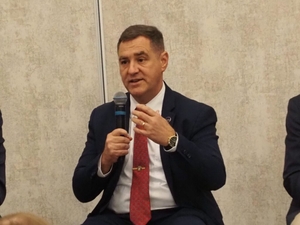
On the left, Democratic-NPL U.S. House candidate Trygve Hammer speaks to during the party's state convention on March 7, 2026. On the right, Republican incumbent U.S. House Rep. Julie Fedorchak gestures at supporters during a victory party in 2024. (Photos by Kyle Martin/For the North Dakota Monitor)
North Dakota’s Republican and Democratic U.S. House candidates agree artificial intelligence is powerful and in need of guardrails, but they differ on the level of accountability for AI products and their parent companies.
Republican incumbent Julie Fedorchak said she supports a bipartisan effort in the U.S. House to regulate the expanding industry and hopes accountability measures for AI misuse will come from the process. Democratic-NPL U.S. House candidate Trygve Hammer said AI regulations should be proactive instead of reactive and companies should be held negligent if their products violate the law.
Fedorchak said AI could be the most powerful technology Americans have encountered.
“That’s one of the main reasons why it’s so important for the U.S. to lead the way in the development of this industry and the regulation of it,” Fedorchak said.
Potential regulations
She said many states are already regulating different aspects of AI, and she believes the federal government should follow suit.
“It doesn’t make sense to have a patchwork of 50 different state regulations that these companies have to try to figure out,” she said. “It’s important to remember what we’re doing this for. People have legitimate fears about privacy.”
Fedorchak said she supports the Frontier Act, a bipartisan AI regulation bill in the U.S. House. The bill would establish reporting requirements for AI companies and their products, such as risk assessments, cybersecurity safety for unreleased AI models, response procedures for critical incidents and compliance audits. The legislation includes civil penalties of up to $1 million if the law is violated.
She said it’s important that AI models have a published safety framework in place when their models are released, as well as reporting requirements for critical incidents that could occur.
Issue spotlight: North Dakota US House candidates differ on solutions to affordability
The bill is under consideration by the U.S. House Committee on Energy and Commerce, which includes Fedorchak as a member.
Hammer said, “I think we need to get a handle on it, and we need to be thinking ahead of it instead of reacting to it.”
An international agreement may be needed to curtail AI use in areas affected by war so those products cannot create and approve their own kill orders without a human in the chain of command, he said.
“That’s part of the problem here is that AI will never have a concept of what’s morally right and wrong,” Hammer said. He added AI hacking into infrastructure will also be a problem since the products have learned how to cover their tracks.
A prohibition on self-feeding artificial intelligence, an AI product that learns and grows on its own without human involvement, is something Congress should look into, he said
Holding AI companies accountable
Hammer said he believes AI companies should be held responsible for the products they create. He added he does not want immunity offered to AI companies similar to what internet service providers received during regulation of the internet, which protects online platforms from content posted to websites by third parties.
At the very least, Hammer said AI companies should be able to be prosecuted for negligence based on the use of their products.
He said international outreach, especially with China, on AI needs to occur to put the products and industry on the same playing field.
“Let’s do this thing right and let’s not rush in and create more problems than we solve,” Hammer said. “When you have a bunch of people who only think about the next quarterly earnings report, it’s just not going to get done the right way.”
‘Dumbfounds us all’: Congress struggles with policies rippling from AI development
An international framework surrounding AI issues is something that should be discussed, Fedorchak said, and the world will need to work together “to some extent” to protect against the potential dangers of AI technology.
She said she didn’t have an answer on whether AI companies should be held responsible for the actions of their products in the hands of third parties, but hoped the House committee addressing AI regulations and the companies themselves would be able to find the “right balance.”
“We have to get bipartisan support for what we’re doing, and so if we get too dug in on a particular position on the front end, perfect could be the enemy of good,” Fedorchak said. She added tech companies do have to be held accountable and take down inappropriate AI content posted to their platforms.
“As a mom, I don’t want my daughter having images of her that were doctored up and posted on the internet,” she said.
Federal role in data center construction
Fedorchak said she supports local control for the development of data centers and doesn’t want the federal government getting in the way.
“I don’t think the federal government has a role to play in where they (data centers) are located,” Fedorchak said. “If there are appropriate places on federal land that could host data processing facilities … I’m open to that. There’s good processes in place for siting and permitting this kind of infrastructure already that are proven.”
She added the National Environmental Policy Act, the Endangered Species Act and historical preservation process have blocked the development of all kinds of infrastructure. One of Congress’ priorities is permitting reform to move projects along more quickly, Fedorchak said, but it would not impact local control.
Hammer said he expressed his concerns about the increase in data center construction two years ago in a debate with Fedorchak. He added he worries about abandoned facilities, if the demand for data centers subsides.
Construction of data centers should be a state and local issue with the backing of transparency laws, Hammer said. Companies constructing the facilities need to be upfront with citizens about energy and water use and written plans addressing the order of operations, if an emergency arises demanding a choice between resident needs and the needs of a data center, he said.
“I think we need to make sure it’s the community that wins,” he said. “Congress needs to force transparency and honesty, and restore trust.”
Hammer said a recent social media post from President Donald Trump about communities becoming “backwards and poor” if they don’t allow data centers into their communities is the wrong attitude.
“These people aren’t dumb. They’re not backward. They are just concerned,” Hammer said. “And part of their concern comes from being surprised, and there has to be better outreach.”
Independent candidates Helene Neville and Charles Tuttle are also running for U.S. House.
North Dakota Monitor reporter Michael Achterling can be reached at [email protected].
Bismarck, ND