Third-party candidates decry exclusion from only debate of the governor’s race
Oct 05, 2026 | 5:24 am ET
Description
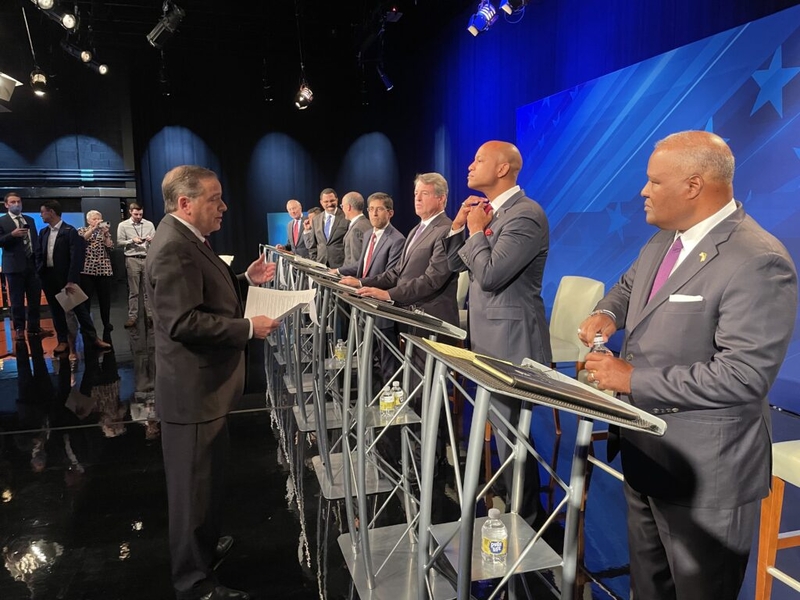
Eight Democratic gubernatorial candidates took the stage for a 2022 primary debate. That has two third-party candidates this year asking why they can't join the two major-party candidates on the debate stage Tuesday for the only debate in the campaign. (File photo by Bruce DePuyt/Maryland Matters)
There are four candidates on the ballot for governor this fall. There will be two on stage Tuesday for the only scheduled debate of the campaign. To Andy Ellis and Cathy White, that doesn’t seem right.
Ellis, the Green Party nominee, and White, the nominee of the Working Class Party, have continued, without success, to push for inclusion in the debate being held by Maryland Public Television. But MPT says only Gov. Wes Moore, the Democratic nominee, and Republican nominee Dan Cox met the criteria to be on the stage.
“We claim to be living in a democracy, yet they put up all these barriers to having third parties in the first place,” White said last week. “The two-party system is a trap that we’re stuck in, like this ping-pong game, just going back and forth, and we’re all the losers for it.”
According to MPT, which is broadcasting the upcoming debate, candidates must be polling at 10% to be eligible to participate in their broadcast debates. That’s tough to do, notes Ellis, when most polls don’t include candidates besides Moore and Cox in their questions to voters.
“There’s a lot of people who look at Wes Moore and Dan Cox and don’t feel like that represents what they want to vote for and would like to see other choices,” Ellis said last week. “The value of adding those … outweighs any lost time that comes with a few extra questions.”
MPT said in a statement to Maryland Matters on Thursday that its content division, its news and public affairs team, and additional broadcast partners collaborate to organize candidate debates “designed to best serve the public interest of citizens across Maryland.”
The ballot takes shape, as state officials certify a handful of third-party hopefuls for Nov. 3
Its content division and senior leadership team review the political debate guidelines about every four years after an election cycle. According to MPT, When conducting a review, the team considers feedback from residents across the state to determine whether updates to debate or participation guidelines are necessary.
But for now, Ellis and White will likely be watching the debate from home.
Ellis has repeatedly demanded answers from MPT leadership, and said he also obtained signatures from hundreds of Maryland voters in support of all parties being included in the debate, which he also sent to MPT leadership.
But in an email Friday, MPT reiterated its position, telling Ellis he had “failed to demonstrate a significant candidacy” through polling, by “demonstrated voter interest” for previous office, substantial media coverage or “financial resources, sizeable volunteer efforts, or large turnouts at campaign stops.”
White said in a Thursday interview it isn’t fair to her or Ellis to be left out of the debate because they aren’t polling in the same manner as major party candidates, who gain far more funding and traction across their campaigns.
Though White said she has been in communication with Ellis regarding an attempt at debate participation, she hasn’t taken much action and has accepted that MPT won’t allow her to debate. She plans to tune in to Tuesday’s broadcast.
Ellis and White separately detailed their frustration with not being able to participate in an event seemingly meant to help voters make a more informed decision on election day.
After back-and-forth discussion with MPT about his debate eligibility, Ellis requested public records over the summer regarding internal MPT communications with or about excluded candidates, records related to the required threshold, and written debate eligibility policies.
Email correspondence obtained by Ellis shows MPT leaders in discussions about not following their debate criteria when extending the 2026 Republican primary debate invitation to the nine candidates running for the nomination this summer. Only three candidates, not including Cox, showed up for the debate in May.
“Your participation would ensure the people of Maryland get a better picture of their electoral options for Governor this election cycle,” MPT emails to Republican candidates in late spring read.
Trio of GOP candidates for governor — out of nine total — meet in debate
Ellis said he agrees with the MPT’s attempt at including all primary candidates and believes its leaders should be taking the same initiative to include the four gubernatorial candidates for the midterm debate.
Other records obtained by Ellis show MPT leaders coordinating and organizing the 2022 gubernatorial midterm debate details and candidates involved before public polling had even begun. He claims that shows MPT was shutting out third-party candidates and reducing their chances at public exposure from the jump. MPT did not comment on these claims.
Public records cited by Ellis also show that Richard Bodorf, the chair of the Maryland Public Broadcast Commission, which is MPT’s governing body, and his wife maxed out donations to Moore’s campaign, giving up to $6,000 each at times since last fall. That shows MPT’s bias toward Moore is excluding the state’s non-principal parties, Ellis said.
MPT wrote in its statement that the broadcast commission doesn’t have any involvement with the planning or decision making for its debates. Bodorff acted within the law when providing candidate donations to Moore, and was chosen for his role as chair because of his extensive background with the Federal Communications Commission, not because of any campaign contributions, MPT added.
Todd Eberly, a political science professor at St. Mary’s College of Maryland, said in an interview last week that a media organization being in charge of the debate broadcast doesn’t necessarily mean it gives way to viewpoint discrimination. These organizations, as part of the nature of the field, already pick and choose what viewpoints are worthy of attention in their day to day, he said.
Today’s voters might not believe debates are as productive as they used to be, Eberly said, with regulations on how candidates can speak to each other and time limits on their responses. But even though political figures are more virtually connected with voters than ever, Eberly said these debates can still have value.
He noted that third party candidates have shown up on debate stages before, but usually through buckets of funding and political and business connections. These conversations surrounding debates and campaign platforms are just another example of the ever-changing nature of how politics are conducted, he added.
Moderating organizations “still see them [debates] as being worthwhile, but if you don’t get the two main characters to participate, no one is going to watch,” Eberly said. “Viewership of databases isn’t what it used to be and the need for them isn’t what it used to be.”
Despite their struggles to be on Tuesday’s debate stage, the third-party candidates agreed that these types of forums are still useful to voters and would boost their exposure.
Even if candidates now might have different avenues to promote their campaign now as opposed to past generations, through social media or news releases, Ellis believes voters want to see candidates engage with one another without a filter. That’s what debates are best at. White also said she believes that not including all candidates blindsides voters, as they don’t get the opportunity to observe the opinions of every candidate in the race.
If he isn’t permitted to participate, Ellis said he does not plan to hold a hold a separate event or mount a protest against MPT, but hopes to to be able to attend the debate and listen in.
“We can talk about why it would be better if we were included, but I’m not going to force myself on to the stage,” he added.
White said she understands her chances of winning against major party candidates are slim, but participating in the debate would allow her to spread her platform and give her party more publicity.
“We’re all on the ballot. We did everything, jumped through all the hoops of fire we were supposed to do,” White said. “Why can’t we all just be in the debate? Are people afraid of ideas? Is this not a democracy? I don’t see what the problem is.”
— Maryland Matters reporter Bryan P. Sears contributed to this report.
Annapolis, MD