Infinite possibilities breed infinite concerns as Michigan voters weigh ‘Con-Con’ question
Oct 05, 2026 | 4:00 am ET
Description
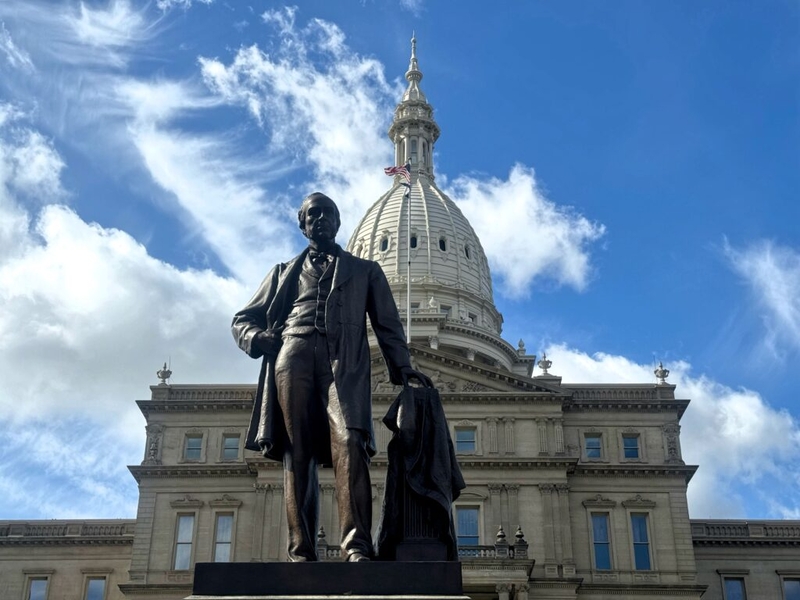
The statue of former Gov. Austin Blair at the Michigan Capitol | Susan J. Demas
In Michigan, the debate over whether to call a constitutional convention boils down to two differing perspectives: opportunity versus uncertainty.
Every 16 years Michigan residents are presented with a ballot question on whether to call a constitutional convention, sometimes called a Con-Con.
If a majority of voters say yes, it will initiate a process that begins with holding partisan elections to select delegates from each state House and Senate district for a total of 148 delegates. Once the delegates are selected, they will convene on the first Tuesday in October following the election where the convention is called. That would be Oct. 5, 2027.
After determining their officers and their rules for proceeding, delegates will work together to determine if any changes should be made to the state constitution, and what those changes will be.
For 110 years, the Citizens Research Council has sought to give Michiganders a shared set of facts
While the convention is not required to propose any changes to the state constitution, any proposed constitution or amendment would need to be agreed to by a majority of the delegates and then be put before the state’s voters at least 90 days after the convention adjourns for the final time. The new constitution, or any amendments, would then be approved, or rejected by Michigan voters.
In Michigan, opponents of the constitutional convention have dominated the conversation, as a bipartisan collective of labor unions, chambers of commerce, civic engagement organizations and political advocacy groups has banded together to make the case against a Con-Con.
Members of the opposition effort, Protect MI Constitution from Special Interests, have argued that approving a constitutional convention would be akin to opening Pandora’s box, opening Michigan’s Constitution up to an unlimited agenda of potential changes alongside influence from political special interests.
In an interview with Michigan Advance, Christy McGillivray, the executive director of Voters Not Politicians, which is a member of the opposition coalition, noted her organization’s role in championing a successful constitutional amendment to establish the state’s Independent Citizens Redistricting Commission.
In recent election cycles, Michigan residents have also voted in favor of amendments to expand voting rights and voting access, require state lawmakers and executive officials to file annual financial disclosures and enshrine the right to reproductive freedom within the state’s constitution.
“We want to protect those things,” McGillivray said. “There’s a whole laundry list of amazing provisions in our state constitution that advocates across the board support, and we want to make sure that we’re not putting those at risk by calling a Con-Con right now when the level of strife and instability in our politics is just at a fever pitch.”

She pointed to the collective opposition to the constitutional convention as a moment of rare political unity.
“Almost everyone agrees that the process for taking a run at all those different and varied protections in our constitution should not be an $80 million unclear process run by delegates at the same time that our state Legislature and elected officials can be working on other stuff,” McGillivray said, referencing a preliminary cost estimate from the nonpartisan Senate Fiscal Agency.
The Senate Fiscal Agency’s formal report released Friday offers three different estimates for the cost of a convention.
There’s a lot of provisions that could be put into a constitution that might favor special interests. There’s no guarantee at all that there’s going to be any semblance of independence.
Adjusting the total cost of the 1961 constitutional convention for inflation, the Senate Fiscal Agency estimated that a constitutional convention could cost the state $10.2 million. In another estimate using the costs of the Michigan Independent Citizens Redistricting Commission as a basis, the agency puts costs for a Con-Con at $22 million a year, or $1.8 million a month.
The agency also used Oklahoma’s 149-member part-time Legislature as another basis for their estimates, with this model projecting an operating budget of $47.3 million, with a monthly budget of approximately $3.9 million.
Additionally, the primary and general election for delegates and the ratification vote could incur up to $60.9 million in election costs, depending on if those elections are held at the same time as other scheduled elections.
Since the state’s most recent constitution was approved in 1963, the document has been amended several times, with McGillivray pointing to both the ballot initiative process, which allows residents to gather signatures to have an amendment placed on the ballot, or the Legislature’s ability to place an amendment before voters.
“I think it’s clear that those ways are specific and tailored, and they almost always garnish bipartisan support, which is so important in Michigan,” McGillivray said.
But the proposal is not without its supporters.
Dennis Lennox, a Republican public affairs consultant who helped lead an unsuccessful yes-vote campaign on the 2010 constitutional convention question, told Michigan Advance his support for a Con-Con stems from a simple reason.
“The Michigan of today, as Michigan prepares to enter the third decade of the 21st century, is not the Michigan of 1960,” Lennox said.
While the document was good for its time, it has since been cluttered with things that have no business being in the constitution, alongside provisions that are no longer legally applicable due to federal court rulings, Lennox said.
Looking at the issues on the minds of Michigan residents – getting undisclosed dark money out of politics, reaffirming local control over matters of planning and zoning in the face of data centers and renewable energy siting, and adjusting or eliminating income or property taxes – Lennox argued these issues are all constitutional in nature and can only be addressed through an amendment.
The process could also be used to enact reforms like subjecting the governor and the Legislature to the Freedom of Information Act and requiring financial disclosures from judges and local officials, Lennox explained. He also pointed to a provision in the state constitution permitting slavery as a criminal punishment as a section in need of removal.
What’s a Con-Con? Michigan voters will decide if they want to rewrite the constitution in 2026.
Rather than going through the efforts to organize ballot initiative efforts for a dozen or more questions, Lennox argued the practical approach is through a constitutional convention.
Lennox acknowledged the massive coalition of organizations opposing the effort, arguing that this “unholy alliance” of interest groups is trying to protect the influence they have over the Legislature under the current constitution.
“It is incredibly difficult for ordinary Michiganders to get something on the ballot because the process is so complicated, you need to have so much money and you’ve got to collect so many signatures,” Lennox said noting that while this is a high bar for ordinary Michiganders to clear, the process is much easier for special interest groups who have money.
While opponents have raised concerns about a convention stripping out successful initiatives like the state’s reproductive rights protections, Lennox said that the people of Michigan will have a moderating influence over the delegates because they have the final say over whether those changes are adopted.
“You would have to be politically stupid to take on poison pill issues or undo things that the people overwhelmingly voted for in recent years,” Lennox said.
J.H. Snider, the editor of the Michigan State Constitutional Convention Clearinghouse, told Michigan Advance that the ratification vote and the 90-day period are key accountability mechanisms.
Snider, who spoke in defense of the constitutional convention as an institution, rather than advocating for a yes or no vote on the measure, notes that this time period allows members of the public and the media to look through the convention’s proposals and highlight the most controversial aspect.
While some may view the convention’s potentially unlimited agenda as a cause for concern, Snider argued that this is a good thing, noting that this is also true of the Legislature and the courts.

Additionally, sitting lawmakers are not permitted to run as delegates, Snider said, later arguing that the structure of the constitutional convention leads to higher-quality candidates than what would be seen in the Legislature.
The structure prevents candidates from seeking a career as a delegate, and there are no incumbents, Snider explained. He also argued that it’s harder for special interests to exert influence over the process because of the ratification vote and the fact that there is no re-election for delegates.
However, that does not mean the process would be completely free from politics and influence.
In an interview with Michigan Advance, Quinn Yeargain, the 1855 professor of the law of democracy at Michigan State University, noted how special interests have written legislation for lawmakers and drafted proposed constitutional amendments in states across the country.
Yeargain pointed out the partisan nature of the delegate elections, noting that many of the individuals who run for delegate are going to be partisan politicians with their own networks to rely on.
“The idea that the constitution itself necessarily and always is apolitical is just not true,” Yeargain said. “There’s a lot of provisions that could be put into a constitution that might favor special interests. There’s no guarantee at all that there’s going to be any semblance of independence.”
Yeargain noted their own opposition to calling a Con-Con saying the state’s constitution has held up incredibly well in the years since it was approved.
“There are provisions in it that – yes, it is correct – are not enforceable as a matter of federal law,” Yeargain said. “But in my view, the remedy for that is discrete amendments rather than potentially, you know, opening up Pandora’s box and allowing the delegates to totally shred the entire constitution and rewrite it entirely from scratch.”
There is no hyperbole when it comes to the provisions that could be added to or stripped out of the constitution, Yeargain explained, emphasizing that just because something is in the constitution doesn’t mean it’s enforceable.
Lansing, MI