P-funk praises Eric’s ID Law, Moore names new judges, more in political notes
Oct 03, 2026 | 4:25 am ET
Description
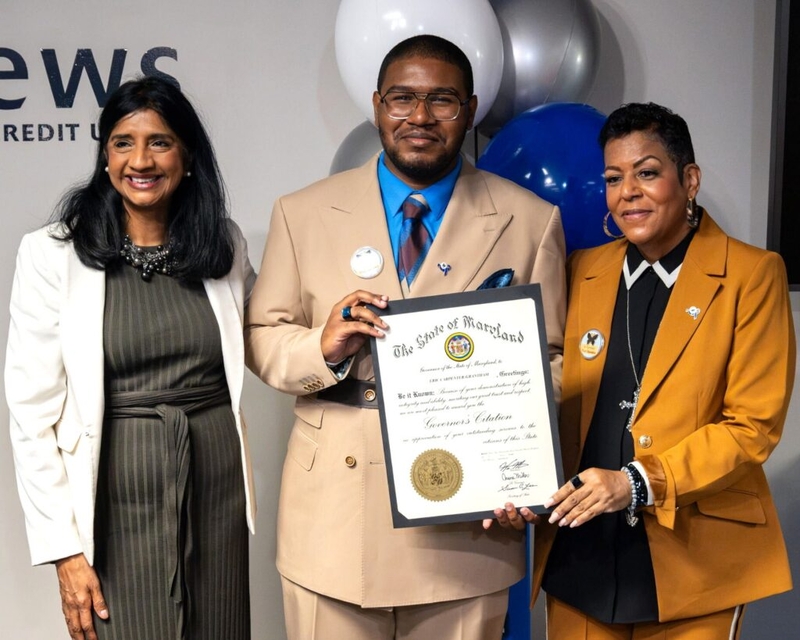
Eric and Linda Carpenter-Grantham pose for a picture Thursday with Lt. Gov. Aruna Miller (D) at Andrews Federal Credit Union in Prince George's County, where an event was held to celebrate the one-year anniversary of Eric's ID Law. (Photo courtesy of Eric Carpenter-Grantham)
Almost 31,000 people have applied to get butterfly logos added to their driver’s licenses and identification cards to indicate a hidden disability in the year since Eric’s ID Law allowing the logos took effect.
That feat was marked Thursday by Eric Carpenter-Grantham, the law’s namesake, his mother, Linda, and 148 others at a celebration at Andrews Federal Credit Union in Prince George’s County. Attendees included Gov. Wes Moore’s mother, Joy Thomas Moore; Lt. Gov. Aruna Miller (D); Comptroller Brooke Lierman; and Del. Kym Taylor (D-Prince George’s), one of the two main House sponsors of the legislation when it passed last year.
And support also came from R&B singer Faith Evans, who spoke in support of the law in a video, sporting a yellow T-shirt with a picture of Eric’s ID on it, and from George “Dr. Funkenstein” Clinton of Parliament Funkadelic, in a blue T-shirt with Eric’s ID on it. His favorite song by Clinton: “Atomic Dog.”
When asked if they ever envisioned tens of thousands of people asking the Motor Vehicle Administration for the butterfly logo, Linda Carpenter-Grantham said no. “Only by the grace of God,” said Eric , who has high-functioning autism.
The logo is designed to alert police and other emergency responders to the developmental or intellectual disabilities that are not immediately noticeable. The decal can be placed on driver’s licenses, MVA-issued identification cards, even moped operator permits.
The law also requires that the state Police Training and Standards Commission, in consultation with the State Police and other stakeholders, “implement training concerning interactions with individuals who have a nonapparent disability.”
It could be closer to becoming law in Washington, D.C., where the Eric’s ID Amendment Act of 2026 is set for a third reading Tuesday before the D.C. City Council. The bill would let applicants for a driver’s license, permit or identification card “to designate a butterfly as the nonapparent disability.” One of its sponsors was Council member Janeese Lewis George, who won the Democratic nomination this year for mayor.
Because of Eric and Linda’s continued push for other states to adopt similar laws, Eric was nominated to participate a grand marshal in the Disability Pride Parade in New York City on Oct. 18.
Back in Maryland, the Carpenter-Granthams said more public outreach and programs are needed for individuals with hidden disabilities. Linda said she would like libraries, grocery stores and businesses to incorporate an Eric’s ID program, letting individuals with hidden disabilities to wear a butterfly lanyard if they wanted to, for example.
“A person with an individual disability or a disability could ask for a butterfly lanyard and for the people who work there would be able to assist them in a grocery store,” she said. “That way a person with a hidden disability could not only be helped, but also that person who works there would be educated and learn how to interact with that person.”
Even though some training is still needed to educate people with hidden disabilities, Eric remains thankful for all the support received. “It’s truly a blessing,” he said.
Judges appointed
The governor announced the appointments of nine — count ’em, nine — judges Friday to district and circuit court vacancies in Montgomery County and Baltimore City Circuit Court.
Sean Richard Delaney, James Burke Miller and Jocelyn Lang Williams will serve as judges in Baltimore City Circuit Court.
In Montgomery County, Keith Joseph Rosa and Carlotta Ann Woodward were nominated to the circuit court bench, while Jason Brian Abbott, Rolando Julio Aleman, Howard Ray Cheris and Seth Bradley Zucker were nominated to the district court.
“As judges, I know that their expertise and experience will continue to be of great service to the people of Maryland in their new roles as judges,” Moore said.
Delaney has been an assistant U.S. attorney in Baltimore for the past 12 years as a member of the office’s Fraud and Public Corruption Section. He was previously a trial attorney in the Department of Justice Tax Division. Delaney received his law degree from Boston College Law School.
Burke Miller is chief of the Felony Trial Division in the Baltimore City State’s Attorney’s Office and lead attorney for the Archdiocese of Baltimore Abuse work group. Before that, Burke Miller worked in the Medicaid fraud control unit of the Maryland Attorney General’s Office and as a prosecutor in Prince George’s County. He received a law degree from University of Baltimore School of Law.
Williams has been an administrative law judge at the Maryland Office of Administrative Hearings for the past eight years. Before that, she was a staff attorney and supervising attorney in the Baltimore office of Maryland Legal Aid. Williams received her law degree from Penn State’s Dickinson School of Law.
Rosa is a partner and co-founder of the Bethesda-based law firm Goitein Rosa, with a practice focusing on civil litigation, including family law. Previously, Rosa served as a special magistrate for the Montgomery County Circuit Court and as an associate. Rosa received his law degree from Florida State University College of Law.
Woodward has been a prosecutor in Montgomery County for the past 14 years and currently serves as chief of the juvenile division and primary prosecutor of animal cruelty cases. Woodward was an associate at Cordier Law Offices before opening her own practice. Woodward received her law degree from University of Baltimore School of Law.
Abbott currently works as general counsel for Prince George’s County Executive Office’s Public Safety and Homeland Security. Abbott previously served as principal deputy state’s attorney for the county and as chief of the strategic investigations unit in the county’s State’s Attorney’s Office. Abbott received his law degree at Columbus School of Law at Catholic University of America.
Aleman is an associate attorney with Salvado, Salvado & Salvado in Rockville. Before that position, he was associate general counsel for the Maryland-National Capital Park & Planning Commission and held two clerkships Cumberland County, Pennsylvania. Aleman received his law degree from Penn State’s Dickinson School of Law.
Cheris is the lead partner and managing member of Armstrong, Cheris and Page in Rockville, which he joined after 17 years as a private practitioner concentrating on civil and criminal litigation. Cheris also worked as a contract attorney for the Montgomery County Public Defender’s Office. Cheris received his law degree from American University’s Washington College of Law.
Zucker served his entire legal career as a prosecutor with the Montgomery County State’s Attorney’s Office. Zucker currently serves as chief of the collateral review unit and the conviction integrity unit. He previously served as a trial prosecutor in the circuit, district and juvenile courts. Zucker received his law degree from William and Mary Law School.
Picking the police for the police
Montgomery County is looking for applicants for upcoming openings on the Advisory Commission on Policing — formerly the Policing Advisory Commission — which advises the county council on police-related legislation and policy and seeks community feedback.
The three-year posts are unpaid, but some expenses are covered. The commission is required to meet at least six times a year, more if needed to complete its work. Each council member appoints a board member and the county executive names two, a youth member (25 or younger) and a young adult (age 26-35) member. Applicants must work in the county, or represent an organization that does, and should reflect the geographic and demographic diversity of the county, with an emphasis on those disproportionately impacted by inequities. They should also have a “keen interest and/or expertise in policing matters, and want to deliberate on policy guidelines affecting departmental operations to help identify unintended consequences and develop safeguards to mitigate them.”
Applications are due by 5 p.m. Nov. 2. Late applications will not be accepted. To apply, send a letter expressing interest and a (four pages or less) resume listing professional and civic experience, home address, telephone number and email address, via email to Council President Fani-González at [email protected], or by postal mail to Fani-González, County Council Office, 100 Maryland Ave., Rockville, Md,, 20850. All interviews and interview materials will be open to the public.
Annapolis, MD