Bipartisan group of Maryland legislators call for menhaden harvest reductions
Oct 02, 2026 | 5:19 pm ET
Description
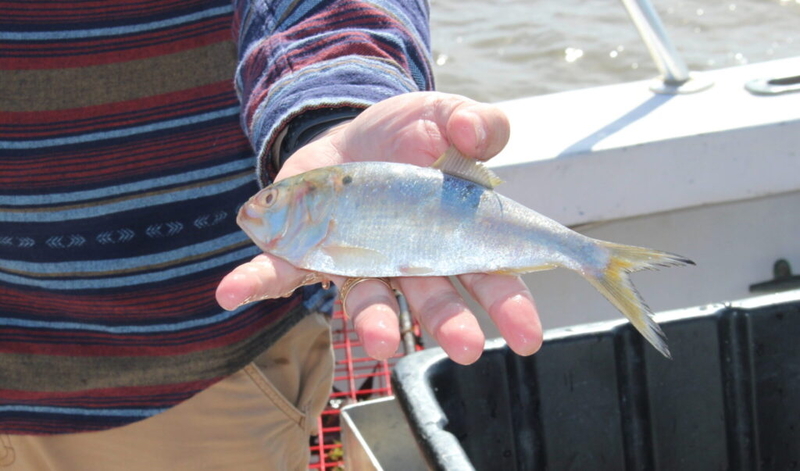
A menhaden pulled from the Chesapeake Bay in the area of Jordan Point Marina. (Photo by Charlie Paullin/Virginia Mercury)
A bipartisan group of Maryland legislators is pushing for fishery managers to institute further restrictions on the harvest of Atlantic menhaden, a small fish that sits at the base of the Chesapeake Bay food chain.
In their letter, the 29 Maryland senators and delegates endorsed a suite of policies that would set new rules for harvesting the silvery forage fish, a key food group for species including striped bass and osprey.
The policies would limit the Chesapeake Bay harvest of menhaden to 13.6% of the total coastwide cap. They would also establish three even-length fishing periods to spread out the catch, and require that fishery managers at the Atlantic States Marine Fisheries Commission reevaluate the menhaden regulations every three years.
In their letter, the lawmakers cited worrying signs about the bay’s menhaden population, and possible impacts to other species that call the estuary home.
“Maryland’s menhaden harvest has fallen by more than 80 percent since 2020 and now sits below ten percent of the quota the State is allowed to take. Crabbers are struggling to find affordable bait and harvesters are unable to participate in the fishery,” reads the Sept. 25 letter.
Maryland has a small commercial and recreational bait fishery for menhaden. The state has prohibited purse seine netting of menhaden in Maryland waters “since before the 1950s,” according to Maryland’s Department of Natural Resources.
Osprey nesting woes in the Chesapeake Bay worsen, survey finds
But in the Virginia portion of the bay, including at the mouth of the Chesapeake, there is a commercial fishery that harvest the small fish in purse seine nets for oil and fish meal. A single company, Ocean Harvesters, conducts the fishing, contracting it out to a company called Omega Protein. The company is able to harvest up to 51,000 metric tons of menhaden per year, a cap that was last reduced in 2018, when it fell from 87,216.
The Maryland lawmakers’ letter also cited recent research from the Center for Conservation Biology at William & Mary, which pointed to concerning breeding numbers for osprey in the Chesapeake Bay.
The scientists determined that osprey pairs nesting in tidal fresh waters were reproducing at an adequate rate to keep the population stable. But 81% of osprey pairs nesting in saltier waters failed to fledge any chicks. And when they did, scientists frequently observed chicks starving in nests.
Scientists at the center cited food stress as the cause for low breeding numbers, writing that the problem “appears to be caused by changes in the availability of Atlantic menhaden to nesting ospreys in the Chesapeake Bay.”
The Maryland lawmakers wrote that, “Taken together with what our watermen are seeing, there is considerable evidence that menhaden availability in the Chesapeake Bay is in serious decline – much to the detriment of Marylanders and the Bay’s frontline species.”
The Atlantic States Marine Fisheries Commission, the regional compact that manages the fishery, is holding a public comment period about the possible menhaden regulations through Oct. 9. In November, the group’s menhaden board, with representatives from each of the Atlantic coastal states, will vote on a final decision.
One of Maryland’s three representatives is state fisheries Director Mike Luisi, who said he is still “digesting” all of the public comment coming from Marylanders in order to arrive at a final decision.
“We believe that there is an availability issue in the bay, and it’s likely that some action is going to be needed in order to see whether or not this reduction fleet is part of that equation,” Luisi said.
There may not be one “silver bullet,” Luisi added. It’s possible that other factors, including changing ocean temperatures, could be influencing menhaden migratory patterns, causing fewer to travel up into the Chesapeake. By adjusting the bay fishery, managers might be able to get a sense of how much the reduction fleet is playing a role.
“I see the board taking some action,” Luisi said. “It’s going to be determining how extreme that action is.”
The Maryland lawmakers on the letter are an “interesting coalition,” said Del. Dylan Behler (D-Anne Arundel). It includes 22 Democrats and seven Republicans, spanning a group that spans various Maryland counties.
“There’s wide, bipartisan consensus on the importance of the Chesapeake Bay to our state’s culture, history and economy,” Behler said in an interview. “We all see the importance of menhaden in that ecosystem.”
And “every corner of the state” is seeing effects that lawmakers believe to be related to a possible overharvesting of menhaden, Behler added.
Ocean Harvesters has long denied charges that the fishery could be contributing to the lack of menhaden in the bay or problems further up the food chain. The company has pushed against new restrictions on the fishery, citing potential job losses.
Representatives from the company suggested that detractors haven’t fully considered how the environment and other factors contribute to the situation. More data is needed, the company insisted, to make informed decisions on any potential restrictions.
In a comment to the Virginia Mercury, the company highlighted the lack of definite data “to comprehensively characterize menhaden abundance and distribution in the Bay or the influence of fishing pressure.”
The Chesapeake Bay Program, which is also pushing for additional menhaden restrictions, agrees that there isn’t much data specific to the menhaden stock in the estuary. But it says the existing evidence is worrisome enough.
“Without really good, effective science that exclusively is looking at Chesapeake Bay menhaden, we have to look and take some of these other data points seriously — and that’s exactly what CBF is doing,” said Will Poston, the Bay Foundation’s forage campaign manager.
Instead of calling for a reduction of the 51,000 metric ton cap, the Bay Foundation and the Maryland legislators are calling for it to be tied to a percentage of the coastwide total allowable catch. If the menhaden harvest were 13.6% of the total allowable harvest, the current harvest level would be reduced about 50%, Poston said.
As a result, the number can change from year to year based on the overall health of the menhaden stock, Poston said.
That way, Poston says, “We’re not going to end up in a similar situation as this year, where maybe we’re concentrating too much menhaden harvest pressures in this estuary when looking at the coastwide ecosystem.”
Annapolis, MD