Ag sec candidates debate Iowa’s beef herd, water quality, land ownership, local food
Oct 02, 2026 | 4:30 pm ET
Description
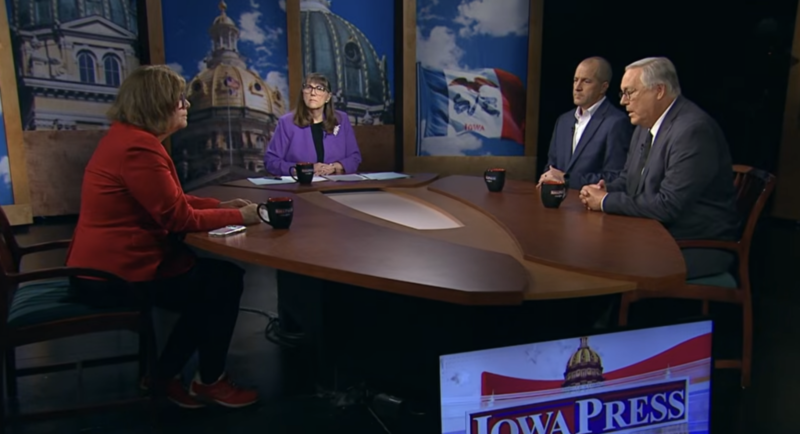
Iowa secretary of agriculture candidates Chris Jones, right, and Mike Naig debated on an Oct. 2 episode of Iowa Press moderated by Kay Henderson, center, and Donnelle Eller. (Screenshot courtesy of Iowa PBS)
Candidates for Iowa’s secretary of agriculture debated over their divergent plans for the role, though the candidates agreed on some issues like growing Iowa’s cattle herd and keeping Iowa land in farmers’ hands.
Current Secretary of Agriculture Mike Naig is running for reelection as the Republican candidate against water quality researcher and activist Chris Jones who has called his bid for the seat a “referendum” on Iowa water quality.
“I think the condition of our water here is the biggest failure of our state government in the history of the state,” Jones said during the debate on “Iowa Press.”
Jones has proposed moving away from an ag economy dependent on corn, soybeans and ethanol with taxpayer-funded “off ramps” for farmers. Naig said Jones’ ag policy ideas make him an “outlier” on the Nov. 3 election ticket for state races.
“Both candidates, the Republican and the Democratic candidate for governor are talking about the same things that I am, which is to provide incentives to farmers and work with farmers, not the mandates and taxes that my opponent is talking about,” Naig said.
Water quality has become a key issue in the state of Iowa, with Jones’ candidacy as a self-proclaimed referendum to the issue and Republican gubernatorial candidate Zach Lahn stating it was a key reason he entered the race. Rob Sand, the Democrat running for governor, has also laid out policies to address water quality, which the majority of Iowa voters say is a top concern, according to a poll from Johns Hopkins Center for a Livable Future.
Jones pointed out that many of Lahn’s points, like calling to break up dominant agribusiness and diversifying the ag economy, are similar to his own policy proposals.
Jones said that while it’s not a “foregone conclusion” that Republicans will maintain the majority in the state Legislature, he believes he would be able to work with them on the water quality issues he is passionate about because they are issues felt by the rural Iowans largely represented by Republican lawmakers.
“Rural people really bear the brunt of a lot of this pollution,” Jones said. “ … So, I think Republican legislators are dialed into this and want to do what’s best for their constituents. I know that they see this as a quality of life issue.”
Naig said he has already shown his ability to work on a bipartisan basis to advance water quality initiatives, including the Farm to Faucet legislation passed earlier this year to help with conservation practice adoption and water treatment infrastructure.
While the ag secretary candidates have different approaches to improving water quality in the state and improving the farm economy, both candidates shared a desire to grow Iowa’s cattle herd and to push for policies that would keep land in the hands of the people farming rather than absentee owners.
More cattle, pasture in Iowa
Jones called the recent move from the Trump administration to temporarily suspend beef tariffs on certain foreign countries in order to import thousands of metric tons of ground beef “one of the stupidest ideas” he’d heard.
President Donald Trump said the decision to import more beef would help lower consumer prices of the protein while the U.S. builds back its beef herd size, which is the smallest it has been since the 1950s.
Jones argued the decision has hurt Iowa farmers and beef producers. He said with the right policies, Iowa could become the “grass fed state” and market the beef raised in the state as such to “rebuild” the beef industry in Iowa.
Naig also criticized the move to import beef and said if producers are going to invest in growing their cattle herds, or add one to their operations, they need to see that there is profitability in their investments.
Naig said persistent drought has “put a halt” to expanding the herd in western parts of the country where cattle has historically been raised.
“If the beef herd is going to expand in this country, it’s going to happen in places east of the Missouri (River)” Naig said. “If it’s going to happen in Iowa, then we need to look at creating more pasture … and then creating certainty in the marketplace that allows somebody to make the investment over a couple of years that it takes to see the payback on that.”
The Iowa Department of Agriculture and Land Stewardship has been working to help landowners in western Iowa and parts of the Des Moines watershed to transition marginal cropland to pasture with the Cattle and Conservation Working Lands Program. Naig said policies like this are the solution to lowering beef prices, not importing foreign beef.
Iowa land in Iowa hands
The candidates also talked about the need to keep more of the state’s land owned by the people who are actually farming the land.
This is an issue that has also come up in the governor’s race with both candidates proposing changes to tax policy to boost in-state ownership. Researchers from Iowa State University say land ownership survey data show that most out-of-state or LLC ownership of Iowa land is connected to succession planning – farmers’ children and grandchildren who own the land but don’t live on it or don’t farm it themselves.
Naig said Iowa already has the “gold standard” for land ownership regulations that prevent foreign or corporate ownership, but he said the state should “create incentives for more of that to be Iowa owned.”
“We shouldn’t make any bones about it – we want more Iowa ground being owned by Iowans, and we’d like more farm ground being owned by farmers,” Naig said.
Speaking with reporters after the debate taping Thursday, Naig suggested creating incentives for farmers who own ag land to help change the ownership patterns, especially, he noted, as more and more farmers prepare to retire.
Outsider farm owners are an issue in the governor’s race. Here’s what experts say.
Jones said the state needs “Iowa farmers to own their own ground, plain and simple.”
When the people who own the land are the ones farming it, he argued, they are “much more likely to aggressively adopt” conservation practices. Jones said if the state mandated certain conservation practices on rented land specifically, it might “inspire” absentee owners to disinvest, allowing farmers to purchase the land they work.
“We definitely need policy here that’s going to get the land ownership patterns that we want, and what we want is the person farming that land to own it,” Jones said.
Farm economy
As Iowa farmers enter a harvest season with diesel prices above $6 a gallon and persistently high input prices, Naig suggested a potential tax holiday to cut down on fuel costs and Jones said farmers need a system that is less reliant on fossil fuels and inputs.
“Talking about the tax on diesel fuel is just scratching at the surface,” Jones said. “Let’s devise some policy here that saves money – saves farmers some real money – by developing a system that’s less reliant on fossil fuels in the first place.”
Much of Jones’ ag policy proposals center on diversifying Iowa farms, which he argues will help farmers’ bottom lines, improve water quality and provide more locally grown food that Iowans have said they want. Jones has proposed a local food program with an annual budget of $10 million to implement.
Jones said the “corn and soy and ethanol” system has not brought “prosperity to rural Iowa.”
“We need to develop a system that’s more diverse, that’s less reliant on the inputs from corporate agriculture, a more diverse assemblage of crops that’s going to be more resilient to climate, more resilient to market forces, more resilient to politics,” Jones said.
Naig said he believes ethanol is an “upside” to the state as a value-added product that contributes billions to Iowa’s economy.
He said the pressure on the farm economy is a combination of factors, including input prices that are affected by the war in Iran, the lack of an updated farm bill and “disrupted” efforts to enact nationwide year-round access to E15 fuel.
“We need to be a state that’s advocating, and we need to be working at the federal level to ensure that we are bringing certainty where we can, that policy is supporting market development,” Naig said.
The secretary of agriculture debate was the first of a series of debates hosted by ‘Iowa Press’ on Iowa PBS. The show will host Senate candidates Ashley Hinson and Josh Turek Oct. 7 for a live debate.
Des Moines, IA