Ever wonder what happens to roadkill? We asked the Oklahoma Department of Transportation
Oct 02, 2026 | 2:00 pm ET
Description
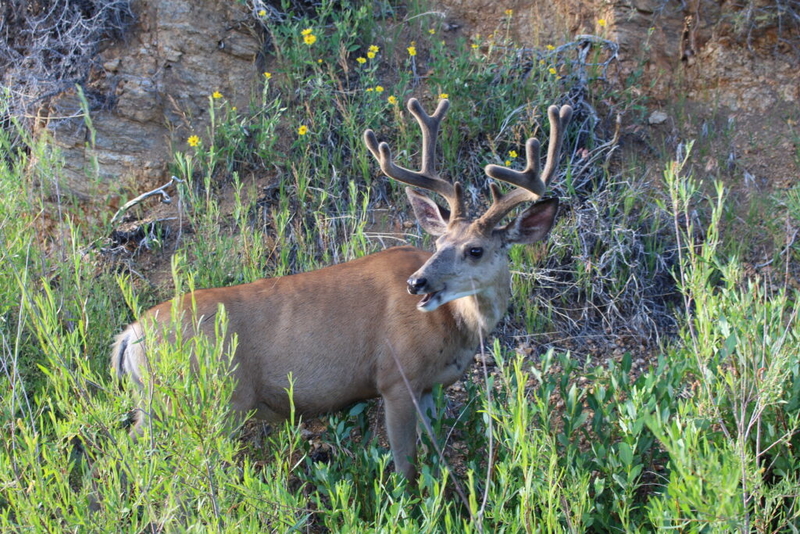
A mule deer is pictured. The number of deer hit by vehicles increases in the fall. (Photo by Ed Godfrey/For Oklahoma Voice)
OKLAHOMA CITY — From dead deer to dogs, it’s not uncommon to drive by the remains of animals hit by vehicles driving on Oklahoma roadways and interstates.
Last year, the Oklahoma Department of Transportation, whose crews are responsible for keeping state highways and interstates clear of debris, spent $5 million alone cleaning up litter, which includes roadkill. The agency employs about 865 heavy equipment operators to remove animal carcasses, said Emily Long, an ODOT spokesperson.
Logan County ODOT Superintendent Bradley Eads said crews prioritize removing roadkill because it’s dangerous for drivers, is a distraction and an eyesore.
Most animals are killed by motorists driving on the highways, and reports are phoned in by residents or Oklahoma Highway Patrol troopers, Eads said.
State troopers will remove the animal debris off the road if they can, but when they can’t, state transportation workers try to respond within 30 minutes, he said.
There is a need for fast removal so that additional animals don’t get hit while scavenging the carcasses, Eads said.
Workers generally work in teams of two, using their hands to drag the roadkill off the road and out of sight. They wear personal protective equipment like sanitary gloves and safety vests, Eads said.
When maintaining the grass near the highways, motorists might notice there is a 15-foot strip of mowed grass that is kept clear at all times for vehicles that need to pull off the highway, but workers also leave a five-foot strip of unmowed grass in the middle, Eads said. That’s where crews move roadkill to decompose, hidden from the passing cars.
However, Eads said sometimes removal crews are not always necessary because scavengers have gotten to the roadkill before they do.
“You would be surprised by how fast they’re gone, they’re usually gone by overnight,” he said.
He said when a lane needs to be closed in Logan County to remove a large animal, the Highway Patrol or the Logan County Sheriff’s Office will help direct traffic. If law enforcement is unable to assist, ODOT does its own traffic control.
ODOT removes roadkill off the highways for the safety of travelers, said Tim Hardcastle, the transportation maintenance manager for District Three, which includes Oklahoma and Canadian counties.
Hardcastle said that highways near populated areas have less roadkill than rural areas due to animals’ habitats being farther away from the roads.
It is more dangerous to remove animal carcasses in high traffic areas, which also have more driving lanes.
Removal crews have to plan in advance for the more dangerous areas, like an inside shoulder where there is less space for ODOT workers to park and get out of their vehicles, he said.
In high-traffic areas, such as Interstate 44 near Oklahoma City, the state Department of Transportation may tap its contractors to help, said Travis Yarbrough, a maintenance coordinator for ODOT who removes roadkill from urban areas of the highways.
Most of the time, “they are pretty much flung off the lanes,” Yarbrough said of the impact.
He said increases in the number of animals struck aligns with the mating seasons. For example, more deer are hit in November during the autumn mating season.
Kelly Adams, a spokesperson and education supervisor for the Oklahoma Department of Wildlife Conservation, says there is no need to contact a game warden when a motorist hits and kills a deer.
But if someone wants to take the carcass home they need to get permission from the county’s game warden, Adams said.
When dogs are hit, the rural and urban areas handle them differently.
In rural areas, workers have limited options to contact the owners. They can check the collar and go to nearby houses to ask if they own the animal or know the person who does, Eads said.
In urban areas, the workers have more tools at their disposal; they can ask animal control to check if the dog has a microchip that can inform them who the owner is.
Editor’s note: This story was produced through a reporting partnership between Oklahoma Voice and the University of Central Oklahoma’s journalism program.
Oklahoma City, OK