Amid bleak financial forecast, Brown Health announces buyouts, executive layoffs
Oct 02, 2026 | 1:51 pm ET
Description
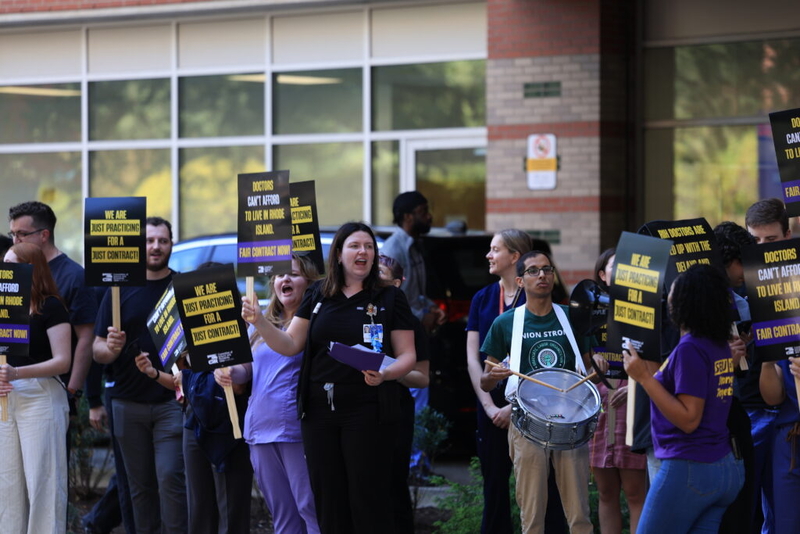
Unionized resident doctors and interns picketed outside Rhode Island Hospital on Friday, Oct. 2, 2026, amid nearly one year of contract disputes with Brown University Health. (Courtesy of the Committee of Interns and Residents/Service Employees International Union)
The state’s largest hospital operator is offering buyouts to 200 non-clinical supervisors and laying off 10 executives amid financial pressures.
Brown University Health announced a series of cost-cutting measures on Thursday, the first day of its new fiscal year. Like healthcare providers nationwide, the hospital conglomerate is struggling against rising costs, a function of market pressures and federal budget cuts under H.R. 1.
“Healthcare organizations across the country continue to face significant financial pressures, and Brown Health is no exception,” John Fernandez, president and CEO of Brown University Health, said in a statement. “Rising pharmaceutical, labor and supply costs, combined with increasing levels of uncompensated care, insurer denials and bad debt, are creating unprecedented challenges. The actions we’re taking will help strengthen our financial foundation while protecting access to care and supporting future growth.”
Brown Health has been sounding the alarm on its lopsided ledger for more than a year, suggesting in July 2025 that it might close the Newport Hospital birthing center, among other program and service cuts. It later committed to keeping the 10-unit labor and delivery center open amid pressure from local and state officials and advocates, and a $1.6 million earmark in the state’s fiscal 2027 budget.
But an increase in uncompensated care, the result of new federal policies restricting Medicaid eligibility and ending discounts for people who purchase their own insurance through state health exchanges, have started to take hold.
Brown Health reported $90.5 million in costs associated with charity care, debt and insurance denials in the three-month period ending June 30, equal to more than 8% of the company’s net revenue. The company remained in the black, with a $23.4 million operating profit for that quarter — the most recent financial data available.
But projections for fiscal 2027 look bleak. Brown Health said it expects to spend $346 million on charity care, insurance denials and debt in the new fiscal year — $71 million more than it spent in the fiscal 2026 year that ended Sept. 30 — due to federal policy changes.
The healthcare operator projects a $64 million deficit for fiscal 2027 based on its target 2.75% operating margin, which includes investments in patient care, infrastructure, technology and workforce.
That’s after a series of “efficiency measures,” including an executive restructuring completed in September that included consolidating or eliminating 10 jobs, as first reported by WPRI-TV 12.
Voluntary buyouts were offered for up to 200 supervisors, managers and directors, who were eligible if they are 60 or older and have been with the company for five years as of Sept. 30. And, starting Jan. 1, Brown Health’s employee health plan won’t cover GLP-1 drugs prescribed solely for weight loss, though insurance coverage will continue for employees who use the medication to treat diabetes.
The GLP-1 insurance policy change will affect 3% of insured employees and dependents, Jessica Wharton, a spokesperson said.
The Newport Hospital birthing center was not named as a program at risk of closing, nor were any other services at The Miriam, Rhode Island Hospital, and Bradley.
Wharton confirmed in an email Friday that the birthing center will remain open, with fundraising efforts underway to close the $4.6 million gap needed to sustain the labor and delivery program. There are no plans to close or reduce other clinical programs right now, Wharton said.
Capital projects at The Miriam and Rhode Island hospitals, already underway, are expected to continue in fiscal 2027, with $210 million budgeted for facility upgrades, Brown Health said. There will also be a merit increase for employees in January, and ongoing investments in technology and equipment upgrades.
“Building a financially sustainable organization is essential to our ability to serve patients, support our workforce and invest in the future,” Fernandez said. “These decisions position Brown Health to continue delivering high-quality care and meet the evolving needs of the communities we serve.”
While Brown Health’s bottom line has dipped into the red on and off since the pandemic, its Rhode Island hospitals remain profitable, with a $97.4 million combined revenue in the first nine months of fiscal 2026. By contrast, its Massachusetts hospitals, purchased from bankrupt former owner Steward Health Care in 2024, have underperformed. Staffing shortages and low patient volume led to operating losses at St. Anne’s Hospital in Fall River, Morton Hospital in Taunton, and associated ambulatory centers.
Results of the full fiscal 2026 financial performance, including breakdowns by hospitals are expected to be published by the end of the calendar year.
Lisa Tomasso, senior vice president of the Hospital Association of Rhode Island, said the buyouts and leadership reductions at Brown Health were part of a “larger, troubling trend” in hospitals nationwide, especially Rhode Island, where uncompetitive Medicaid reimbursement rates doesn’t cover the cost of care.
“The financial and operational pressure on hospitals is quickly escalating, and the state’s healthcare system urgently needs continued support in this time of crisis to preserve access to care and support the needs of all Rhode Islanders,” Tomasso said in a statement Friday.
Doctors picket outside Rhode Island Hospital
On Friday, unionized resident physicians staged a picket and rally outside Rhode Island Hospital . The 700-member labor group, the first unionized doctors in Rhode Island, have been locked in contract negotiations with Brown Health for almost a year.
For members with the Committee of Interns and Residents and Service Employees International Union, salary and benefits are the major points of contention. However, doctors also want Brown Health to establish policies limiting access for federal immigration agents at the Providence hospital, and ensuring employees who need to miss work for mandatory immigration visa appointments don’t lose their jobs.
Dr. Samantha Palacios, a union member who works as a senior resident physician in the hospital emergency room, acknowledged the financial challenges her employer is facing, but insisted residents and interns should not sacrifice their demands for wage increases.
“It doesn’t change what our bottom line is,” Palacios, 30, said in a phone interview after the picket. “We are aware there are issues across all of the United States when it comes to funding things. We shouldn’t be what gets cut.”
A Nevada native with more than $400,000 in student loan debt, Palacios said she has not had a raise, even for cost-of-living, in her two years working for Brown Health.
“Our ability to live a life where we can survive can’t be what’s on the chopping block at the end of the day,’ she said.
Kelly Brennan, a Brown Health spokesperson, did not comment on the picket, but said there has been “substantial progress” in the negotiations with union doctors, including 90 tentative agreements.
“We remain focused on reaching a fair, sustainable agreement that recognizes the contributions of our interns and residents while ensuring we can uphold our commitments to high-quality patient care, our workforce, and the communities we serve,” Brennan said in a statement.
- 5:03 pmUpdated to clarify the projected fiscal 2027 deficit is relative to a 2.75% operating margin and to add information about employees affected by changes to GLP-1 insurance coverage.
- 2:16 pmUpdated to include the number of executive positions consolidated by Brown University Health, and to include a statement from the Hospital Association of Rhode Island.

Providence, RI