Donors, digs and Donald Trump: Attacks in Oregon gubernatorial debate underscore a close race
Oct 02, 2026 | 12:10 am ET
Description
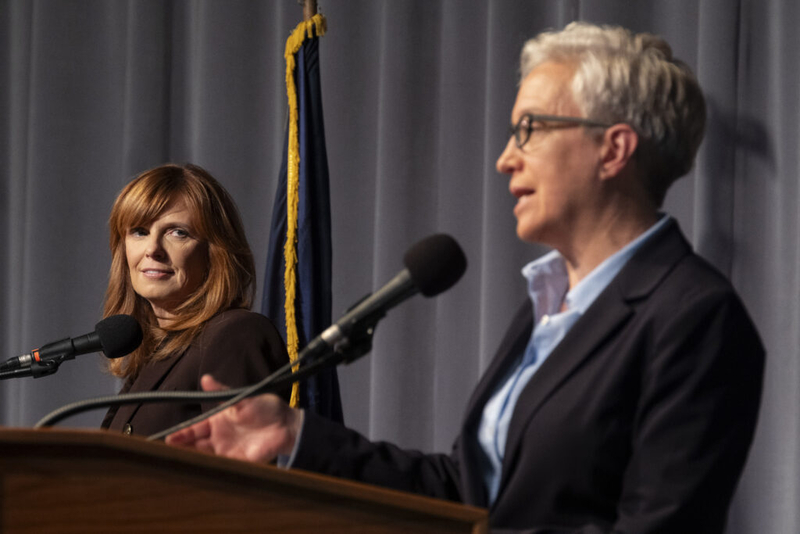
The debate became more heated as Sen. Christine Drazan, R-Canby, and Gov. Tina Kotek accused each other of misrepresenting the facts at the gubernatorial debate on the University of Oregon campus on Thursday, Oct. 1, 2026. (Photo by Will Yurman/Lookout Eugene-Springfield/Pool)
EUGENE — Oregon Gov. Tina Kotek and her repeat challenger state Sen. Christine Drazan, R-Canby, exchanged their fiercest swipes yet at one another on Thursday in their first televised debate, with both candidates painting the other as a political boogeyman who will further entrench the state’s deepest issues.
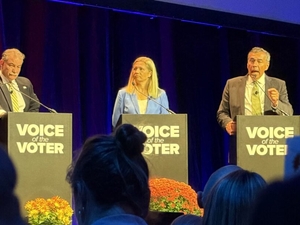
The two squared off at the University of Oregon for their first official debate of the 2026 gubernatorial race, moderated by KVAL anchor Kendall Bartley with questions from reporters at Lookout Eugene-Springfield and the Oregon Journalism Project, as well as a student journalist.
Drazan painted Kotek as a power-hungry spender who has failed to provide Oregonians with clear progress on issues such as education, economic development, homelessness and mental health. Kotek fired back by framing a litany of votes that the senator has taken or avoided as proof that Drazan is not committed to holding corporations and the federal administration accountable in Oregon.
The debate also comes as polling from Drazan’s campaign and independent pollsters has found that the race is competitive, despite Oregon’s four-decade history of electing Democratic governors. A recent poll the Lake Oswego-based DHM Research conducted for Oregon Public Broadcasting found Drazan was leading Kotek among likely voters by 47% to Kotek’s 46%, with 3% for Brett Smith of the Pacific Green Party of Oregon. That lead is within the poll’s margin of error.
Although the two shook hands before and after the debate, the stakes and competitiveness of the race were palpable on Thursday’s debate stage. Drazan used her opening statement with a warning that Kotek would use the debate as an opportunity to deflect from her record and mislead voters. She later questioned whether Kotek was “advancing a drinking game tonight” by focusing on the federal administration. YouTube commenters on livestreams were telling each other to drink each time Kotek mentioned President Donald Trump.
Their tensest exchange involved campaign donations in the final Oregon gubernatorial race with unlimited contributions. Kotek has raised more than $12 million to Drazan’s nearly $11 million, and Kotek has more than $4.4 million in her campaign bank account compared to more than $1.1 million for Drazan.
Much of Kotek’s support comes from labor unions, leading Drazan to assert she’s beholden to unions. Kotek retorted that Drazan has anti-union supporters, leading the senator to quickly rebuke Kotek’s claim as “absolutely bizarre.”
“Have you been reviewing my donors?” Drazan asked. “Are you concerned somehow about the people that are supporting a change in leadership in our state?”
“I think we all understand who’s supporting who in this race,” Kotek responded.
The governor has consistently sought to nationalize the election by tying Drazan to the Trump administration, but growing dissatisfaction with public services, homelessness and economic development in metropolitan and highly-populated areas of the state has cast doubt on Kotek’s ability to secure a decisive victory.
She took Thursday as an opportunity to reiterate Drazan’s record as a legislator, such as a vote against a 2025 state law forcing data centers to pay for their energy demands and Drazan’s opposition to Democrats’ multi-billion dollar failed transportation tax package during the 2025 session. Drazan was the House Republican leader at the time.
“Holding a press conference is not a solution,” Kotek said. “And point blank telling me there’s nothing in it for you to help with solving the transportation issue is what you (Drazan) told me in the 2025 session.”
Clearer daylight over social, political issues than economics, affordability
Drazan and Kotek offered familiar jabs when discussing issues such as the National Guard, mail voting and abortion. While Kotek and Drazan sparred over whether the state is making significant gains to boost jobs and lower the cost of living, there was agreement over some of the strategies aimed at improving Oregon’s economic policy offered by Kotek’s prosperity council earlier this year.
Drazan said that her goals have always been to respect Oregonians and engage in stronger conversations about access to the ballot, Oregon’s abortion laws and public safety.
She also offered some of her clearest remarks yet on her comments after Trump last September vowed to send the National Guard to Portland in which she condemned “violent mobs and domestic terrorists” and said “we need order, we need to restore safety, and Oregon’s local leaders have failed to provide it.” A federal judge blocked the Trump administration from conducting the deployment on the grounds that the activity near the facility failed to reach the threshold of posing a danger of rebellion.
“Technically, I didn’t support his decision. Let me be clear, I don’t want National Guard troops in Oregon,” Drazan said. “Here’s what I did: I said Oregon should enforce our own laws.”
Kotek pointed to Drazan’s endorsement by the state’s leading anti-abortion group and accused Drazan of “recreating the facts” around Portland’s U.S. Immigration and Customs Enforcement facility, the site of mostly peaceful protests but where protesters in summer 2025 also shattered the glass front door of the building. Authorities have charged a small fraction of the thousands of protesters at the site since last year with crimes.
“The attorney general and I fought in the courts to make sure unlawful actions could not happen,” Kotek said. “100 days later, the troops went home. Not only Oregon troops, but California troops, and we averted a disaster.”
Both candidates expressed support for the work of Kotek’s prosperity council, a group of economic advisers convened last year who recommended in the summer that the governor work to slash taxes, reduce regulations and replace the state’s Climate Protection Program which former Democratic Gov. Kate Brown first enacted through an executive order.
The candidates did, however, disagree on how quickly to implement those actions. Many of the prosperity council’s recommendations would require changes to state law with approval of the Legislature.
“We continue to get reports one after another talking about jobs that are leaving our state and going to states that are more competitive,” Drazan said. “The prosperity council laid out a roadmap, which the governor should have immediately embraced, and she should have taken immediate action to implement the portions of that that she could today as governor.”
Kotek argued that she is doing everything she can within her power to act on the council’s recommendations. She said she is working on legislation for next year because “that is what I can do right now” and pointed out that her state agencies are working on a fast-track permit process that was approved by the Oregon Legislature this year. Drazan voted in favor of that law.
“I am working hard,” she said. “We have new job openings that are coming in the life sciences sector that my opponent just seems to ignore, as if nothing is happening. I’m not going to trash our state.”
The two candidates’ second debate will take place in Medford on Oct. 7 at 7 p.m.
Salem, OR