Despite vow of bipartisanship, gubernatorial candidates spar in first televised debate
Oct 01, 2026 | 11:30 pm ET
Description
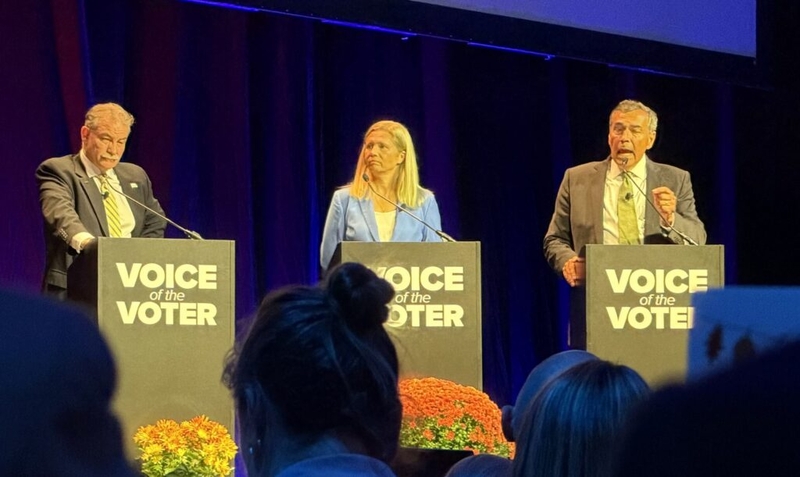
Republican Bobby Charles, Democrat Hannah Pingree and independent Rick Bennett on stage at the Cross Insurance Arena in Portland on Oct. 1. (Photo by Eesha Pendharkar/Maine Morning Star)
Maine’s three gubernatorial candidates exchanged sharp attacks over each other’s records during their first televised debate Thursday, even as all three pledged at the end of the night to work across party lines.
The first of four planned debates was hosted by News Center Maine and the Maine Chamber of Commerce at the Cross Insurance Arena in Portland Thursday evening.
Throughout the event, Democrat Hannah Pingree, independent Rick Bennett and Republican Bobby Charles often detoured from answering questions about housing prices, property taxes, energy costs and healthcare to take swipes at each other.
But after criticizing each other for an hour, all three responded to the final audience question about whether they would commit to bipartisanship by promising if elected to work with lawmakers across the aisle.
”I am not interested in being a partisan governor because I cannot get done what I think this state needs,” Bennett said. “We need to get back to a politics of collaboration and compromise.”
But most of the night was less harmonious.
Pingree and Charles sparred over a topic the Republican had brought up in a press conference a day before: a state grant made to Pingree’s husband’s film production company while she was in charge of Gov. Janet Mills’ Office of Policy Innovation and the Future.
“Bobby has been spewing … misinformation,” Pingree responded, denying his allegations that it had been improperly awarded.
Charles went after both Bennett and Pingree for being “Augusta insiders.”
“I find it ironic that two people who’ve served for 30 years and 25 years are saying that we need to fix the system,” he said.
Bennett predominantly focused his barbs on Charles, but said Pingree’s track record in state government was inadequate, particularly her time in the Mills’ administration.
“Hannah Pingree has been in charge of housing for seven years, and she’s been calling it a crisis,” he said.“But when you have a crisis, you act like there’s a crisis, and you get it done. If you don’t do that job, you don’t merit a promotion.”
Amid one heated moment between the two men over the Republican nominee’s time in Washington D.C., Pingree interjected with: “This is why we need women in charge,” eliciting the largest cheer of the night from the crowd of business owners.
Housing
All three candidates highlighted their various plans to lower property taxes and the cost of housing, while also critiquing their opponents’ ideas.
Pingree reiterated her commitment to spending $100 million on housing each year to accelerate housing production. She also said she would mandate a 90-day timeline for the Maine Department of Environmental Protection to respond to new housing proposals. Finally, she proposed making a change to the Maine Constitution in order for the state to be able to tax second homes owned by people who only live in Maine during the summer.
“I think housing is the fundamental issue that is holding back the state of Maine,” she said. “We need to build more housing to ensure that young people can afford to stay here, we need rentals that people across our workforce can afford, and we need to make it happen quickly.”
Charles said Pingree’s $100 million was not enough to address housing shortages.
“The only way you get the housing stock up is to methodically encourage building,” he said, which he said would require reducing red tape to ensure speedier housing construction.
Bennett also critiqued Pingree’s plan, saying, “A $100 million sounds like a lot of money, but when you go to per unit, it gets us nowhere near what we need to do.”
The independent candidate echoed the need to build more housing, but said he would do that by reviving manufactured housing, which he described as a heritage industry in western Maine where he lives, and by conducting an audit to figure out what causes regulatory delays in permitting.
His housing plan would also reduce down payments for first-time homebuyers by using state funds as a guarantee for banks.
Taxes and spending
When asked about the economy, Charles was the only candidate to commit to cutting taxes — a campaign promise he has emphasized for months.
He also said he wants to provide a $100,000 property tax exemption for all Mainers and cut income taxes, although he did not explain by how much. Maine’s current income taxes are between 5.8% and 7.15% for single filers, with a newly implemented millionaire’s tax.
The Republican nominee said the state can make up for the lost revenue by investigating agencies such as the Maine Department of Health and Human Services and shrinking state government.
“We’re also going to cut the funding for non-residents,” he said. “We’re going to not provide free housing to non-citizens, and we’re not going to be providing free health care to them.”
Bennett said Charles “just doesn’t simply understand how the fiscal process works, which doesn’t surprise me because inspector generals and auditors at the federal government cited him dozens of times for mismanagement of federal spending,” referring to the Republican’s time at the Bureau of International Narcotics and Law Enforcement Affairs under President George W. Bush.
Rather, Bennett said the state needs to increase oversight of its budget process. He said the fact that it does not allow for public hearing is “the reason that the state budget has grown 77% in 10 years, twice the rate of inflation.”
Bennett’s biggest priority in terms of cutting taxes is addressing high property tax rates, which he said are inequitable and volatile. He proposed addressing that by expanding the fairness tax credit, a state income tax relief program that gives money back to eligible homeowners and renters
Pingree partially agreed with Bennett on expanding the fairness credit, saying, “middle and low income Mainers are paying too much of their income right now in all forms of taxes.” But she also called him out for not supporting the recently passed millionaire’s tax, which she supports.
The new tax imposes a surcharge of 2% on wealthy Mainers, specifically on the portion of a resident’s taxable income beyond $1 million for single filers, $1.5 million for heads of households and $1.5 million for people filing jointly. The tax is expected to impact 2,631 tax returns and generate $150 million in the next biennium.
“I believe in taxing wealth, not work, and we’re going to have to work hard to do that in the next couple of years,” she said.
Pingree did not commit to cutting government spending, acknowledging that the next budget is going to be a challenge due to a $1 billion shortfall Mills’ successor will have to deal with.
“What we are spending money on is healthcare, which keeps our hospitals afloat, education — keeping it at 55 percent,” she said. “A lot of these things go out to communities.”
Augusta, ME