At Zeldin visit, New Hampshire Republicans celebrate end of vehicle inspections
Oct 01, 2026 | 5:00 am ET
Description
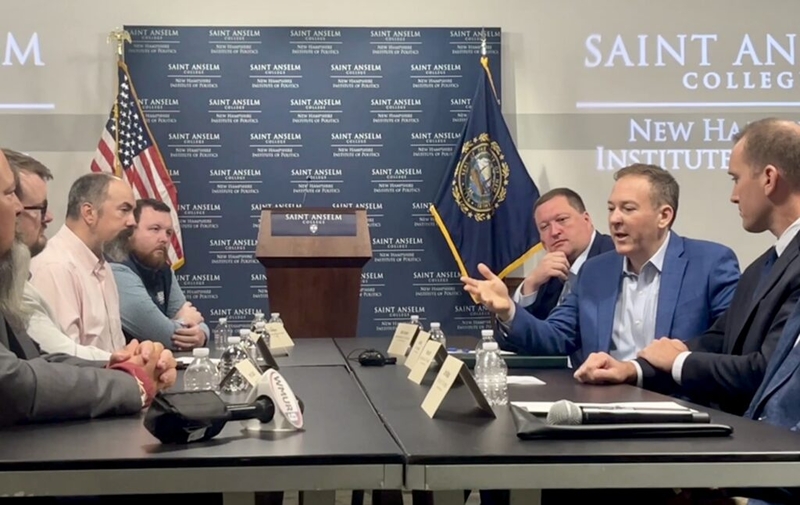
Left to right: Reps. Henry Giasson, R-Goffstown, Ross Berry, R-Weare, Jason Osborne, R-Auburn, Joe Sweeney, R-Salem, Environmental Protection Agency New England Administrator Mark Sanborn, Environmental Protection Agency Administrator Lee Zeldin, and EPA Environmental Protection Specialist Patrick Lillis, at a roundtable to discuss New Hampshire's bid to leave the Ozone Transport Region, at St. Anselm College, Sept. 30, 2026. (Photo by Ethan DeWitt/New Hampshire Bulletin).
As they passed legislation to end New Hampshire’s vehicle inspection program last year, state lawmakers made a gamble.
Ending the inspections would mean ending annual emissions testing, violating New Hampshire’s decades-long approach to comply with the Clean Air Act. And the U.S. Environmental Protection Agency had not granted New Hampshire permission to withdraw from those legal obligations. By repealing inspections, the state was risking lawsuits and federal enforcement, Department of Environmental Services Commissioner Robert Scott warned lawmakers then.
Republican lawmakers, citing public support for ending inspections, pushed ahead and passed the repeal anyway.
A year later, that gamble appears to have paid off. New Hampshire’s inspection program effectively ended in January, when state police stopped enforcing expired stickers. And the EPA under President Donald Trump did not take action against the state. Instead, the agency proposed exempting New Hampshire from its vehicle emissions testing requirement in August, and the department is aiming to finalize its decision by the end of the year, an unusually fast timeline.
Now, the proponents of the inspection repeal are taking a victory lap.
On Wednesday, EPA Administrator Lee Zeldin arrived in New Hampshire and sat down with Scott and top Republican lawmakers to discuss the end of the state’s car inspection program and celebrate the state and federal collaboration that led to it.
“The ask was for us to act in an expedited fashion, as quickly as possible,” Zeldin said, addressing a panel at St. Anselm College attended by reporters. “And that message has been heard.”
“You guys have really focused and done the due diligence work to move this forward,” Rep. Ross Berry, a Weare Republican, said to Zeldin.
Scott agreed. “They’ve been working at light speed compared to perhaps other administrations,” he said of the EPA approval process.
The EPA has not yet formally ruled on New Hampshire’s bid to exempt itself from the emissions testing requirements, which includes an effort to leave the compact of Northeast states meant to impose emissions limits.
And until he reviews 400 pages of public comment submitted before a deadline last Friday, Zeldin said he can’t give his opinion on that compact, created in 1990 and known as the “Ozone Transport Region.”
But during the discussion Wednesday, Zeldin and other top EPA officials made it clear that the agency would move fast on its decision, and state lawmakers appeared to anticipate success.
“We’re targeting the end of this calendar year to publish final action,” said EPA Environmental Protection Specialist Patrick Lillis.
Under Zeldin, the EPA has made moves to repeal other federal rules relating to emissions. In February, the agency repealed federal emissions standards for vehicles and engines, and on Sept 14, it partially rolled back carbon pollution limits on coal-fired power plants.
The decision over New Hampshire’s own rules comes as the state faces a federal lawsuit by a New Hampshire resident, Marilyn Jonas, who suffers from asthma and argues the state is violating the Clean Air Act by ending the inspection program. Jonas’ lawsuit is supported by attorneys for Gordon-Darby, the company that helped run New Hampshire’s inspection program and had sued the state before withdrawing its lawsuit earlier this year.
But the dilemma dates back to 1990, when Congress passed amendments to the Clean Air Act that put New England and mid-Atlantic states into the Ozone Transport Region, a compact of shared responsibility for emissions standards. The idea was to create a shared responsibility among Northeast states to stop ozone pollution, which crosses state lines.
To uphold its part of that agreement, New Hampshire lawmakers created the annual, mandatory state vehicle inspection program in 1999. The inspections required on-board diagnostics that would allow the state to track vehicle pollution — and require drivers to fix problems. The EPA added the inspection program into New Hampshire’s “State Implementation Plan” in 2001, making the program binding for the state under federal law.
Leaving the Ozone Transport Region is not impossible; parts of Maine successfully did in 2022, after state leaders argued Maine was not contributing to pollution in other states and that its rural businesses were harmed by unnecessary emissions caps.
But in order to legally leave the compact, a state must get permission from the EPA, and must do so by demonstrating that its emissions are low enough to justify its departure.
When Gov. Kelly Ayotte signed the inspection repeal as part of the budget in June 2025, state leaders suddenly faced reporting requirements. The state Department of Environmental Services and Department of Safety needed to show to the federal government that New Hampshire’s emissions were low enough to not need the inspection process — or be in violation of federal law.
On Wednesday, New Hampshire leaders recounted the effort to race through that approval process.
“We worked very closely with especially EPA Region 1 staff to research what the requirements are,” Scott said, referring to the New England region. “The Clean Air Act is designed with an off-ramp to do this exact thing.”
To get there, New Hampshire State Implementation Plan Administrator Catherine Beahm presented projections that nitrogen oxides would have decreased by 16% between 2022 and 2026 even if the inspection program had not existed, and submitted evidence that New Hampshire’s contributes less than 1% of the air pollution in other states in the compact.
The state formally petitioned the EPA to withdraw from the Ozone Transport Region on Dec. 24. “We were able to give them a Christmas present,” Scott said.
“We knew they were going to sue,” Berry said. “But you guys have not bent, not wavered; you kept the ball moving forward very quickly. A lot quicker than I think anybody expected.”
And Republican lawmakers present took the opportunity to lay out their case for repealing the state inspections in the first place: affordability. House Majority Leader Jason Osborne, an Auburn Republican, said constituents complained of paying for repairs that might not have been necessary due to warning lights.
“Every year on their birthday: ‘Happy birthday; here’s a $5,000 bill for a light on a dashboard,’” Osborne said.
Osborne added that the bill had been added to the budget because if it were introduced as a standalone bill it would face pressure from industry groups to kill it.
“In order to get around the special interests, we kind of had to bury it into the budget process,” he said.
To Zeldin, the collaboration between New Hampshire and EPA officials epitomizes what he calls “cooperative federalism.”
“We don’t want to have an agency where we sit inside of headquarters acting like we know the air, land and water of all the states and local communities better than the representatives and the residents of those states and those local communities,” he said.
But representatives for Jonas, who is suing the state, denounced state and federal officials’ efforts to end the inspection program Wednesday, and said the decision would harm the air.
“New Hampshire may meet all federal air quality standards on a statewide level, but attainment data reflects regional averages rather than the specific street-level air quality an individual breathes every day,” a spokesperson for Gordon-Darby said Wednesday. “For individuals like Marilyn living with chronic respiratory conditions such as asthma, even subtle changes in air quality or the removal of localized control strategies can have a noticeable, real-world impact on their health.”
For his part, Scott argued the repeal of the car inspection program is possible because emissions have improved in the state.
“I’m very pleased that our air quality has continuously got cleaner and cleaner and cleaner for a lot of reasons, so that put us in a good place,” he said.
Still, in an interview after the panel, he said he would have preferred it if lawmakers had waited for official permission first.
“Obviously, for a lot of reasons I’d prefer not to have lawsuits,” he said.
Concord, NH