Arizona’s voter-approved dark money law defeats First Amendment challenge in appellate ruling
Sep 30, 2026 | 7:27 pm ET
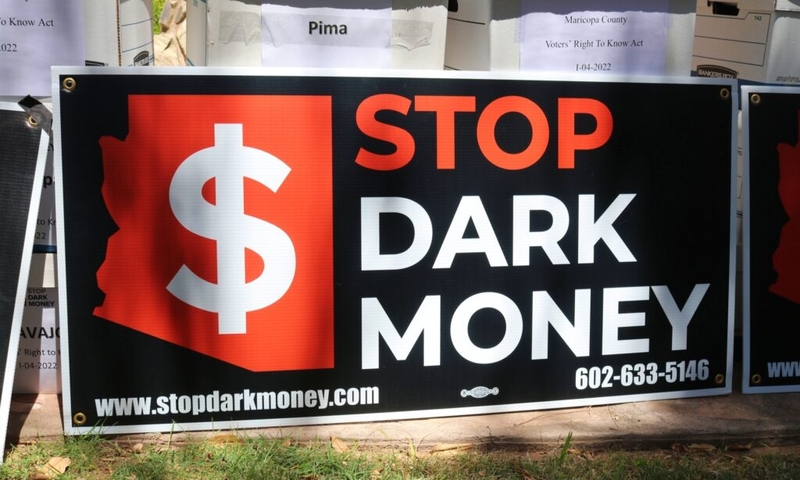
Description
(Photo by Jim Small/Arizona Mirror)
A federal appeals court on Wednesday said Arizona’s law that forces disclosure of anonymous campaign spending is constitutional, rejecting the claims of a conservative group that argued that the law violated the First Amendment rights of people who want to secretly influence voters.
The ruling by a three-judge panel on the 9th U.S. Circuit Court of Appeals is the second loss for Americans for Prosperity, the most prominent among the network of conservative organizations founded by the wealthy Koch brothers, in its bid to have the overwhelmingly popular law scrapped. A trial court judge previously rejected Americans for Prosperity’s arguments.
More than 70% of Arizona voters approved the Voters’ Right to Know Act, which was on the ballot as Proposition 211, in 2022. The law requires that political committees and other politically active nonprofit corporations disclose the sources of their funding in a bid to combat the anonymous campaign spending that has transformed American elections over the past 15 years.
Disclosure is required if an individual or organization gives more than $5,000 to a committee or organization that spends more than $50,000 on a statewide campaign or ballot measure or $25,000 on a legislative race.
Americans for Prosperity and other conservative critics of the law have argued that such disclosures have a “chilling effect” on the free speech of Arizonans and are a violation of the First Amendment.
But the majority on the appeals panel disagreed, saying that the government has a strong interest in informing voters and the “modest” burden of disclosure on the campaign donors doesn’t infringe on their constitutional rights.
“Plaintiffs’ actual complaint seems to be that those who want to make large-money donations to campaign media spending cannot do so anonymously behind intermediaries,” Judge Gabriel Sanchez wrote on behalf of himself and Judge Johnnie Rawlinson.
Sanchez was appointed to the appellate bench by President Joe Biden, while Rawlinson was appointed by President Bill Clinton.
The ruling rejects all of Americans for Prosperity’s arguments that the law’s mandates aren’t “narrowly tailored” to avoid violating the constitutional rights of people engaging in political speech, and Sanchez noted that several requirements are less onerous than similar provisions in federal election regulations that have withstood judicial scrutiny.
The majority also relied heavily on an Arizona Supreme Court ruling from earlier this year in which the state high court upheld the law and rejected similar arguments brought by local conservative organizations.
That view was not shared by Judge Patrick Bumatay, an appointee of President Donald Trump, who wrote in a dissenting opinion that the law should be struck down because the First Amendment was understood in the 18th century to protect both anonymous political speech and the anonymous funding of that speech.
The practical result, Bumatay wrote, is that the law reaches up the funding chain of political organizations to donors many steps removed and requires “looking infinitely back to the original source” in order to trace money through a chain of transfers.
“While donor disclosure laws are not new … Arizona’s law constitutes a radical departure from what we’ve seen before,” he wrote.
Bumatay wrote that the law fails even under the legal test the U.S. Supreme Court has used for 50 years to largely endorse disclosure of political spending. But much of his dissent rests on history. He argued that the nation’s founders viewed the forced unmasking of political speakers as a violation of “the rights inherent to citizens of a free republic.”
“Political speech was sacrosanct: A public commentator could not be dragged into the light against his will,” he wrote.
The ruling leaves the law in effect for the Nov. 3 general election. Americans for Prosperity can ask the full 9th Circuit to rehear the case or petition the U.S. Supreme Court, which in 2021 sided with Americans for Prosperity Foundation in a challenge to California’s donor-disclosure rules for charities.
Former Arizona Attorney General Terry Goddard, who spearheaded the effort to enact dark money disclosure laws in Arizona, said the 9th Circuit’s ruling is “another validation” of what voters wanted.
“I hope this is something that gives voters a little more confidence,” he told the Arizona Mirror. “If someone can secretly influence the vote that I cast, how can I be a knowledgeable voter? I can’t.”
At the end of the day, Goddard said, voters don’t want billionaires spending money anonymously to fund the deluge of political ads they see each election cycle.
“That kind of thing hurts voters and tarnishes the entire electoral system,” he said.
A request for comment to Americans for Prosperity was not immediately returned.
Phoenix, AZ