Mass. voters hold Trump, utilities most responsible for high energy costs, new poll finds
Sep 30, 2026 | 9:13 am ET
Description
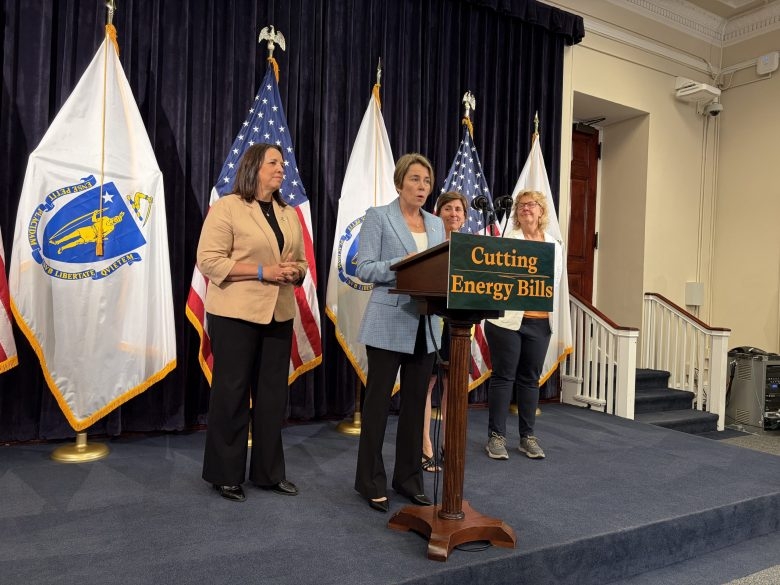
Gov. Maura Healey alongside, left to right, Lt. Gov. Kim Driscoll, Energy and Environmental Affairs Secretary Rebecca Tepper, and Climate Chief Melissa Hoffer, bashes the utility companies and pushes for energy affordability legislation.
DURING AN ELECTION YEAR defined by affordability, voters aren’t directing their greatest outrage at Gov. Maura Healey for at least one of the central challenges confronting the state: spiraling energy costs.
Instead, 32 percent of likely voters are pointing the finger at President Trump, and 28 percent say gas and electric utility companies are most to blame for the energy affordability crisis enveloping the state. Just 13 percent of respondents said the governor is most responsible for energy costs that have soared in recent years, according to a new CommonWealth Beacon/MassINC Polling Group survey (Toplines | Crosstabs).
The findings, from 800 likely voters across Massachusetts surveyed earlier this month, aren’t necessarily surprising. Trump’s poll numbers have cratered in the Bay State — and he continues to flounder here. And the utility companies are the ones, after all, with their names on the monthly bills that customers receive.
But Healey’s ability to evade the bulk of the blame with voters for high energy costs is notable as she seeks reelection this fall, given how energy issues have proven stubborn, dogging much of her first term.
Massachusetts residents pay double the national average for electricity. And energy affordability is the top household concern in Massachusetts, business groups found in their own poll earlier this year — which was released just after the Iran war started.
The numbers reflect the fact that much of the electorate understands that energy markets are global, said Dan Dolan, president of the New England Power Generators Association. Trump has directly impacted the landscape, Dolan added, noting that the president canceled offshore wind leases, to cut funding for solar projects, and launched hostilities with Iran, which has sent oil prices skyrocketing.
“Massachusetts and New England have been uniquely impacted by the fact that this president, who holds himself out as energy dominance and energy abundance, has pointedly gone after some of the energy sources that this region is trying to expand, and so that dissonance, coupled with the run-up in global energy prices, points the focus on the president,” Dolan said.
Massachusetts has adopted some of the country’s most ambitious climate commitments, aiming to reach net-zero greenhouse gas emissions by 2050. Just 9 percent of respondents said, though, that clean energy programs bear the brunt of the blame for high energy costs, ticking up to 16 percent among Republican voters.
That finding provides color to the larger backdrop, in which House Democrats advanced a measure earlier this year that would cut $1 billion from Mass Save, the state’s energy efficiency program funded by a charge on ratepayers’ bills, believing it to be an effective way to save customers money on energy costs. And it’s one of the few levers Beacon Hill can immediately pull to immediately lower energy bills.
But if voters don’t see programs like Mass Save as the culprit for their high bills, according to the poll results, it could undermine the political appetite to enact such deep cuts. The Senate already rejected that proposal, and lawmakers will need to hash out their differences in conference committee.
The polling “pinpoints the complexity of the issue,” said Barbara Kates-Garnick, a former state undersecretary of energy under Gov. Deval Patrick and a professor at Tufts’ Fletcher School. “There’s no one villain here.”
Healey has tried in several ways to offer ratepayers relief in a bid to combat what could be a significant political vulnerability, though little has emerged yet in the form of tangible cost savings. She worked with the utilities to delay some charges last winter and has called on the Department of Public Utilities to open a wide-ranging investigation into customer bills. She has also urged legislators to reach agreement on a sprawling legislative package she first proposed close to 18 months ago and is now pitching lawmakers on suspending the state’s 24-cents-per-gallon gas tax for two months.
Healey does pick up significantly more blame from voters who identify as Republican, more of whom – 26 percent — think the governor is most responsible for high energy costs than any other option in the poll. That’s compared with just 4 percent of Democratic voters who think Healey is most to blame on the issue.
By contrast, 43 percent of Democratic voters call out Trump as most responsible for high energy costs, compared to 14 percent of Republican voters. Among independent voters, about 1 in 3 blamed Trump for high energy costs and 28 percent pointed to the utilities as most responsible.
One reason why the utilities are receiving so much more blame than Healey overall is because “people can plug it into a progressive narrative about greedy corporations,” said Evan Horowitz, executive director at Tufts’ Center for State Policy Analysis, even though the companies’ profits and spending decisions largely need approval from state regulators.
Still, Dolan said, “no one is immune” from voter backlash over rising energy costs.
Boston