Canada is SC’s 3rd-largest export market. ‘It’s too early’ to gauge impact of tariffs.
Sep 29, 2026 | 9:00 am ET
Description
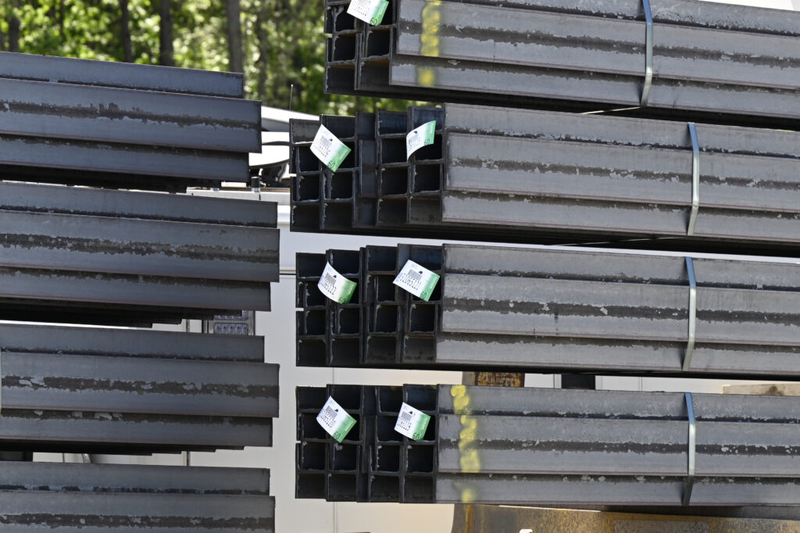
Steel i-beams form a perimeter barrier at Nucor Steel Berkeley in Huger, South Carolina, on Thursday, May 1, 2025, when Vice President J.D. Vance spoke there. (File photo by Mark Susko/Special to the SC Daily Gazette)
More than a month after the latest tariffs on Canadian-made products were enacted, the trade war’s impact on South Carolina’s economy is still difficult to assess, even as further restrictions on Canadian imports take effect Tuesday.
“It’s hard to speculate on specifically what impacts tariffs will have at this point,” Joey Von Nessen, a research economist at the University of South Carolina, told the SC Daily Gazette.
“It’s too early to provide any specific outlook on what those individual effects would likely be,” he said last week, adding “it really will depend on how long they last going forward.”
More than $8 billion in goods and services move between South Carolina and Canada each year, and Canada is the Palmetto State’s third-largest export market behind Germany and Mexico, according to the state Department of Commerce.
Among the top commodities Canada exports to South Carolina are plastics, aircraft and car parts. In return, automobiles and rubber are among the top products South Carolina sends to Canada.
The Palmetto State is also a key destination for Canadian travelers, with the Myrtle Beach area one of the most popular vacation choices.
Part of the problem in assessing the impact of President Donald Trump’s most recent 50% tariffs on nearly $28 billion in Canadian goods — enacted Aug. 26 — is that companies have been reluctant to talk about U.S. trade policy.
Last year, Spartanburg County-based BMW halted some shipments of X-model SUVs to Canada after that country hit the automaker with counter-tariffs in reaction to Trump’s initial trade salvo. Those shipments resumed. But BMW opposes tariffs generally. A spokesman for the carmaker said BMW’s position is unchanged but did not address Canadian tariffs specifically.
“Free trade, which has always been a guiding principle for the BMW Group, is of immense importance worldwide: it is one of the most crucial drivers of growth and progress,” the company said in a statement Tuesday to the SC Daily Gazette. “Tariffs, on the other hand, hinder free trade, slow down innovation and set a negative spiral in motion. They are ultimately detrimental to customers, making products more expensive and less innovative.”
Volvo looks to energize SC plant with new models amid shifting global trade, market trends
Volvo did not respond to the Gazette’s request for comment.
The automaker, which builds the EX90 SUV at its Lowcountry plant, has also pulled that vehicle from Canada due to tariffs. However, EX90 sales amounted to only 143 units to Canada in 2025.
Automotive News reported this week that the overall share of U.S.-made vehicles sold in Canada dropped to 28.4% during the first half of 2026, down from 35.4% a year ago.
The S.C. State Ports Authority, a quasi-government agency, also did not want to comment directly on trade policy.
Micah Mallace, the authority’s president and CEO, said very little containerized trade moves between the port and Canada, with plastic pellets used to make thousands of consumer goods the largest commodity. Most trade between Canada and South Carolina moves by truck or rail.
South Carolina metal makers like Century Aluminum and Nucor Steel have traditionally praised tariffs and other trade measures designed to reduce foreign dumping of cheap products on the U.S. market, but neither has publicly weighed in on the latest Canadian trade war.
On Monday, Trump announced plans for a $15 billion steel mill in Iowa. He linked Mesabi Metallics’ decision to build the new facility, which he said will be the nation’s largest, with his tariffs on steel imports. The company will use iron ore from its $2.5 billion mine in Minnesota, which opened earlier this month.
SC now requires American-made steel for roads, bridges and other public projects
Timna Tanners, an analyst with Wells Fargo, told Bloomberg that Canada’s counter-tariffs on roughly $20 billion worth of U.S. steel are largely irrelevant because those metal products are already prohibitively expensive due to previous tariffs.
Trump’s 50% tariff on Canadian wood products – and Canada’s retaliatory tariffs on the U.S. – have led to surging costs for plywood, specialized wood panels and other products. That is expected to lead to higher housing costs as interest rates are making homebuying less affordable.
South Carolina’s $23 billion timber and logging businesses, already under considerable stress, are feeling additional pressure. For example, Canada-headquartered Canfor Corp. permanently closed sawmills in Estill and Darlington after last year’s initial round of Trump-imposed tariffs.
More recently, Jones and Sons Logging Inc. told a Greenville television station that the latest tariffs will add $10,000 to the cost of machinery. Company owner Jeff Jones did not respond to the Gazette’s request for comment.
Canada was the state’s largest source of forest product imports in 2025, at $259 million. Solid wood imports were $390 million – a 3.4% increase of 2024 figures. Forest product exports fell by more than $1 billion last year, to $555 million, and the S.C. Forestry Commission is predicting further declines because of tariffs and a weak economy.
Starting Tuesday, another batch of imports from Canada – including some alcoholic beverages, molasses and some dairy byproducts – will be banned from coming into the United States. It’s not clear what impact that could have in South Carolina, as none of those products are major import commodities to this state. Products already on store shelves or in inventory can continue to be sold.
Regardless, consumers will wind up paying the cost, Von Nessen said, and that can snowball into big problems for the economy as a whole.
“Consumers will see an uptick in prices, and that has the potential to weigh on consumer spending as we look ahead to the end of 2026, and higher inflation overall,” he said. “When consumers are losing purchasing power, that will eventually cause them to cut back on their spending, which can cause an overall pullback in economic activity.”
- 4:46 pmThis article was updated with a response from BMW.

Columbia