US attorney tells AZ officials feds won’t back down on scouring voter data for noncitizens
Sep 28, 2026 | 7:52 pm ET
Description
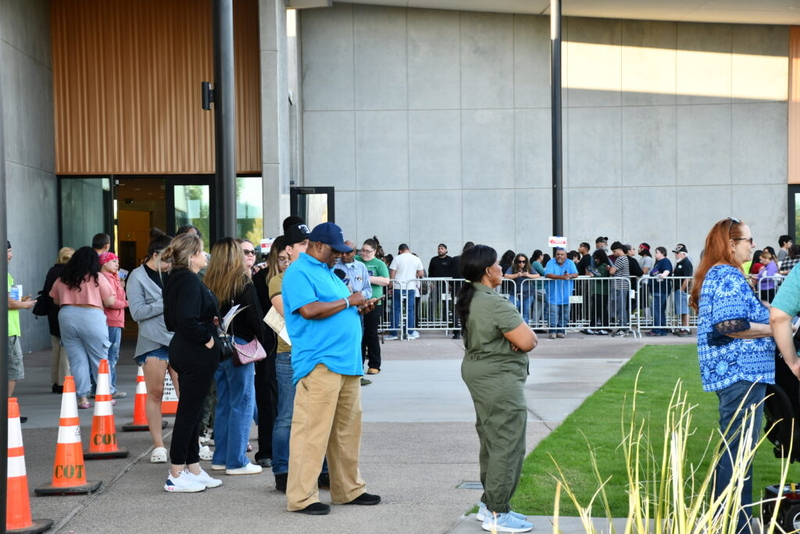
Voters wait in a long line outside of the vote center at the Tolleson Civic Center on Nov. 5, 2024. Photo by Caitlin Sievers | Arizona Mirror
The U.S. Attorney for Arizona responded to concerns by the state’s top lawyer and election chief raised about how the Trump administration is using state data to identify noncitizen voters by telling them that the federal government will not back down.
Last week, Attorney General Kris Mayes and Secretary of State Adrian Fontes sent a letter to U.S. Attorney Timothy Courchaine requesting confirmation that any personal information on Arizona voters was not being used to search for noncitizens. If that is happening, they wrote, Arizona will sue the Trump administration to stop it from violating voter privacy laws.
Courchaine didn’t mince words in his response, saying that the duo have “no reason for concern” and that the voter and election data his office obtained in March from the Arizona Senate was “promptly turned over to the FBI for review” and “is not being used for the purposes you have outlined.”
In March, the Federal Bureau of Investigation subpoenaed records from the state Senate related to its partisan audit of the 2020 election that tried — but failed — to prove Donald Trump lost the election because of fraud. Among those records were copies of Maricopa County’s voter registration database.
Courchaine also cited the recent U.S. Supreme Court ruling that said the federal government can move forward using a flawed database to look for possible noncitizen voters to purge from voter rolls. That ruling determined that the use of the database did not violate federal privacy laws.
“Moving forward, we would welcome an opportunity to work directly with Secretary of State Adrian Fontes to review voter rolls, which would negate the need for subpoenas and alleviate concerns of misuse,” Courchaine wrote. “By working directly with our office and federal law enforcement, Secretary Fontes can help us achieve both ends at the same time — protecting voter privacy and ensuring the integrity of Arizona elections.”
Mayes’ office declined to comment on the letter.
Fontes’ office told the Arizona Mirror that the letter and Supreme Court ruling don’t change their stance.
“(A)bsent a final court order or other lawful judicial process, the Secretary of State’s Office will not be disclosing the voter rolls to the Department of Justice. Despite the DOJ’s letter’s claims, doing so would violate both federal and Arizona privacy law, and the United States Supreme Court’s ruling…does not change that,” a spokesperson for the Secretary of State’s Office said in a written statement. “The Secretary’s Office is committed (to) following the law and protecting Arizonans’ privacy, regardless of pressure from the federal government to do otherwise.”
Noncitizen voting is incredibly rare. A review by the Maricopa County Attorney’s Office of 270 potential nonvoters sent to the office by Maricopa County Recorder Justin Heap only found eight noncitizens who had actually voted.
Of the 60 flagged individuals who had been found to have voted in an election, only eight were noncitizens, and “no more than three” ever voted in a single election, Maricopa County Attorney Rachel Mitchell said.
And a nationwide review by the Trump administration has led to only 160 arrests out of the 211 million registered voters in the country.
Mayes and Fontes’ offices have contended that using the state’s database of voters in the way a whistleblower alleges the Trump administration has would violate state law, which makes it a felony to share private information of voters — including birthdates, Social Security numbers and drivers license numbers.
“Authorized government officials” are allowed to access the information under the law and the Supreme Court’s recent ruling which said the federal government does have a right to create and compile the personal information of voters.
The system in question, the Systematic Alien Verification for Entitlements database or SAVE, was originally intended to be used to verify the legal status of immigrants or naturalized citizens for eligibility for public programs. It was expanded by President Donald Trump to be used for voter roll maintenance.
Phoenix, AZ